
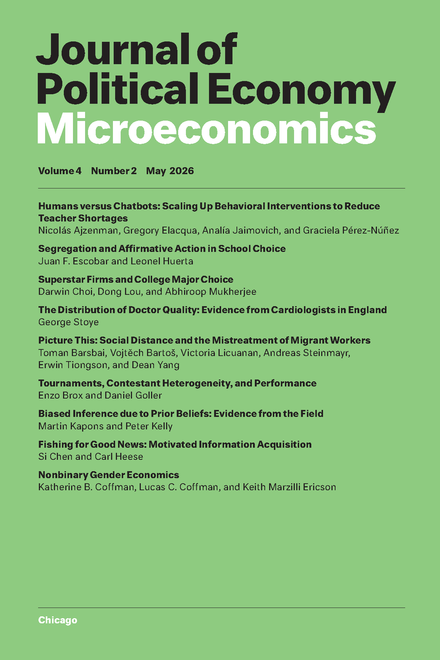
Journal of Political Economy Microeconomics (JPE Micro)
We are excited to announce a special issue dedicated to the “Science of Scaling” in the Journal of Political Economy Microeconomics. This special issue aims to advance rigorous, interdisciplinary research on scaling as a scientific endeavor, building on the growing recognition that scaling extends beyond mere policy implementation to encompass fundamental questions about generalizability, benefit-cost analysis, and real-world application of empirical findings.
Background and Motivation
When research on scaling first emerged, the concept often felt disturbingly vague, bundling together disparate ideas that required careful unpacking before they could be studied scientifically or used to inform policymakers effectively. Over time, through systematic empirical work, a clearer distinction has crystallized: whereas external validity focuses on generalizing treatment effects across contexts, scaling is fundamentally about generalizing benefit-cost profiles to policy-relevant scales, populations, and implementation environments. Today, scaling has evolved far beyond its origins as a practical policy objective. It now represents a rich domain for scientific inquiry, demanding contributions from economics and allied disciplines such as psychology, implementation science, and public policy. This special issue seeks to foster innovative theoretical and empirical papers that treat scaling as an object of study in its own right—exploring its methodological foundations, economic incentives, institutional challenges, and pathways to impact.
Scope of the Special Issue
We invite submissions that address, but are not limited to, the following themes:
- Theoretical models of scaling failures and successes, including coordination frictions, information asymmetries, and incentive misalignments.
- Empirical studies on the transportability of interventions, with emphasis on benefit-cost heterogeneity across scales.
- Methodological innovations for assessing scalability, such as the SANS framework (Se- lection, Attrition, Naturalness, Scaling) or related transparency tools.
- Explorations of “Option C Thinking” in research design, emphasizing context-aware integrated approaches that incorporate scaling considerations from the outset.
- Interdisciplinary perspectives on scaling in fields like development economics, behavioral science, education, health, and environmental policy.
- Policy-relevant analyses of scaling in practice, including case studies of high-profile interventions that succeeded or failed at scale.
Papers should demonstrate strong theoretical grounding, methodological rigor, and clear implications for both academic research and real-world application. We particularly encourage work that bridges the gap between controlled experiments and large-scale implementations.
Submission Guidelines
- Deadline: Papers must be submitted by December 31, 2025.
- Submission Process: Submit manuscripts through the JPE Micro’s Editorial Manager submission system. Please select “Special Issue Submission – Science of Scaling” during the submission process to ensure your paper is considered for this issue.
- Manuscript Preparation: Follow standard JPE Micro guidelines, including double-spaced text and inclusion of data/code for replication where applicable. For full instructions, see the JPE Micro author guidelines.
- Review Process: All submissions will undergo the journal’s rigorous peer-review process. Accepted papers will be published in the special issue, expected in 2027.
This special issue represents a timely opportunity to shape the emerging science of scaling and enhance the social value of empirical research. We look forward to your contributions! For inquiries, contact the JPE Micro editorial office at [email protected].
Our Very Best,
The Editors
JPE Micro