
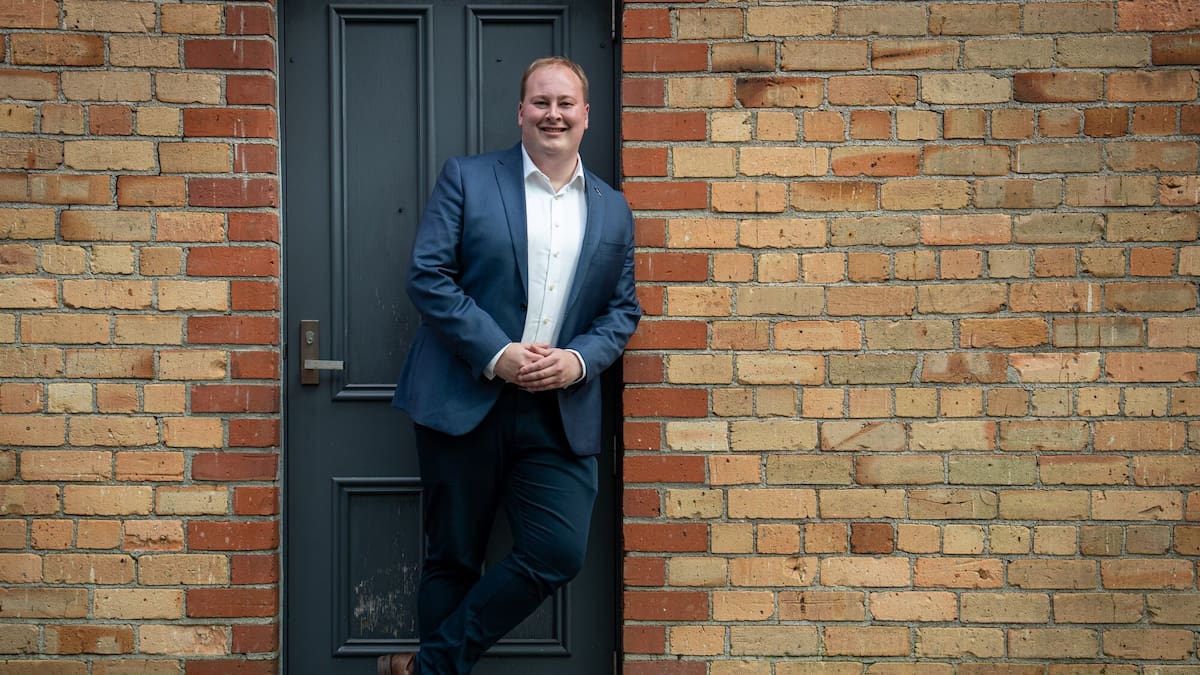
“If you’re going to get into it, get into it with eyes wide open … I’ve chosen this. Not everyone has.
“Whenever I think about posting things on social media, I’ll talk to whoever might be in the photo. ‘Are you okay with this? Do you want to be tagged or not?’… Because I would hate for people who haven’t chosen it to have to deal with it.”
He’s not complaining. Far from it. Olsen has worked his whole life to get into a position where people pay attention to what he says.

Growing up in Whangārei, the son of a builder and a bank teller, Olsen was an involved child.
You know the type, a school volunteer (librarian, bell ringer, PE monitor), a youth ambassador for various causes, a competitive problem-solver (literally. He competed in the States). He met the Queen for his various achievements – twice.
He never had a classic high school job like his mates. Instead, he was paid $20 a meeting to be on the Whangārei District Council Youth Advisory Group. It covered his prepaid phone bill each month.
But it was at St Francis Xavier Primary School that he got a taste for the power of numbers. He was 8 or 9 and, along with some friends, wanted some grown-ups to help clean a nearby stream that was suddenly looking very polluted.
Sure, the story about the dead eels they’d seen was good, but the facts – and economic cost – of not fixing it? Those got councillors and local MPs moving.
“I thought, well, if the numbers are the thing that makes decisions compelling and convincing, I need to have a better idea of what the numbers are and how to best understand them so that I can try and make that difference,” Olsen remembers thinking.
Again, he was 8 years old. And he had just discovered the joy of economics.

By the time he was 19, he was in Wellington (and “where the decision-makers were”), a Victoria University student and employed part time at Infometrics, the consultancy of 12 staff that, a decade on, Olsen now runs.
In 2019, he was named one of the Asia New Zealand Foundation’s 25 to Watch. And in 2020, when Covid-19 hit, we had no choice but to watch him.
After an off-the-cuff seven minutes on live TV as the first lockdown was announced, he became a media darling, regularly called upon to help explain what was happening to the world, our markets, house prices, food prices, employment rates, inflation rates, imports and exports.
Today, he is still the first person many people would think of if they were ever forced to name a New Zealand economist (it could happen!) – and still someone people want to hear the opinion of.
“Which is very weird at the grand old age of 29,” Olsen says. “And trust me, I pinch myself about that just about every day … Like, is this allowed?”
That’s right, Olsen won’t be 30 until next January. He knows for sure that his youth has counted against him in the past (“Yeah, 100%. Like, yeah, all the time”), but bets that anything he lacks in life experience, has become a unique selling point in the world of economics.
Because he experiences the world a little differently to your average numbers guy.
When people yell at him on the street, it’s often about petrol prices – except Olsen doesn’t own a car. And people definitely want to know what he thinks about mortgage rates, but he doesn’t own a house either.
“Houses are not affordable,” he says, instantly sounding like any other put-out Gen Zer.
“Things are a lot more affordable than the peak in 2021, yes. But they still suck relative to the long term. And I do worry that we’ve got a bit of a recency bias and we’re like, ‘remember that Mount Everest position? [It’s] good relative to that’ … But it still sucks.”
So instead of paying down a mortgage, Olsen dishes out interest rate reckons while living with three flatmates and sleeping in a bed carbon dated at around 30 years old, an aged hand-me-down from a friend’s family bach that he snapped up when moving into his first flat 11 years ago.
“As someone who on the daily looks at finances and spending and opportunity cost and all those sorts of things, I often do go, what’s the best use of my money here?” he justifies.
“But I bought some real fancy-ish bamboo mattress topper thing online at a 70% Briscoes deal at some point, because I’m not paying full price …”
Once upon a time, it was rude to talk about money, sex or religion at the dinner table. And while Olsen might not have a university degree majoring in the other two, he reckons money is fair game these days.
“Everyone talks about money. In New Zealand we talk about how we don’t talk about money enough … But you talk to people and they’re pretty open about their money or their questions around money.
“No one actually talks about the dollars and cents for the dollars and cents. They talk about it because of what it represents. It gives you opportunity, it gives you options, it gives you choice. And choice is huge.”
He pulls out an old joke about how economists are known as doomsayers because professionally, they are always looking at the opportunity cost, the trade-off of decisions. Whatever I’m doing right now is great – but what could I be doing instead?
In Olsen’s mind that’s important because the better informed you are, and the better information you have, the better decisions you can make.
“And you can do that at the tippy top, from the Beehive and government officials, down to people in their homes every night making decisions on their mortgage and what they’re spending on.”

And that’s where economics comes in. While accountants are focused on the minutiae, economists are like satellites out in space, looking at the big picture and putting it into context. Olsen admits it’s impossible to apply a numerical value to everything. But trying is half of the job.
“People are rational in their own thinking process. They might not be rational to you or me, but that’s unfortunately the beauty of difference and humans being unique. If we’re all robots, this life would be pretty formulaic and boring. It might be economically efficient, but to what end?
“If you boiled it down and you were to go robotic rational-financial-only thinking, there’s a bunch of stuff that people wouldn’t do. Travel’s pretty hard to justify. Kids are hard to justify. But [that thinking] doesn’t account for the human factor.”
That’s Olsen’s special sauce; making the complicated, simple and the boring, relevant.
“I think the biggest thing with economics that I really have struggled with, and I still struggle with every day, is that sometimes … we can make this stuff too complicated, too highfalutin, too difficult to get across.
“If it’s not useful and understandable to the general member of the public, I don’t know what we’re doing. We’re just making ourselves sound smart.”
The problem is, life as New Zealand’s most media-friendly economist doesn’t really stop. Sometimes he thinks it would be nice to have a classic nine-to-five job and something that even resembles a normal routine.
Instead, life at the moment looks something like: “Get up, go to the airport, go to the office, go to a TV interview, go and present at a breakfast or a lunch or a dinner, go and view a new factory, a new farm, jump on another plane, work the weekends because you were jumping on the plane too much in the week, go to court, go to Parliament, go to a business, maybe go to sleep”.
Last year, he took 151 flights and slept in his own bed less than half the time. And this year?
“The last [time] I updated the spreadsheet was probably a couple of weeks ago. It’s about 55%, so slightly better.”
He has a spreadsheet keeping track of how often he is away from home?
“I’m an economist. We have a spreadsheet for just about everything.”

At this juncture Olsen admits this was what he is nervous to talk about. Chat about the economy and it’s a piece of cake.
“Talking about myself, more difficult,” he says.
So what does he feel safe revealing? Well, when he goes off on a tangent?
“My mind does not stick around particularly long, it moves on.”
He loves to travel, but reckons he’d be bored “within probably four hours” if he ever did an OE. The idea of him working in a London pub is floated, and it turns out Olsen doesn’t drink and being practical is not part of his skill set.
“A friend got a coffee machine, I couldn’t use it to save my life. I’ve learned comparative advantage: some things you’re good at, some things you’re not so good at.”
He’s a marriage celebrant, but he’s single and certainly not “lovey dovey”.
He has got into into hiking recently, though describes himself as “a slightly unwilling participant. I absolutely hate it during the hike and I love it at the end of the day when you’ve done it.”
Olsen describes himself as a nerd, more than once, and suggests he was the type of child who earned all the badges at school. He’s wearing one today – a small enamel tūī he bought to help fundraise to replant trees damaged in the Christchurch earthquakes – on his navy blue suit.
He bought his first suit when he was still in his late teens. He’s rarely been spotted in the world without one since. And (almost) always in blue – “I don’t have the complexion for much else”.
“I remember at one point, we’re staying at a marae and someone made the joke that, ‘this guy must sleep in his suit’. And I think I did that night just to prove the point. Very uncomfortable. Not good for the suit.”
He’s laughing, but it’s a telling anecdote. Olsen isn’t the type of person who will put on an act just to be liked.
“I couldn’t care less about being popular. I don’t need people to like me. I need them to respect the views that we’re giving, the evidence that we’re coming up with,” he says.
Except sometimes, that doesn’t happen.
“Sometimes the emails are awful. Man, people have a lot of time on their hands to tell you that you’re a s**t.
“I’m totally fine if people want to call me out on a particular point … but when people start off with just utter personal attacks, it’s like, you’re clearly not actually interested in talking about the policy … If you want to disagree with me, totally cool. You bring your facts and I’ll bring mine, let’s have a genuine contest.”
And he does get it wrong – his most recent mistake was being adamant New Zealand wouldn’t reach a Free Trade deal with India so quickly – and he’s happy to admit when that happens. And he uses the feedback as a measure of performance, in a job where it’s often impossible to know when you’re winning.
“It’s very hard in this role sometimes to figure out if you’re actually doing a good job. Are you making any difference? If we provide good information … you never quite know if someone’s made a good decision based on it afterwards. There’s a lot of industries where you can see tangible results. If you’re a doctor or nurse, you know you’ve helped someone out.
“If we do a good job as economists … Well, you can never look at any one policy that either made it through or didn’t and go, that was us.”

Youth Advisory Group, pictured here in 2014 addressing the Whangārei District Council. Photo / NZME
Ah yes, policy. He previously advised National’s youth wing and there was that job on the council as a teen, but Olsen has been asked about his political ambitions for as long as people have been asking him anything, really.
Last time it came up on the record, he batted the idea away, “no plans right now” style. What about now? Can he hear the Beehive calling his name?
“I continue to give, I suspect, the same response as then, which is that representative democracy suggests that enough people want you to represent their interests and you have to take that seriously … so yes, I would [think about going into politics], but my big thing there is I’d want to get into it because I thought that was where I could make the most difference,” he says.
“At the moment, I think I can uniquely make the most difference in the economist’s role.
“If at some point that was a place that I thought I could make the most difference, then yeah, it might well be on the cards.”
That sure sounds like a politically friendly response. If only Olsen had a plan he was working towards …
“The worry is that there’s just so many interesting things happening out there. I want to get involved in lots of them. I want to try and make this place a better place. That’s the whole objective with all of this. If I could leave this place better off than when I found it, we’ve done enough work.”
Bridget Jones joined the New Zealand Herald in 2025. She has been a lifestyle and entertainment journalist and editor for more than 15 years.