
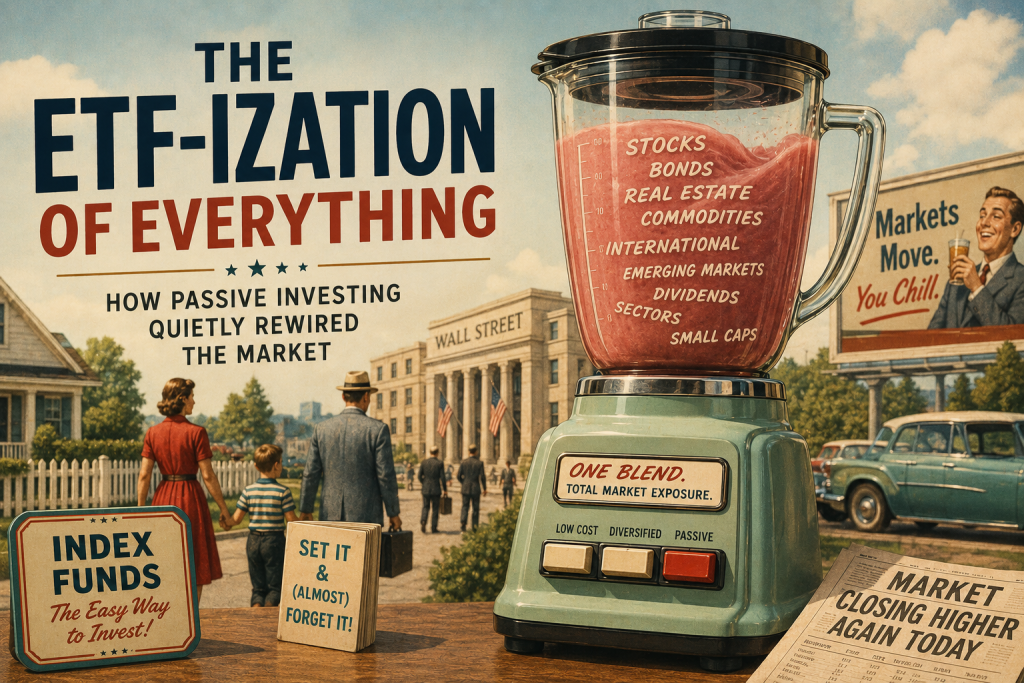
The most consequential force in modern markets is also the most boring, which is exactly why almost nobody examines it. Passive investing means the index funds and ETFs that now command a share of the market rivaling active management. It has quietly rewired how every stock gets priced. The revolution sold itself on virtue, lower fees and simple diversification, and delivered both. Yet it also created strange and underappreciated distortions, mechanically inflating the large and starving the small regardless of merit. This file examines those effects, a deeper look beneath our chapter on the machine takeover. Passive investing is not wrong, exactly. It is simply not what most of its users believe it to be. The gap between belief and mechanism is where the distortions live.
The Revolution Nobody Questioned
First, consider the genuine virtues, because they are real. They also explain the stampede. Active managers, as a group, had failed to beat the market after fees for decades. The data made the failure undeniable. Index funds offered a logical alternative. Own the whole market at a tiny cost, capture its average return, and stop paying for stock-picking that mostly underperformed. The argument was sound, the math honest, and the savings substantial. Across the 2010s, money flooded out of active funds and into passive vehicles. It was one of the largest migrations in financial history. By the decade’s end, in fact, passive strategies held a share of the US market that rivaled and then surpassed active management. The revolution was rational. Its consequences, however, went almost entirely unexamined.
What Passive Actually Means
Notably, strip away the marketing and a passive fund follows one rule. It buys the stocks in an index, weighted by their market value. Then it holds them regardless of any judgment about worth. A bigger company gets a bigger share of every incoming dollar automatically, with no analysis involved. This sounds neutral. Yet the neutrality is exactly the problem. The fund does not ask whether a company is cheap or expensive, well run or failing, profitable or doomed. It asks only how large the company already is. Size determines the buying, and the buying reinforces the size. A strategy marketed as simply owning the market turns out to embed a bias. The bias runs powerfully, and unexamined, toward whatever is already biggest.
The Mechanical Distortions
In practice, the distortions follow directly from the weighting rule. When a dollar enters a market-cap-weighted index fund, it flows disproportionately into the largest companies. Their prices rise regardless of their fundamentals. Higher prices mean larger market caps. That means a larger share of the next incoming dollar, which pushes prices higher still. In effect, the mechanism is a feedback loop with no reference to value at any step. The biggest companies receive an automatic, price-insensitive bid that grows as more money goes passive. Meanwhile, companies outside the major indexes receive none of this flow, no matter how profitable they are. So the market divides into the included and the excluded, and the division has nothing to do with quality. It has only to do with membership.
The Inclusion Lottery
Indeed, index membership became one of the most valuable and arbitrary attributes a company could possess. When a stock joins a major index, the passive funds tracking that index must buy it. Billions in mandatory, price-insensitive demand arrive within days. The buying happens because the rules require it, not because anyone judged the company worth owning. Deletion reverses the effect, forcing mechanical selling regardless of the business underneath. Researchers have documented these inclusion premiums and deletion penalties for decades. They grew more powerful as passive’s share of the market climbed. For a company, getting into an index became a windfall and falling out a punishment. Both were largely disconnected from anything the company actually did. The lottery rewarded size and membership, never merit.
The Orphaning of Small Companies
Meanwhile, the cruelest distortion fell on the small companies that sit outside the major indexes. A profitable, well-run small company simply does not receive passive flows. It is not in the indexes those flows track. As more money went passive, an ever-larger share of all market buying bypassed these companies. They were starved of demand regardless of their performance. The effect compounded the coverage desert described in our machine-takeover chapter, where Wall Street research had already abandoned small companies. Now both the analysts and the passive money had left. A small company could grow earnings, pay down debt, and run its business beautifully, and still find no natural buyer. The dominant force in the market was structurally blind to its existence. This orphaning is precisely the hunting ground that deep value investing exploits.
The Two-Tier Market
Ultimately, the combined effect created a market split into two tiers priced by entirely different logic. The favored tier was the large companies inside the major indexes. They enjoyed a permanent automatic bid that pushed valuations ever higher, compounding on autopilot. The orphaned tier was the profitable small companies outside the indexes. They drifted toward prices that assumed their irrelevance, ignored by the machinery that moved everything else. Both tiers were priced by the same passive mechanism, one inflated by inclusion and the other starved by exclusion. Notably, the gap between them widened across the decade, producing exactly the conditions a value investor dreams of. Sound businesses, available cheap, ignored by a market that had stopped pricing on merit. The strategy described in our Man vs. Machine hub harvests this exact gap.
The Hidden Fragility
Beyond the pricing distortions, passive dominance also introduced a subtler systemic risk. When a large share of the market buys mechanically on the way up, the same machinery can sell mechanically on the way down. Redemptions force index funds to liquidate holdings regardless of price. In a panic, this could amplify declines exactly as portfolio insurance did in 1987. That was the first machine crash, described in our Black Monday file. Of course, the concern is not merely theoretical. A market increasingly dominated by price-insensitive buyers may also become dominated by price-insensitive sellers when sentiment turns. The same automation that smoothed the ascent could sharpen the descent. Passive investing may have reduced fees while quietly increasing the market’s vulnerability to mechanical cascades. Few of its users ever consciously made that trade.
The Price Discovery Problem
Of course, markets exist to discover prices, and passive investing free-rides on that function without contributing to it. A passive fund does no analysis, forms no view, and simply accepts whatever price the remaining active investors set. This works only as long as enough active investors remain to do the actual pricing. As passive share grows, fewer participants are left performing genuine price discovery. That raises an unsettling question about how well prices reflect reality at all. The market may be increasingly priced by a shrinking minority of active participants, with the passive majority merely following along. This dynamic gets explored further in our file on how algorithms price stocks. The more passive the market becomes, the more mispriced it may grow, since the function that corrects mispricing keeps shrinking.
The Closet Momentum Trade
A truth about index investing deserves stating plainly, because so few investors grasp it. A market-cap-weighted index fund is, secretly, a momentum strategy. It automatically holds more of whatever has risen and less of whatever has fallen, since rising prices increase a stock’s weight and falling prices shrink it. The passive investor who believes they have bought neutral, diversified exposure has actually bought a portfolio tilted toward whatever is already winning. In a long bull market dominated by a few giants, this tilt produces excellent returns and feels like wisdom. Yet the same tilt concentrates risk in exactly the most expensive stocks, precisely when caution would serve best. Passive is not the opposite of momentum investing. Rather, it is momentum investing wearing the costume of prudence, which is what makes it so quietly dangerous.
The Self-Limiting Problem
One question hangs over the entire passive revolution. What happens if it succeeds completely? Price discovery depends on active investors doing the analytical work, then trading on their conclusions. If passive eventually crowds out nearly all active management, the function that sets rational prices would atrophy, leaving the market increasingly mispriced. At that point, the rewards to active analysis would grow so large that capital would flow back toward it, restoring a balance. So passive investing may be self-limiting, unable to fully conquer the market without recreating the very opportunities that justify active management. The disciplined investor watches this dynamic with interest, since every dollar that goes passive makes the neglected corners of the market a little more profitable to examine. The revolution, taken far enough, plants the seeds of its own reversal.
The Opportunity in the Distortion
For the disciplined investor, every distortion is also an opportunity. Passive investing, then, created a generational one. The orphaning of small companies meant that sound businesses sat unbought and underpriced. They were available to anyone willing to do the analysis the passive machinery skips. The two-tier market meant something simple. Value, in the literal sense, accumulated in the neglected tier while the favored tier grew expensive. An investor who could analyze companies directly, rather than buying them by index membership, faced a stocked hunting ground. It was stocked precisely because everyone else had stopped hunting. The deep value discipline detailed in our firm profile is, in one sense, a direct response to the passive revolution. Where the machines buy by size, the disciplined investor buys by worth, and collects the difference.
Where The Conversation Continues
Passive investing is the quiet structural force behind the modern market’s strangest features. Understanding it explains much of what looks irrational on the surface. The wider machine takeover fills that chapter, and the full arc opens from the fifty-year pillar. Our print feature lands in the July issue, Out East. A great many portfolios there sit comfortably in index funds whose actual mechanics their owners have never examined. The funds are not a mistake, exactly. They are simply a tool whose hidden biases reward understanding. The investor who grasps what passive money actually does, and does not do, can position accordingly. Most never look under the hood. The few who do find the engine running on rules nobody chose.