
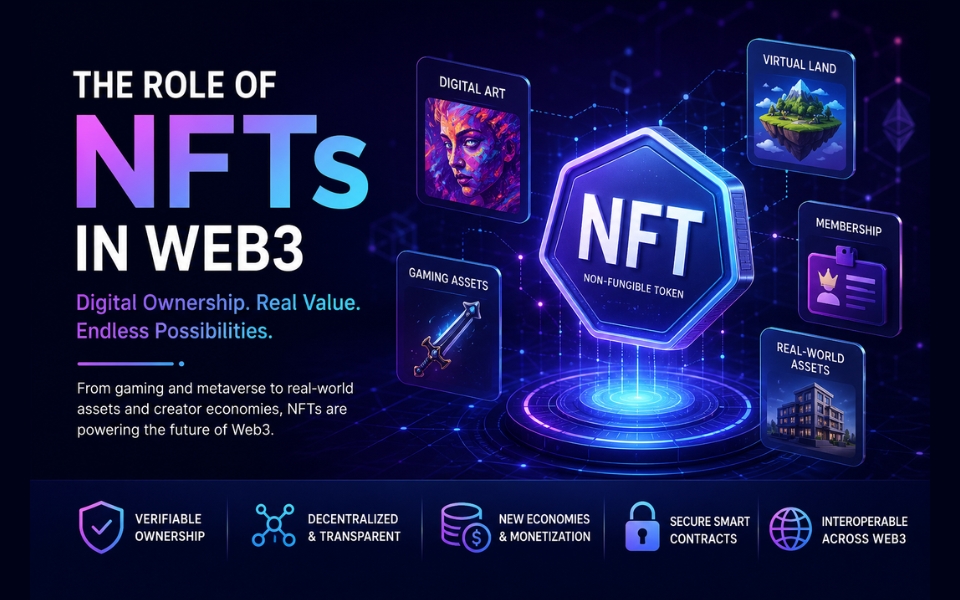
The evolution of Web3 has transformed the way users interact with digital assets, online communities, and decentralized applications. Among the technologies driving this change, Non-Fungible Tokens (NFTs) have emerged as one of the most impactful innovations. While NFTs initially gained popularity through digital art and collectibles, their applications now extend far beyond simple ownership of digital images.
Today, NFTs are being used in gaming, digital identity systems, membership platforms, virtual real estate, event ticketing, and real-world asset tokenization. Their ability to create verifiable ownership on blockchain networks makes them an essential component of modern Web3 ecosystems.
As blockchain adoption continues to grow, NFTs are becoming closely connected with Crypto token development and broader blockchain infrastructure. Understanding how NFTs work and their role in Web3 can help businesses, developers, and entrepreneurs build more valuable and sustainable decentralized applications.
Understanding NFTs in Web3
A Non-Fungible Token (NFT) is a unique digital asset stored on a blockchain. Unlike cryptocurrencies such as Bitcoin or Ethereum, which are interchangeable, each NFT contains distinct information that makes it unique.
This uniqueness enables NFTs to represent ownership of specific assets, whether digital or physical. These assets may include:
NFTs provide proof of ownership that can be verified publicly through blockchain records. This feature aligns perfectly with the decentralized principles of Web3, where users maintain greater control over their assets and digital identities.
Why NFTs Are Important in Web3
Traditional internet platforms often maintain complete control over user data and digital assets. In many online games, social media platforms, and marketplaces, users purchase or create assets but do not truly own them.
NFTs change this dynamic by allowing ownership to exist independently on blockchain networks.
Through NFTs, users can:
-
Verify ownership of assets
-
Transfer assets freely
-
Access exclusive communities
-
Participate in decentralized economies
-
Trade assets across multiple platforms
For developers and businesses, NFTs unlock new opportunities for creating user-centric ecosystems. This is one reason why NFTs have become increasingly important in Crypto token development strategies.
How NFTs Work
NFTs operate through smart contracts deployed on blockchain networks. These smart contracts define the rules governing ownership, transfers, royalties, and metadata.
The basic NFT process includes:
-
Creating or identifying an asset.
-
Deploying an NFT smart contract.
-
Minting the NFT.
-
Assigning ownership to a blockchain wallet.
-
Recording transactions on the blockchain.
Each NFT contains a unique token ID and associated metadata. The metadata may include descriptions, images, attributes, and ownership information.
This transparent structure enables users to verify authenticity without relying on centralized authorities.
NFT Standards Used in Blockchain Development
Several NFT standards have become widely adopted across blockchain ecosystems.
ERC-721
ERC-721 is the most common NFT standard on Ethereum. It is designed specifically for unique digital assets.
Common use cases include:
-
Digital art
-
Virtual land
-
Membership passes
-
Collectibles
ERC-1155
ERC-1155 allows developers to manage multiple asset types within a single smart contract.
It is often used for:
-
Gaming assets
-
Metaverse items
-
Large NFT collections
BEP-721 and BEP-1155
These standards serve similar purposes within the BNB Chain ecosystem and provide lower transaction costs for NFT applications.
Choosing the appropriate standard is a critical aspect of Token Development because it impacts scalability, interoperability, and marketplace compatibility.
NFTs and Digital Ownership
One of the biggest contributions of NFTs to Web3 is digital ownership.
Before NFTs, ownership of digital assets often depended on centralized databases maintained by companies. If a platform shut down or restricted access, users could lose their assets.
NFTs create immutable ownership records stored on blockchain networks. These records can verify:
-
Original creators
-
Current owners
-
Transfer history
-
Asset authenticity
This capability makes NFTs valuable for creators, collectors, businesses, and consumers alike.
NFTs in Gaming and Metaverse Platforms
Gaming has become one of the largest sectors benefiting from NFT adoption.
NFTs allow players to own in-game assets rather than simply renting access from game developers.
Examples include:
-
Weapons
-
Character skins
-
Virtual land
-
Achievement badges
-
Collectible items
Players can trade or sell these assets through NFT marketplaces, creating new economic opportunities within gaming ecosystems.
Similarly, metaverse projects use NFTs to represent:
-
Virtual real estate
-
Digital buildings
-
Wearables
-
Event access
-
Community memberships
Many modern Token development solutions now integrate NFT functionality directly into gaming and metaverse applications.
NFTs for Membership and Community Access
NFTs have introduced innovative approaches to memberships and community management.
Instead of relying on usernames and passwords, projects can grant access through NFT ownership.
NFT-based memberships can provide:
This approach gives users greater control while enabling projects to build stronger communities around verifiable ownership.
NFTs and the Creator Economy
NFTs have significantly changed how creators monetize their work.
Artists, musicians, writers, and content creators can now connect directly with audiences without depending entirely on intermediaries.
Benefits include:
When properly implemented, NFT smart contracts can distribute royalties automatically whenever assets are resold.
As a result, NFTs have become a powerful tool within modern Crypto token development ecosystems focused on creator empowerment.
Real-World Asset Tokenization
Beyond digital applications, NFTs are increasingly being used to represent physical assets.
Examples include:
-
Real estate
-
Fine art
-
Luxury watches
-
Certificates
-
Supply chain assets
-
Intellectual property
This process is known as tokenization.
NFTs can improve transparency, simplify ownership verification, and increase accessibility for traditionally illiquid assets.
As blockchain adoption expands, tokenized real-world assets may become one of the most important applications supported by advanced Token development solutions.
NFT Marketplaces
NFT marketplaces play a critical role in the Web3 ecosystem by enabling users to buy, sell, and trade NFTs.
Key marketplace features include:
-
Wallet integration
-
Asset listings
-
Auctions
-
Search and filtering
-
Royalty management
-
Collection management
Successful marketplaces require robust infrastructure, secure smart contracts, and seamless user experiences.
This is where professional Token Development expertise becomes valuable, helping projects build secure and scalable NFT platforms.
NFT Storage and Metadata
An NFT itself typically stores references to asset data rather than the entire file.
Storage options include:
On-Chain Storage
Asset data is stored directly on the blockchain.
Benefits:
-
High permanence
-
Maximum decentralization
Challenges:
IPFS Storage
The InterPlanetary File System (IPFS) provides decentralized storage for NFT metadata and media.
Benefits:
-
Lower costs
-
Greater decentralization
Hybrid Storage
Many projects combine blockchain records with decentralized storage systems for improved performance and cost efficiency.
Proper metadata management is essential because broken links or inaccessible files can reduce the value and functionality of NFTs.
Benefits of NFTs in Web3 Development
NFTs offer numerous advantages for businesses and developers.
Verifiable Ownership
Blockchain records provide transparent ownership verification.
Digital Scarcity
NFTs enable the creation of limited digital assets.
Improved Monetization
Creators can generate revenue through direct sales and royalties.
Interoperability
Assets can move across compatible wallets and platforms.
Enhanced User Engagement
NFTs support loyalty programs, memberships, and gamification.
New Business Models
Organizations can develop innovative products around ownership, access, and digital identity.
These benefits explain why NFTs continue to play an important role in Crypto token development strategies worldwide.
Challenges and Risks
Despite their advantages, NFTs also present challenges.
Security Risks
Poorly written smart contracts can create vulnerabilities.
Market Volatility
NFT values can fluctuate significantly.
Copyright Issues
NFT ownership does not automatically grant intellectual property rights.
Liquidity Concerns
Finding buyers for certain NFTs can be difficult.
Regulatory Uncertainty
Laws surrounding NFTs continue to evolve in many jurisdictions.
Projects should carefully evaluate these risks before implementation.
The Future of NFTs
The future of NFTs extends far beyond digital collectibles.
Emerging trends include:
-
Dynamic NFTs
-
NFT-based identity systems
-
Tokenized real-world assets
-
Cross-chain interoperability
-
Enterprise certification systems
-
AI-powered NFT experiences
-
Decentralized loyalty programs
As Web3 technology matures, NFT adoption will increasingly focus on practical utility rather than speculation.
Organizations investing in Token Development today are exploring ways to combine NFTs with broader blockchain ecosystems to create more engaging and valuable user experiences.
How Menten KD Supports Blockchain Innovation
As the blockchain industry evolves, companies require reliable expertise to navigate NFT implementation, smart contract architecture, and Crypto token development. Menten KD focuses on helping businesses understand blockchain opportunities and build solutions that align with real-world objectives.
From NFT ecosystems to advanced Token development solutions, strategic planning and secure implementation remain essential for long-term success.
Conclusion
NFTs have become a foundational element of Web3 development by enabling digital ownership, transparent verification, community engagement, and decentralized asset management. Their applications now extend far beyond digital art into gaming, memberships, creator economies, identity systems, and real-world asset tokenization.
As blockchain technology continues to advance, NFTs will remain closely connected to Crypto token development and broader Token Development initiatives. Businesses that focus on utility, security, and user value are likely to benefit most from NFT adoption.
Whether used for digital collectibles, virtual experiences, or tokenized real-world assets, NFTs represent an important step toward a more decentralized and ownership-driven internet.