
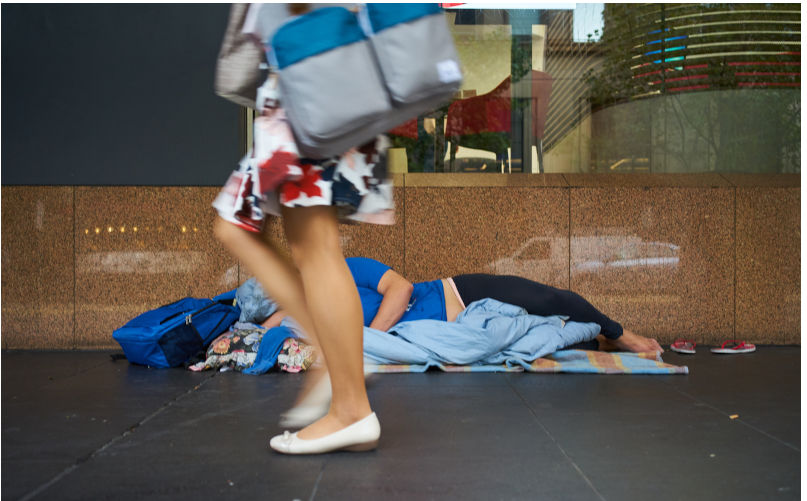
To address inequality and the social problems it gives rise to, Australia must return to a robust mixed economy with essential services in public control.
Politicians and bureaucrats who are responsible for the neoliberalisation of the Australian economy since the 1980s remain unyielding in their belief that inequality is not a serious problem confronting the country’s economy and society today. They point to things like low productivity rates (blame the workers!) and external pressures (the Ukraine and Middle East conflicts), to explain why inflation remains a problem, and why taxing the rich is not a good idea.
Yet, Oxfam has recently reported that the 20 richest Australians now hold more wealth than the bottom three million households. Meanwhile, the ACOSS report on Poverty in Australia in 2025 has revealed that 3.7 million Australians are now living below the poverty line – that is one in seven people, an increase of 12.4 per cent since 2021. One in six children (that is 757,000 kids) now live in poverty. If this is not inequality, what on earth is it?
The grim statistics made public by Oxfam and ACOSS are not receding. Inequality in Australia is growing. It is the single most important issue facing the country today. The rich are getting richer and more selfish by the day. Their ideological defenders in the Murdoch media insist they should not be obliged to share their wealth more equitably. The poor are getting poorer, but also angrier and turning to populists like Pauline Hanson for help. Little do they understand that Hanson’s biggest backer, Gina Rhinehart, the richest person in the country, is a firm advocate of policies that would drastically increase inequality.
A timorous Labor government fiddles at the margins of the Australian economy, nervously curtailing aspects of the negative gearing rort, while hesitating about proposals in the recent budget to limit the excesses of the capital gains tax. But there is no bold plan to comprehensively reform the ramshackle tax system that for decades has been undermining a progressive or redistributive taxation future for the economy. Some in the Albanese government remain in thrall to neoliberalism even as it has proven to be disastrous for middle- and working-class people across the country. The government’s timidity contrasts with the bold reforms of the Chifley, Whitlam and Hawke eras, making it an anaemic reflection of those earlier Labor achievements.
In what’s left of the Liberal and National parties in the parliament, an entrenched commitment to neoliberalism remains intact, even though they are the very parties most responsible for inflicting so much of neoliberalism’s damage on the Australian economy. (A notable exception in their ranks might be Andrew Hastie.) With their heads buried in the ideological sand, they studiously ignore the fact that surging inequality is a potent factor inciting voters to abandon them in droves. Menzies’ ‘forgotten people’ have been completely ignored by what has become Taylor’s and Canavan’s rump coalition. No wonder One Nation seems more attractive than the Liberals and Nationals in the febrile political and economic climate Australia is facing today.
What all the neoliberal evangelists refuse to understand is that the inequality their ideology is incubating is directly responsible for some shocking social problems. When increasing numbers of people are excluded from access to meaningful and properly paid (dignified) work and decent living conditions, they turn to desperate measures – home invasions, burglary, stealing cars, gang violence, drug addictions and overdose deaths, domestic violence. All these things and more, such as homelessness, are increasing as inequality increases.
Over the past four decades, the Australian economy has been systematically hollowed out. It is now a stupid economy. Essential services have been privatised, resulting in profits for shareholders being granted priority over the rights of consumers and other vulnerable people. Deregulation has allowed dodgy, if not criminal, practices to become the norm for much of corporate Australia – for example, the malevolent actions of major banks exposed by the Hayne Royal Commission or the dealings of private consultancy conglomerates hired by successive governments (hello KPMG) after various governments’ vandalising of the public services, especially during the Howard, Abbott and Morrison governments. That the Albanese government continues to hire these consulting firms is beyond any justification.
The mainstream political parties and their apparatchiks are incapable of devising bold policies that will convince the greatest number in society that they are at the centre of any government’s focus. That is why the Liberals and Nationals are facing extinction at the next election. The Albanese government’s policy pusillanimity is why its traditional support base – especially among working class voters – is fast fading away.
The time of independents in the parliament has arrived. Australia needs many more MPs like David Pocock, Helen Haines, Monique Ryan, Allegra Spender and Kate Chaney. It would be hugely advantageous to see the very effective Greens Senator Barbara Pocock and possibly Labor’s Ed Husic join their ranks. Zoe Daniels’ return to the parliament would be excellent, maybe via the Senate. Apart from Barabara Pocock and Ed Husic, those people are unfettered by restrictions imposed by the established political parties. (This is especially true of the rigid centralised control that operates in Pauline Hanson’s One Nation). Unlike the all the other MPs, the independents are in close touch with their communities. They are providing more intelligent policy options than anyone in the government or the opposition at this time.
How may the stupidity of the Australian economy be overcome? The myriad failures of the neoliberal experiment should by now be obvious to all, except for the blinkered ideologues in the parliament. Governments must learn to carefully and consistently re-regulate whole areas of the economy. Out-sourced services must be monitored by qualified experts. Publicly owned essential services (electricity, water, health, education, a public legal service, a publicly owned bank, a publicly owned real estate agency) must be put in place to compete with the private sector in these and related areas. Strong public competition confronting the rampant profiteering and rent seeking of the neoliberalised private sector is the most effective way to bring the latter to heel.
In short, Australia needs to return to a robust mixed economy. It needs to shake off the negative values of neoliberalism and replace them with social democratic values. A redistributive (genuinely progressive) taxation system should be the first priority of a boldly innovative government in which committed independents can wield the whip.
The views expressed in this article may or may not reflect those of Pearls and Irritations.