
As SpaceX, OpenAI and Anthropic move toward US index inclusion, Australian portfolios face a mounting structural challenge. Accelerating methodology changes are creating index concentration risk that advisers and allocators can no longer afford to ignore.
The mechanics of passive investing have always carried a latent structural risk. As indices evolve, the portfolios benchmarked to them evolve with them. This occurs regardless of whether that evolution serves the underlying investor’s objectives.
The index concentration risk is now crystallising. Its implications for Australian institutional and retail investors are significant.
The recent listing of SpaceX and the anticipated public offerings of OpenAI and Anthropic are not merely notable capital market events. They represent a structural inflection point in the composition of major US equity indices. The driver is concurrent methodology changes across Nasdaq, S&P Dow Jones Indices and FTSE Russell.
For Australian portfolios with international equity allocations benchmarked to these indices, the consequences are material and, in many cases, already in motion.
The structural shift in index methodology
The scale of the methodological changes underway is significant. Nasdaq’s revised rules, effective 1 May 2026, permit companies ranked in the top 40 by market capitalisation to enter the Nasdaq 100 within 15 trading days of listing. The rules also abolish the minimum free-float requirement. They further allow up to a 3x float weighting multiplier for low-float stocks.
FTSE Russell has reduced its post-IPO seasoning period to five trading days. S&P Dow Jones Indices is currently consulting on halving its seasoning period. It is also considering waiving both the minimum investable weight factor and the four-quarter profitability test for the largest issuers.
These changes, taken together, represent a meaningful acceleration of the pipeline from private capital markets to index inclusion. The effect is to compress the period during which institutional investors can evaluate newly listed companies. Passive flows compel exposure before that evaluation can be completed.
Apollo’s chief economist estimates that the top ten S&P 500 constituents could soon account for nearly half of the index’s total weight. That compares to approximately 40 per cent today.
Bloomberg Intelligence further estimates that S&P 500 index funds alone would need to purchase nearly one-fifth of SpaceX’s available float within six months of inclusion. Russell 1000 and Nasdaq 100 trackers are expected to face comparable pressure.
Portfolio-level implications for Australian allocators
Australian balanced portfolios typically allocate 20 to 25 per cent to international equities. Most of that exposure is benchmarked to the S&P 500 or Nasdaq 100. The arithmetic is direct: one to two per cent of total assets may become concentrated in three specific pre-revenue or early-revenue companies across technology and aerospace sectors.
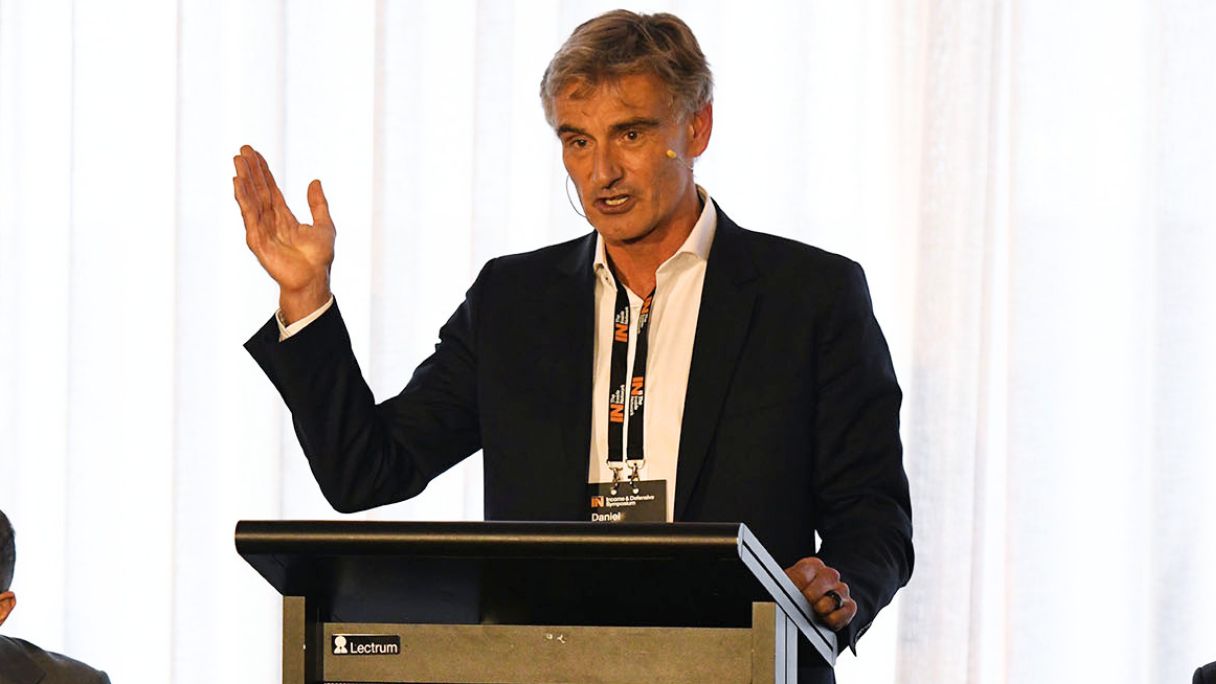
Daniel Liptak, head of distribution at Datt Capital, frames the challenge clearly.
“Most Australian advised portfolios have never been stress tested for single name concentration at the index level. What’s coming is not a marginal shift but a structural one, and it’s happening largely on autopilot.”
A further layer of exposure compounds the index concentration risk. It does not appear in conventional public market reporting: indirect pre-IPO positions held within Australian superannuation funds’ private equity and venture capital allocations.
Australian super funds have consistently grown their unlisted asset books over the past decade. Global venture managers who hold late-stage positions in precisely these companies have deployed a meaningful portion of this capital.
Coatue Management, Dragoneer, Founders Fund, Iconiq and D.E. Shaw all participated in Anthropic’s February 2026 funding round, which valued the company at US$380 billion.
These same managers maintain LP relationships with major Australian super funds including Hostplus, AustralianSuper and Australian Retirement Trust. SpaceX and OpenAI carry similarly concentrated late-stage investor lists.
The layered exposure problem
The critical structural issue is that private market positions do not unwind upon IPO. PE and VC funds typically operate on 10 to 12-year investment horizons. This means existing pre-IPO exposure continues to sit alongside newly acquired public market exposure rather than offsetting it.
For some clients, the post-IPO period may therefore give rise to concentration from three simultaneous sources. These include existing private market exposure via PE and VC allocations, existing public market exposure through international equities, and incremental mechanical exposure generated by index inclusion and passive rebalancing flows.
“The risk is compounded by a layer of exposure that many advisers are failing to measure: indirect pre-IPO positions already sitting inside Australian superannuation funds’ private equity and venture capital allocations,” Liptak notes.
“Super funds have been actively growing their PE and VC books, and a meaningful portion of that capital is deployed through global venture managers who hold late-stage positions in all three of these companies.”
A further structural constraint operates at the super fund level. The Your Future, Your Super performance test benchmarks MySuper products against specified indices. This creates an institutional incentive for the largest funds to remain closely aligned with their benchmarks. That incentive persists even as those benchmarks become more concentrated.
This regulatory dynamic materially limits the extent to which super funds can exercise discretion to underweight high-weight index constituents.
“The funds aren’t going to be the ones to push back against this,” Liptak says. “The mitigation will need to happen at the individual portfolio level.”
A framework for managing index concentration risk
Liptak outlines five responses available to advisers and allocators. The first and most immediately actionable is to conduct look-through analysis across all portfolio vehicles. This quantifies aggregate single-name exposure across listed and unlisted asset classes, rather than relying on fund-level reporting alone.
Second, concentration limits should be updated on a look-through basis to reflect the new environment. Third, the passive-active mix in international equities warrants reassessment.
“Passive vehicles will automatically absorb whatever weight these companies get in the index. Active managers retain the discretion to underweight or exclude them. That makes the manager structure decision a direct portfolio call, not a neutral implementation detail,” Liptak says.
Fourth, the case for reducing home bias in international equity exposure deserves consideration in the current context. Fifth, advisers should assess alternative allocations to ensure they provide genuinely differentiated exposure rather than a correlated source of equity beta.
Liptak identifies the Australian small and mid-cap listed equity segment as one practical diversification option.
The universe of approximately 300 to 400 companies listed outside the ASX 50 exhibits lower analyst coverage and less index-driven price formation.
Returns link more closely to company-specific fundamentals and domestic economic conditions. These are structural characteristics largely uncorrelated with the supply-demand mechanics that will drive mega-cap index inclusion flows.
“The performance of the businesses in our portfolios is driven by Australian economic conditions, local sector trends and company-specific execution,” he says. “These factors are essentially uncorrelated with the supply-demand mechanics that are going to shape the US mega-cap listings.”
Acting ahead of the shift
The new index methodology changes have compressed timelines significantly. Passively managed international equity allocations will reflect the full weight of these companies quickly after index inclusion.
Allocators who have not yet conducted look-through analysis or reassessed their manager structure must act ahead of those inclusion dates.
“We’re not suggesting Australian small and mid-caps are a substitute for international equities,” Liptak says. “The more relevant point is that, in an environment where international equity exposure is becoming structurally more concentrated through factors beyond investors’ control, the Australian small and mid-cap segment offers one of the few listed equity allocations that can provide a genuine structural offset.”
Datt Capital’s Datt Absolute Return Fund and Datt Small Companies Fund are benchmark-aware but not benchmark-constrained. Liptak argues this approach becomes directly relevant as the largest US index constituents accumulate weight. Those dynamics have little to do with fundamental valuation.
Ultimately, allocators should conduct a comprehensive exposure audit across all asset classes without delay. Advisers and allocators must urgently understand how their portfolios are positioned relative to these structural shifts.