
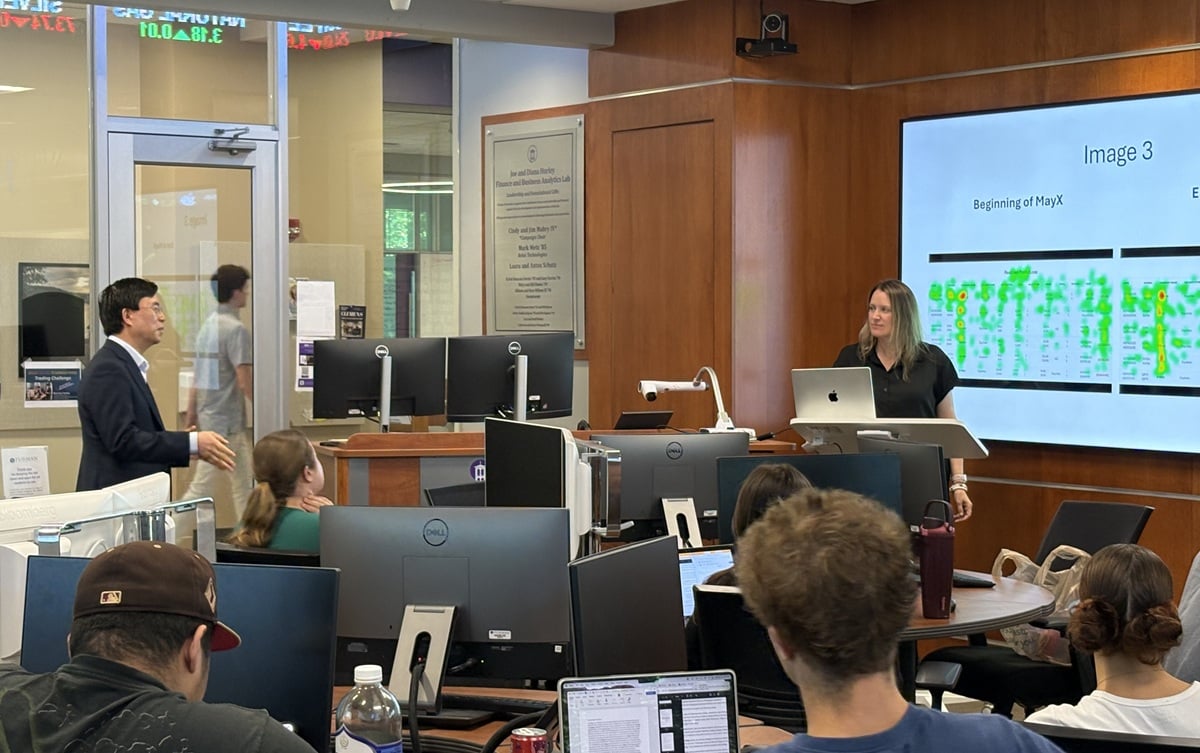
Francis Kim (left) and Jeanine Stratton lead Stock and Option Trading MayX.
Sixteen students were introduced to the world of stock and option trading when they participated in the same-titled MayX that wrapped June 3.
Francis Kim, associate professor of finance, and Jeanine Stratton, associate professor of marketing, offered a range of securities for students to trade using $1 million in virtual seed capital. They also used eye-tracking measures to assess students’ behavioral responses to ranking updates, profit-and-loss fluctuations, returns and portfolio value trends.
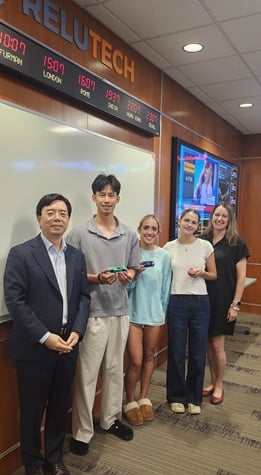
From left: Francis Kim, Team 3 members Daniel Zhang, Hayden Barnett and Pauline Bailey, and Jeanine Stratton in the Business Analytics Lab.
Five teams, comprising students with little to no prior background in stock investing, competed for the Stock and Option Trading Challenge championship. Using Bloomberg Terminals in the Joe and Diana Hurley Finance and Business Analytics Lab, alongside the StockTrak platform, they traded stocks, options, futures, bonds and cryptocurrencies in real-time.
Team 3 won the championship, achieving a three-week return of 10.39% and a total profit of $103,873.
“It’s a remarkable outcome,” Kim said. “The return is equivalent to an annualized rate of approximately 180%.”
Business administration rising seniors Pauline Bailey ’27 (marketing track) and Daniel Zhang (finance track), and rising sophomore Hayden Barnett executed 69 transactions, averaging about five trades per day. Their portfolio spanned 20 stocks, two exchange-traded funds (ETFs), a crude oil future and 10 options.
“We actively followed market news, earnings reports, and economic developments that influenced stock prices,” Team 3 wrote in a reflection. “We focused heavily on sectors with strong growth potential, particularly technology and artificial intelligence.”
Team 3 also learned other lessons beyond picking successful stocks.
“Effective investing requires research, patience, discipline, diversification and emotional control,” they wrote. “We learned that market movements depend on earnings announcements, economic conditions, investor sentiment and unexpected events. So, investors must constantly evaluate information and be willing to adjust their strategies when circumstances change.”
Pre- and post-course eye-tracking data showed that students significantly improved which information they focused on, ultimately improving their understanding of securities markets. Their insights broadened from a narrow focus on team rankings to a deeper appreciation of profits, losses and rates of return.
“This experience will greatly influence our future investing decisions,” Team 3 wrote. “We now have a stronger understanding of how to evaluate investment opportunities, manage risk and build a diversified portfolio. We also gained valuable experience using financial resources, analyzing market trends and making decisions under uncertainty. Most importantly, we learned that losses are a natural part of investing and that every trade is an opportunity to learn and improve.”