
Others Specials
Over the past few years, the way Indians participate in financial markets has started to change. More traders and investors are using data, automation, and technology-driven workflows instead of relying entirely on manual execution and discretionary decision-making. The Indian trader was long defined by gut feel: screen-watching, emotional reactions, and discretionary calls made in real time. From around 2019 onward, algorithmic and API-driven trading grew more common across Indian markets as broker APIs opened up and retail-friendly automation tools became widely available. To understand what is algorithmic trading in today’s context, it helps to see it as the meeting point of financial domain knowledge, statistics, and computing, not a niche tool reserved for global hedge funds. More Indian market participants are incorporating systematic and data-driven methods into their workflows as markets become more competitive and information-rich.
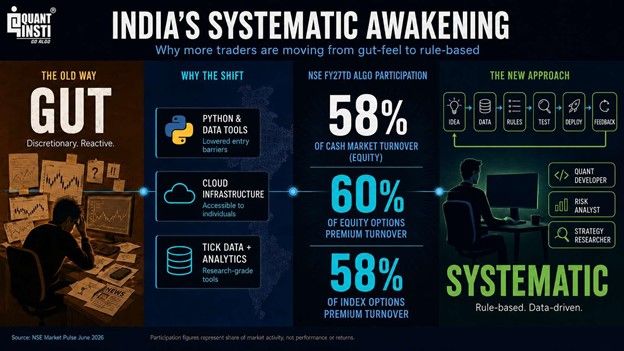
Nitesh Khandelwal, Chief Executive Officer and Director at QuantInsti and Co-Founder at iRage, describes this as a “systematic awakening”: “For a long time, retail trading in India was primarily discretionary, driven by gut feeling or technical chart patterns. But that’s changing fast. More and more traders now want to build rule-based strategies, automate parts of their execution, and leverage data and analytics to make decisions.”
The Data-Driven Shift: Growing Adoption
The growing role of algorithmic trading is visible in NSE’s market participation data. As per NSE Market Pulse June 2026, algos accounted for 58% of NSE cash market turnover in FY27TD, while in equity options, algos accounted for 60% of premium turnover. In index options specifically, algo share stood at 58% of premium turnover. This shows that algorithmic execution is now a mainstream part of India’s equity and options market structure, not a niche institutional capability.
The shift happened for straightforward reasons. Broker APIs became widely accessible to retail clients in the recent period. Python and modern data tools lowered the technical entry barriers for non-programmers. Cloud infrastructure cut deployment and maintenance costs sharply. These developments arrived at roughly the same time as increased retail participation in Indian markets and growing regulatory clarity around automated trading. Systematic trading became far more accessible to individual traders, developers, and finance professionals than it was even a few years ago.
Algorithmic trading and evolved systematic strategies were once locked behind prohibitive entry costs. Today, individual traders and small research teams can access tools previously available only to larger institutions, including API-based execution, cloud computing resources, and advanced data analysis frameworks.
Beyond the “Black Box”
Many traders are exploring algorithmic approaches because they help automate repetitive tasks and reduce emotional interference in trading decisions. Algorithms execute consistently according to predefined rules, particularly when monitoring multiple instruments or reacting to changing market conditions. They also make it easier to test ideas and evaluate whether a strategy has shown reliable behaviour across different market conditions.
Whether exploiting statistical approaches to momentum or using co-integration for pairs trading, a systematic approach aims to base decisions on predefined rules, research, and historical evidence rather than discretionary judgment alone.
As Nitesh told Moneycontrol,
“Automating takes care of some of the biggest reasons for failure in trading – discipline and risk management.
– Nitesh Khandelwal, Chief Executive Officer and Director at QuantInsti and Co-Founder at iRage
Algorithms can monitor liquidity, bid-ask spreads, and volume conditions in real time to help improve execution quality, where the broker and market infrastructure support it.
Regulatory Maturity: SEBI’s 2026 Framework
A major reason more Indians now view algorithmic trading seriously is the regulatory clarity SEBI has provided. SEBI’s retail algorithmic trading framework, introduced in 2025, brought greater clarity to retail-facing algo trading and third-party strategy providers. The framework now mandates clear audit trails and unique exchange-issued identifiers for every automated order.
SEBI distinguishes between “White Box” algos, where the logic is transparent and rule-based, and “Black Box” algos, where logic is undisclosed. Certain providers offering algorithmic trading strategies or recommendations may be subject to registration and compliance requirements depending on how their services are structured. Readers should refer to the latest SEBI guidelines for current requirements. For the professional trader, this provides a safer environment to deploy capital and a clearer legal roadmap for scaling operations.
The Infrastructure of a Modern Trading Desk
Setting up a professional desk takes more than a computer and a brokerage account. Quantitative finance begins with data. Serious practitioners in India use real-time tick-by-tick (TBT) data or advanced market depth data, covering multiple levels of bid and ask information beyond the best available prices. This raw data must be cleaned for outliers and adjusted for corporate actions like splits, dividends and other adjustments to prevent look-ahead bias.
Backtesting sits at the core of systematic trading: assessing how a strategy would have performed across different market regimes before risking any capital. Many practitioners use event-driven backtesting for execution-sensitive strategies because it models order handling and transaction costs more realistically, while vectorized approaches remain popular for rapid research and prototyping. Risk management separates a professional desk from an expensive experiment.
The Role of AI and LLMs in 2026
As of 2026, most practitioners treat AI as a support tool rather than a strategy generator. The real question is how it fits into the workflow, not whether it belongs there. Large language models are used by many Indian quants as support tools to process unstructured data: earnings call transcripts, company disclosures, and news sentiment that would take a research team days to work through manually.
LLMs are currently not reliable for generating standalone profitable strategies, but they can be valuable tools for rapid prototyping and research. They can translate logic between programming languages, explain complex mathematical models, and filter massive news feeds into actionable sentiment signals. Most traders use AI tools to speed up research and data processing, while strategy design, risk management, and validation stay human-driven.
Career Evolution: The Rise of the Quant
Large financial institutions, proprietary trading firms, and fintech companies continue to recruit quantitative talent in India across research, development, and risk-management functions. Roles like Quantitative Developer, Risk Analyst, and Strategy Researcher are genuinely in demand.
Compensation in quantitative roles varies widely by firm, experience, and specialization. Proprietary trading firms typically pay differently from banks or fintechs, and candidates with strong track records in strategy or risk management tend to command significantly higher packages. This is no longer the exclusive domain of PhDs. Professionals from engineering, statistics, and even non-engineering backgrounds are making the transition successfully through structured education.
Building a Strong Foundation in Algorithmic Trading
If you are looking to treat trading as a business rather than a hobby, the path involves building proficiency across statistics, financial computing, and market microstructure.
Python is worth developing because of its ecosystem: Pandas for data manipulation, TA-Lib for technical indicators, and a large community producing open-source research and tools. Many traders start with free resources, research papers, and community forums. For a more structured path, an algorithmic trading course like EPAT (Executive Programme in Algorithmic Trading) covers statistics, programming, risk management, and market microstructure.
Never take a strategy live without rigorous backtesting and at least a reasonable period of paper trading in real-world conditions. Slippage and transaction costs erode margins in ways that only show up after deployment.
Algorithmic trading is not a shortcut to profitability. Successful strategies require ongoing research, monitoring, and adaptation. Market conditions change, transaction costs evolve, and strategies that worked historically may stop performing. Understanding those limitations matters as much as learning the technology itself.
Disclaimer: This article is intended for educational and informational purposes only and does not constitute financial, investment, or legal advice. The examples and strategies mentioned are for illustrative purposes and do not constitute financial or investment advice. Readers are encouraged to conduct their own research before making any trading or investment decisions.