
8h40 ▪
5
min read ▪ by
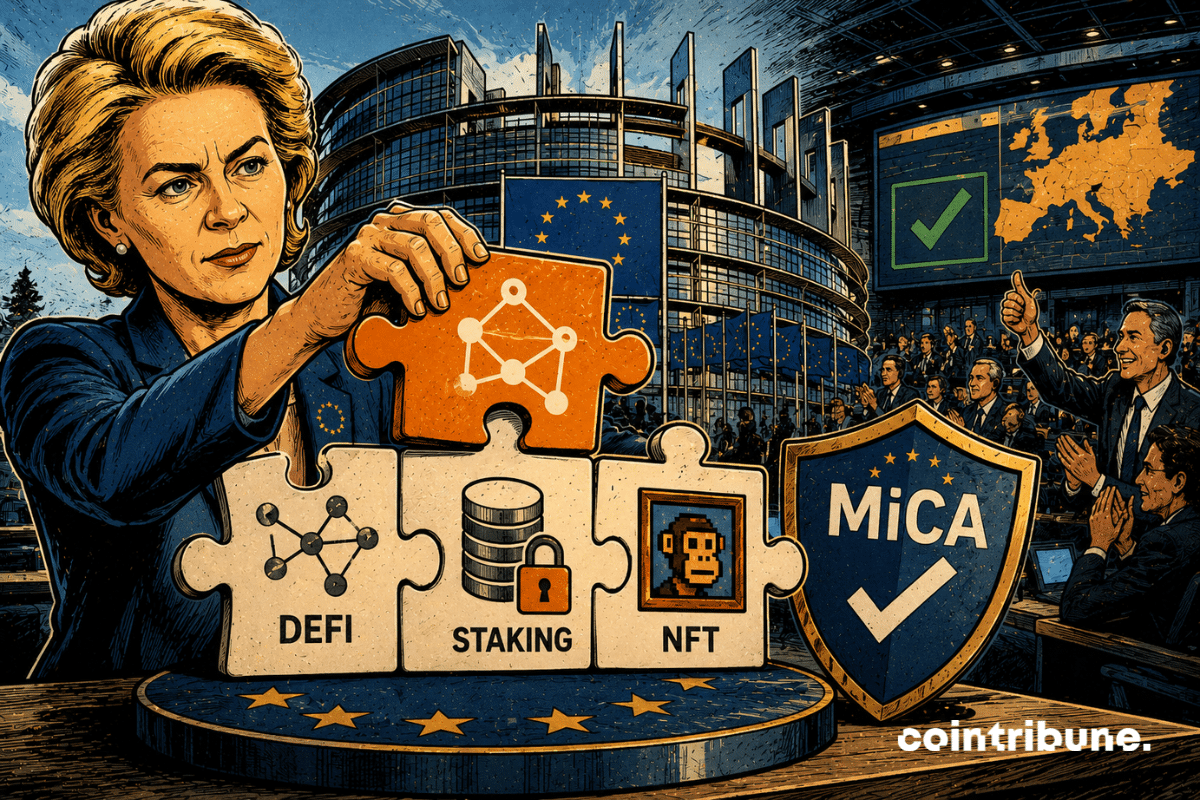
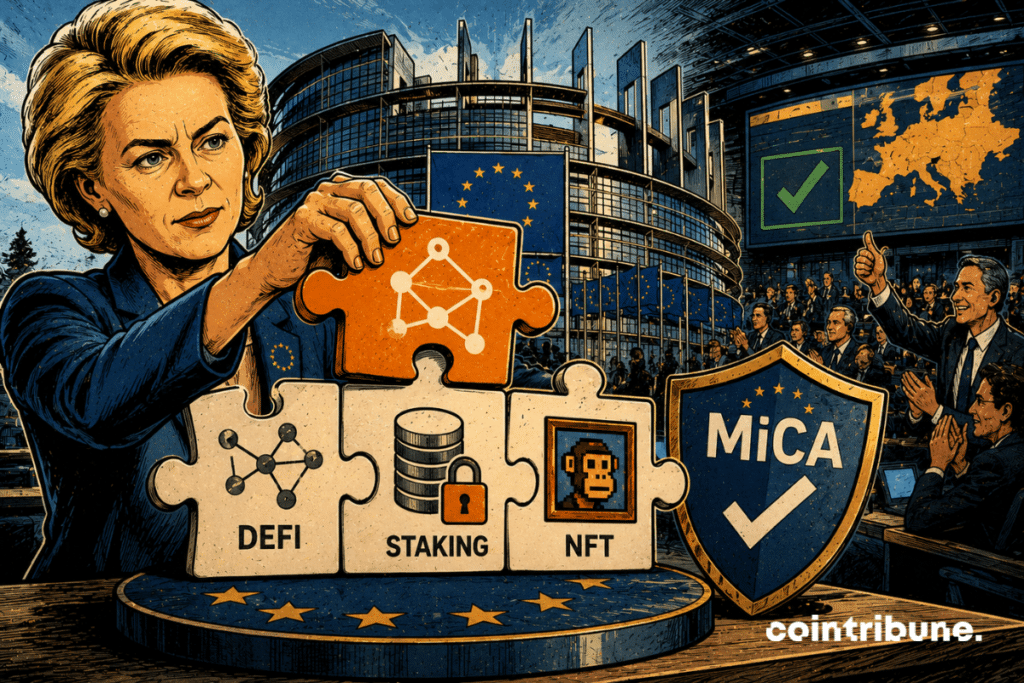
MiCA, in its current form, has already driven away crypto players of all sizes. For many of them, this regulation represents an administrative and financial desert crossing. However, European policymakers consider this framework insufficient and want to expand it. DeFi, staking, and NFTs are now in their sights. An ambition that raises its share of paradoxes and questions about Brussels’ real strategy.
In Brief
- The European Parliament requests the extension of MiCA to DeFi, staking, and NFTs.
- Euro-compliant stablecoins have seen their capitalization jump 128% in one year.
- Rapporteur Van Overtveldt, a former hawk, now defends a strategic vision of cryptos.
- Coinbase, OKX, and other well-prepared players benefit from their competitors’ difficulties.
Beyond MiCA : EU lawmakers want to cast the net wider
Hardly had the MiCA transition period ended, when the European Parliament was already looking further ahead. On July 7, 2026, the deputies adopted a report asking the Commission to assess the integration of DeFi, staking, crypto lending, and NFTs within the regulatory scope. This official position does not yet change the law but clearly sets the direction to follow.
The European Commission has in fact anticipated this movement and launched a public consultation as early as May 2026 on these very subjects. It even reopened the debate on the ban of yield-generating stablecoins.
Meanwhile, euro stablecoins compliant with MiCA show spectacular growth of 128% year-on-year. Their capitalization has risen from $295.6 million to $673.9 million, a progression that reflects investors’ appetite for regulatory clarity.
This desire for extension contrasts with the difficulties faced by some actors. While Brussels wants to widen the net, not all exchanges manage to comply.
The Van Overtveldt paradox : from crypto hawk to unlikely champion
Johan Van Overtveldt, Belgian deputy and rapporteur of the text, embodies alone the European antithesis. In 2023, this man compared cryptocurrencies to drugs and demanded strict restrictions after the Silicon Valley Bank collapse. Today, he leads a report that not only calls for regulating DeFi and NFTs but also encourages the development of euro stablecoins.
This spectacular turnaround raises questions about the sincerity of Europe’s strategic shift. The report now argues that euro stablecoins could complement tokenized bank deposits and wholesale CBDCs. They would also strengthen the competitiveness of European financial markets, a vision Van Overtveldt would never have dared defend three years ago.
However, this new stance is not unanimous. Parliament warns against divergent national rules that could fragment the single market. Member States must apply MiCA consistently, but between national interests and European ambition, the game promises to be complex.
DeFi, staking, NFTs : exchanges seize the opportunity
The public consultation launched by the Commission in May 2026 covers very concrete topics: DeFi, staking, lending, NFTs, and tokenized financial assets. Companies are already adapting to this new regulatory landscape by anticipating upcoming changes.
BNB Chain has published guides to help European users transfer their assets to self-custody wallets.
Meanwhile, euro stablecoins compliant with MiCA are proliferating on the market. EURC, EURCV, and EURI lead the dance, bringing the total capitalization to nearly $674 million. This growth proves that regulatory clarity attracts capital, contrary to the predictions of the most pessimistic.
The current situation mainly benefits exchanges that anticipated the movement and prepared their compliance. Coinbase, MiCA-licensed since 2025 via Luxembourg, and OKX, which obtained its pre-authorization, are rubbing their hands. While some struggle to comply, others nibble market shares and turn regulation into a competitive weapon.
Key figures to remember:
- Growth of MiCA euro stablecoins: +128% in one year;
- Capitalization of compliant stablecoins: $673.9 million;
- Public consultation by the Commission: launched in May 2026;
- End of the MiCA transition period: July 1, 2026;
European regulation, by imposing binding rules, chases away some players but attracts the strongest. Binance is desperately seeking a breach to enter the territory, while Coinbase and OKX, which offer up to 400 euros in BTC to new users, savor their advantage.
Maximize your Cointribune experience with our “Read to Earn” program! For every article you read, earn points and access exclusive rewards. Sign up now and start earning benefits.

La révolution blockchain et crypto est en marche ! Et le jour où les impacts se feront ressentir sur l’économie la plus vulnérable de ce Monde, contre toute espérance, je dirai que j’y étais pour quelque chose
DISCLAIMER
The views, thoughts, and opinions expressed in this article belong solely to the author, and should not be taken as investment advice. Do your own research before taking any investment decisions.