
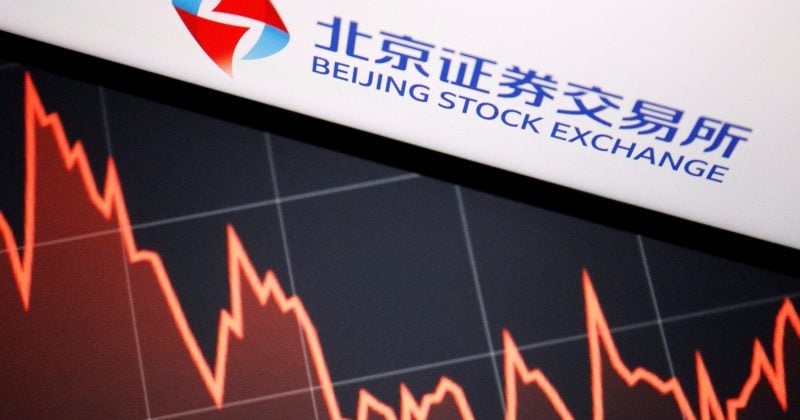
China’s quantitative hedge funds just had a week they would rather forget. A global selloff in chip and AI-related stocks cascaded into domestic markets, and the funds built to profit from systematic patterns found themselves on the wrong side of a rapid, painful reversal.
The numbers behind the pain
Zhejiang High-Flyer Asset Management, one of China’s most prominent quant shops, saw one of its funds drop 15.7% in the week ending July 17, 2026. The firm manages more than 70 billion yuan in assets, roughly equivalent to $10 billion, so a weekly loss of that magnitude is not a rounding error.
High-Flyer is led by Liang Wenfeng, a figure who has become something of a symbol for China’s ambitions at the intersection of artificial intelligence and finance. The fund in question was targeting outperformance against the CSI 1000 Index, a benchmark weighted toward smaller-cap Chinese companies.
That smaller-cap tilt turned out to be the problem. Funds employing momentum factors and strategies tied to smaller-cap indices were hit hardest, as the AI sector rotation unwound positions that had become deeply crowded over the prior months.
Why this week, why now
The immediate trigger was a global selloff in semiconductor and AI-related equities. China’s domestic tech and chip names were caught in the crossfire, and quant funds with heavy factor exposure to those segments had little room to maneuver before the losses accumulated.
Similar episodes played out in the Chinese quant space between 2022 and early 2024, when momentum reversals and crowded unwinds caused sharp, short-duration drawdowns across systematic strategies. The difference now is the scale of assets involved. Significant inflows into China’s quant hedge fund sector throughout 2025 mean the crowding problem is more acute than it was during prior episodes.
It is worth noting that China’s quant funds have operated under regulatory scrutiny for several years, particularly around high-frequency trading practices and the market impact of large systematic flows.
What this means for investors in systematic strategies
For anyone allocating to quant funds in China, or watching from the outside, this episode carries a few clear signals worth taking seriously.
First, factor crowding is a real and recurring risk. When a strategy attracts enough capital, the positions that generated alpha in a less crowded environment become a liability when sentiment turns and everyone heads for the exit at the same time.
Second, the CSI 1000, the benchmark High-Flyer was targeting, covers companies that are significantly less liquid than the large-cap names in the CSI 300. In a fast-moving selloff, that liquidity gap matters enormously.
Quant funds represent a significant and growing share of daily trading volume in domestic markets. When those funds are simultaneously reducing exposure, the resulting selling pressure can amplify moves in ways that affect even investors with no direct exposure to systematic strategies.