
There are some numbers in the last couple of months of Echelon Insights polling I think are worth calling out.
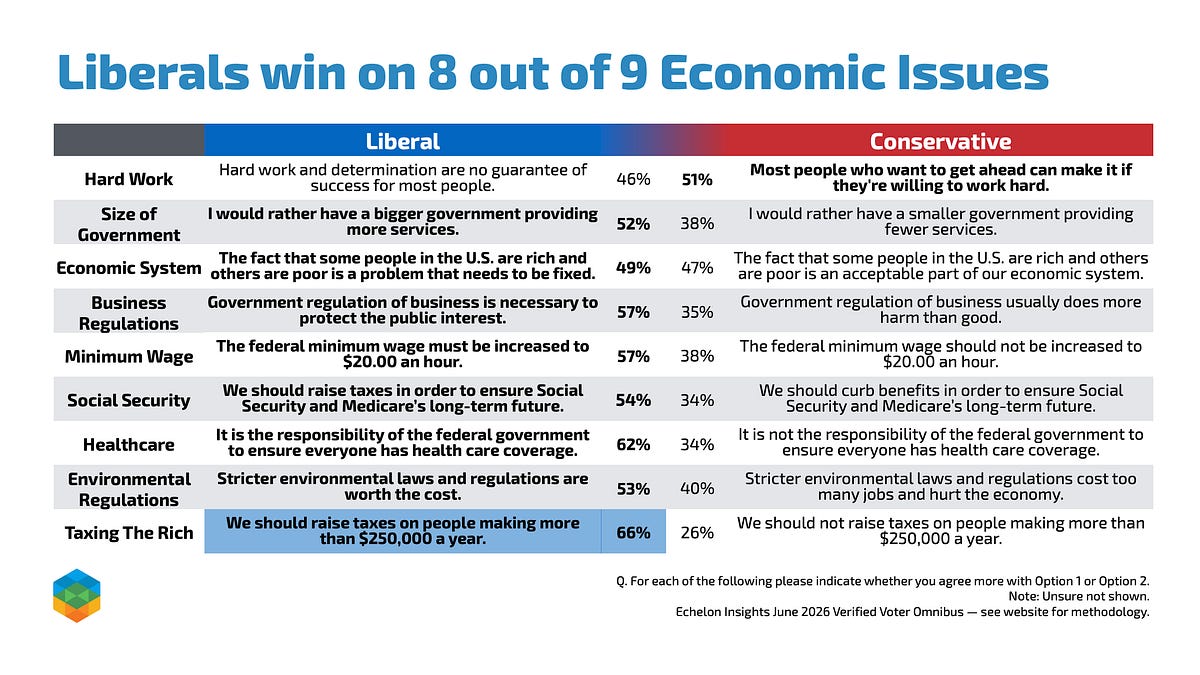
The first come from our annual Political Tribes survey, which show voters leaning strongly to the left on an array of economic policy positions, a leftward tilt that has gained steam in recent years.
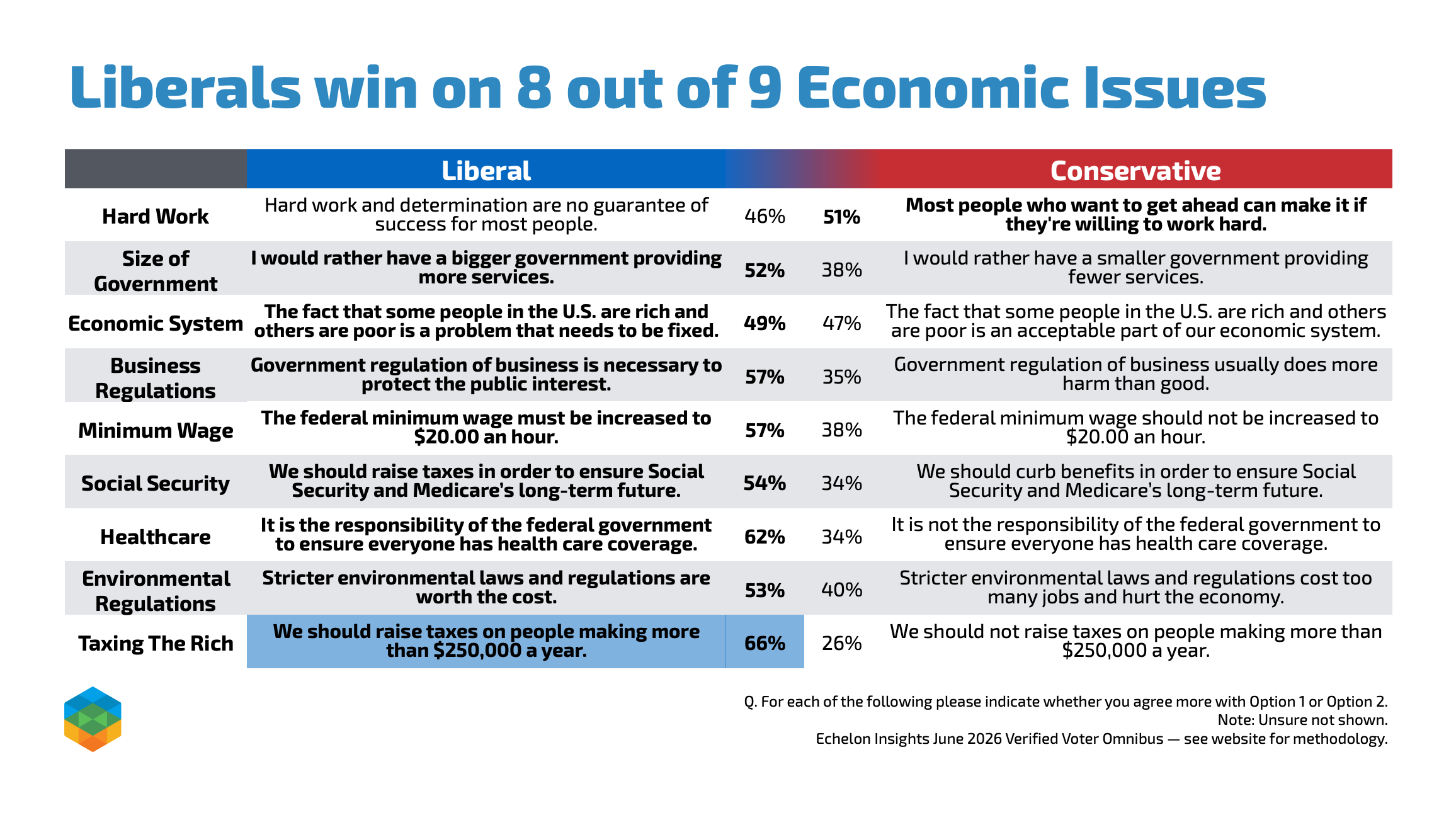
And then there’s our polling from this month, where any version of a capitalist economic model is viewed more favorably than any version of a socialist or social democratic economy.
This is a stark manifestation of the political science finding that voters are symbolically conservative but operationally liberal. They embrace conservative branding and vibes, but they’re left-wing when it comes down to policy brass tacks.
There’s a certain conceit on the left that issue polling wins entitle them to win elections, but that’s not how things work in the real world. Voters remain loyal to certain right-coded ideals—capitalism, freedom, patriotism—that have stood the test of time and have built up significant brand equity.
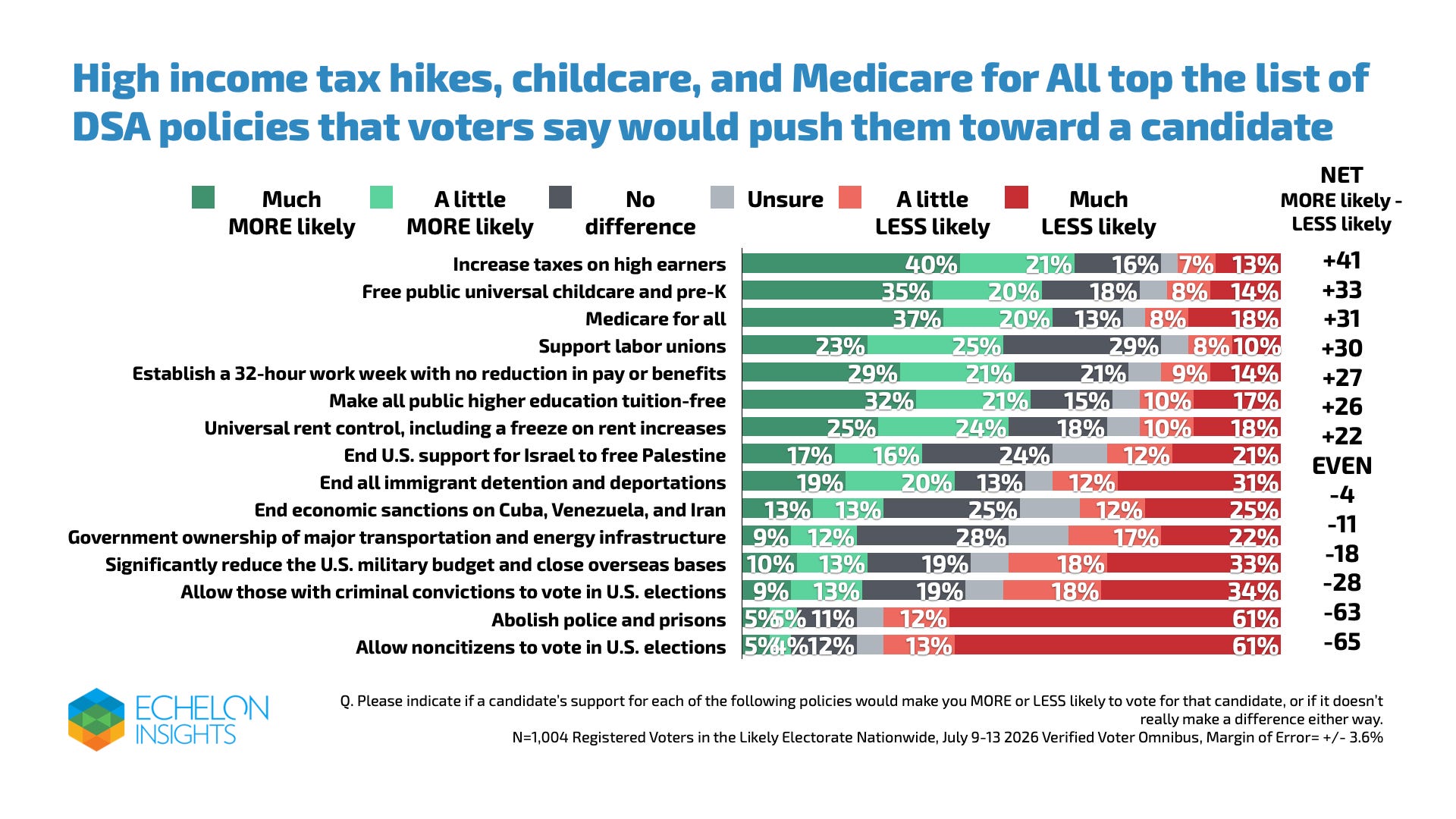
The frustration goes the other way too. To the chagrin of conservative wonks, reverence for free markets has not translated into support for specific free market policy positions. That’s how voters can favor a free market economy by 41 points and Medicare for All by 31 points and rent control by 22 points.
At this point, it’s time to inject some common sense into our modern understanding of these debates: of course it’s possible to support price regulation that distorts markets and consider oneself a capitalist. In fact, this was once the entirety of the Democratic economic platform. It’s why Democrats would often win elections with disproportionate support from working class voters. Support for regulation wasn’t tainted by the brand of some weird and exotic economic ideology.
Thanks to the DSA, fairly popular economic ideas are now dragged down by a socialist label anathema in American politics before Bernie Sanders’ run in 2016. That’s not right-wing propaganda — the people most strongly pushing these ideas now actively embrace the socialist label, so you can’t get upset when voters notice.
This branding war is now polarizing the Democratic Party. Democratic voters split almost evenly on whether they prefer socialism (38 percent) or capitalism (35 percent). And in order to signal to swing voters that they’re not insane, moderates have to explicitly say that they’re capitalists, something which further alienates the socialist plurality in the party.
In the old days, Democrats didn’t need to make this choice. They could simply say they were for regulated capitalism. Today, that kind of positioning brands you an establishment stooge.
The thing here is that the symbolically capitalist, pro-regulation voter never went away. In fact, this group is something pretty close to the swing voter in American politics. I asked our internal AI to break down the 18% of voters who held favorable views of capitalism and supported universal rent control. It basically describes what a common-sense Democrat looks like:
🗳️ Generic Ballot (with Leaners)
This group breaks 69% Democratic / 29% Republican — a +39-point Democratic margin — compared to a much narrower +5-point Democratic margin in the full sample (49.5% D / 44.1% R). And it’s not soft: 55% say “Definitely the Democratic candidate.” This is the most striking finding — a group with favorable views of capitalism votes Democratic at a landslide clip.
📅 2024 Presidential Vote
They voted for Harris over Trump 65% to 32% — again dramatically more Democratic than the full sample, which was essentially a coin flip (49% Harris / 47% Trump). This isn’t a newly converted group; they were already decisively Democratic in 2024.
🧭 Who They Are (Demographics & Ideology)
Compared to the overall sample, this subgroup is:
More male — 59% men vs. ~48% in the full sample
Ideologically center-left — 48% liberal, 28% moderate, 24% conservative (vs. 29%/30%/39% overall) — a significant leftward skew
Half college-educated (50%), roughly on par with the sample
More likely to be Democrats — 50% Democrat vs. ~33% overall
Income-skewed middle-to-upper: 37% earn $100K+ (vs. similar sample average)
The irony, again, is that many of the DSA’s stated aims are popular on paper, from universal health care to raising taxes on high earners. But they’re bound up in extremely unpopular non-economic positions: reducing the U.S. military presence overseas (-18), allowing those with criminal convictions to vote in U.S. elections (-28), abolishing police and prisons (-63) and allowing noncitizens to vote (-65). And most importantly, many of these standard-issue liberal economic positions now have to contend with the dead weight of the socialist brand (-29).
On the flip side, this is also why those on the right should not confuse the quadrants chart showing that most swing voters are culturally conservative and economically liberal with support for everything associated with Warrenomics. The voters in this quadrant still identify firmly as capitalists or free marketeers. They may want to level the playing field, but possess a strong work ethic and believe you can get ahead through your own effort and not government handouts. They think Democrats are the party of welfare cheats but still support Social Security, which they think is simply a repayment of the money they’ve put in. To them, anything even vaguely adjacent to socialism is anathema to the uniquely American ideal of getting ahead through your own hard work. Their economic ideology, such as it is, comes from their daily experiences not an economics textbook. These voters are in the middle on most things, which is why we should be wary of over-intellectualizing the shift to Trump among upper right-quadrant voters as any sort of mandate for moving in the direction of a Warren or Sanders economic agenda. The data shows that working class voters have moved right on economics as they’ve moved right politically—but they are still far from both the DSA and free market think tanks.
Policy has always sat in tension with the deeper values of the electorate. This is not new. Only the terminally online fail to understand that this common-sense middle still exists.