
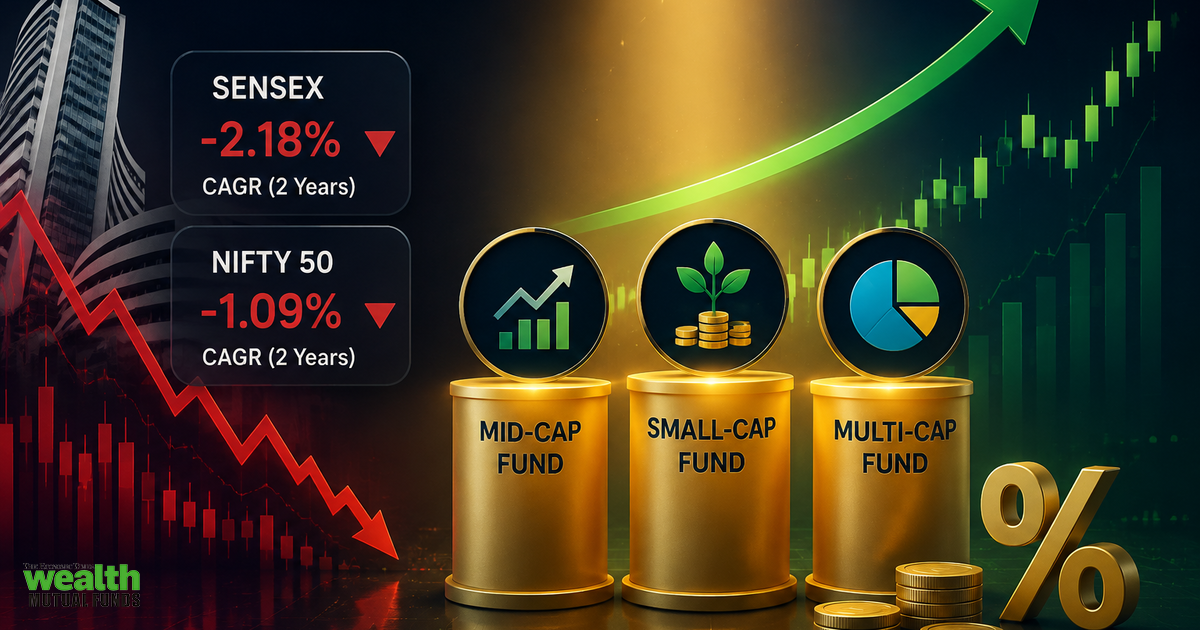
The three funds that outperformed belong to the mid-cap, small-cap and multi-cap categories, which have a different market exposure compared with the large-cap-heavy Sensex and Nifty 50. This raises questions about what drove their performance, whether the gains can continue, and how investors should approach active and passive funds amid changing market conditions.
Also Read | Explained: How the 8-4-3 rule of compounding can help you reach Rs 1 crore sooner
What helped these three mutual funds outperform the broader market?
The performance gap between the benchmark indices and these mutual funds can partly be explained by their different market-cap exposure. While the Sensex and Nifty 50 are dominated by large-cap stocks, the three funds have exposure to mid-cap, small-cap and multi-cap segments.
Rajesh Minocha, a Certified Financial Planner (CFP), Founder of Financial Radiance told ETMutualFunds that these funds are classified as mid-cap, small-cap, and multi-cap, and operate in a different segment than the Sensex and Nifty as a result, direct comparisons are not appropriate, as large caps were more affected by recent significant FII outflows.

Minocha further said that strong stock selection and the recent recovery in select mid-cap and small-cap stocks contributed significantly to their outperformance. However, investors should avoid evaluating a fund based solely on one or two years of returns, as funds rebounding from a weaker base can deliver unusually high short-term performance.
Shivam Pathak, CFP and Founder of Asset Elixir shared with ETMutualFunds that these funds benefited from active stock selection and greater exposure to the mid- and small-cap segments, which performed better than large caps over the last two years.
They also avoided some of the large benchmark constituents that faced earnings and valuation challenges, helping them generate superior returns, Pathak further said.
An analysis by ETMutualFunds showed that these three funds were Motilal Oswal Small Cap Fund, Motilal Oswal Multi Cap Fund and Invesco India Midcap Fund which gave 12.96%, 11.75% and 10.93% CAGR respectively in the last two years.
Among these three funds, two were from Motilal Oswal Mutual Fund and one was from Invesco India Midcap Fund.
What factors helped these funds?
Pathak said that it was a combination of mandate, disciplined stock selection, and active portfolio management. While these factors helped during this phase of the market cycle, investors should not expect the same level of outperformance every year and consistency across different market cycles is more important than short-term returns, he further said.
Minocha said that typically, outperformance results from a combination of stock selection, sector allocation, and disciplined portfolio management. However, market leadership changes over time, so sustained outperformance is not guaranteed.
He further said that it is advisable to focus on risk-adjusted metrics such as the Sharpe Ratio and Standard Deviation, rather than relying solely on historical returns.
Passively managed funds don’t require any active involvement of fund managers as they follow a given market index and mirror its movements whereas actively managed funds are handled by professional managers, who play an active role in choosing and changing the securities in the portfolio.
The strategy of active funds is to outperform the market whereas that of passive funds is to achieve index return. The expense ratio and management fees are high in active funds and low in passive funds. The risk in active funds is high depending on the fund manager’s expertise whereas in passive funds, the risk is low as involvement of fund managers is not there.
How should investors balance index and actively managed funds?
Minocha said that in general, a balanced approach is more effective. Index funds can serve as the core for low-cost market exposure, while active funds may be added selectively to seek additional returns.
He further said that higher-risk segments such as mid-cap and small-cap should remain a limited portion of the portfolio, with a larger allocation to broadly diversified categories like Flexi Cap funds.
Pathak said that a core-satellite approach works well. Investors can use index or large-cap funds as the core of their portfolio and complement them with actively managed mid-cap, small-cap, or flexi-cap funds to seek alpha and the allocation should always reflect an investor’s goals and risk appetite.
How have other funds performed in the last two years?
Out of the other 268 funds, 185 funds gave positive returns ranging between 0.01% to 9.67% whereas the other 83 funds gave negative returns in the last two years. These negative returns ranged from 0.07% to 12.39% in the said time period.
Where should investors invest after recent market performance?
With markets remaining volatile, investors may be tempted to move into funds that have recently delivered the highest returns. However, both experts advised against chasing recent winners.
Pathak said that rather than chasing the best-performing funds, investors should focus on asset allocation and diversification and given the recent market volatility, staggered investments through SIPs or STPs remain a prudent approach.
Large-cap and flexi-cap funds offer relatively better valuation comfort, while exposure to mid- and small-caps should be gradual and aligned with the investor’s risk profile, Pathak further said.
Also Read |Wealth creators: 12 equity mutual funds turn Rs 1,000 SIP to nearly Rs 3 crore since their inception
Minocha said that investors should avoid chasing recent top performers, they should continue their SIPs, invest gradually, and adhere to their asset allocation plan and for most investors, flexi cap funds remain a suitable core holding, while exposure to mid-cap and small-cap funds should be moderate and aligned with their risk tolerance and long-term objectives.
(Disclaimer: Recommendations, suggestions, views and opinions given by the experts are their own. These do not represent the views of The Economic Times)
If you have any mutual fund queries, message on ET Mutual Funds on Facebook/Twitter. We will get it answered by our panel of experts. Do share your questions on ETMFqueries@timesinternet.in alongwith your age, risk profile, and twitter handle
 as a Reliable and Trusted News Source