
Nigeria’s listed technology companies are entering a new investment phase as stronger cash positions and improving economic conditions give them greater capacity to fund expansion, although high financing costs and expensive technology equipment are forcing companies to deploy capital selectively.
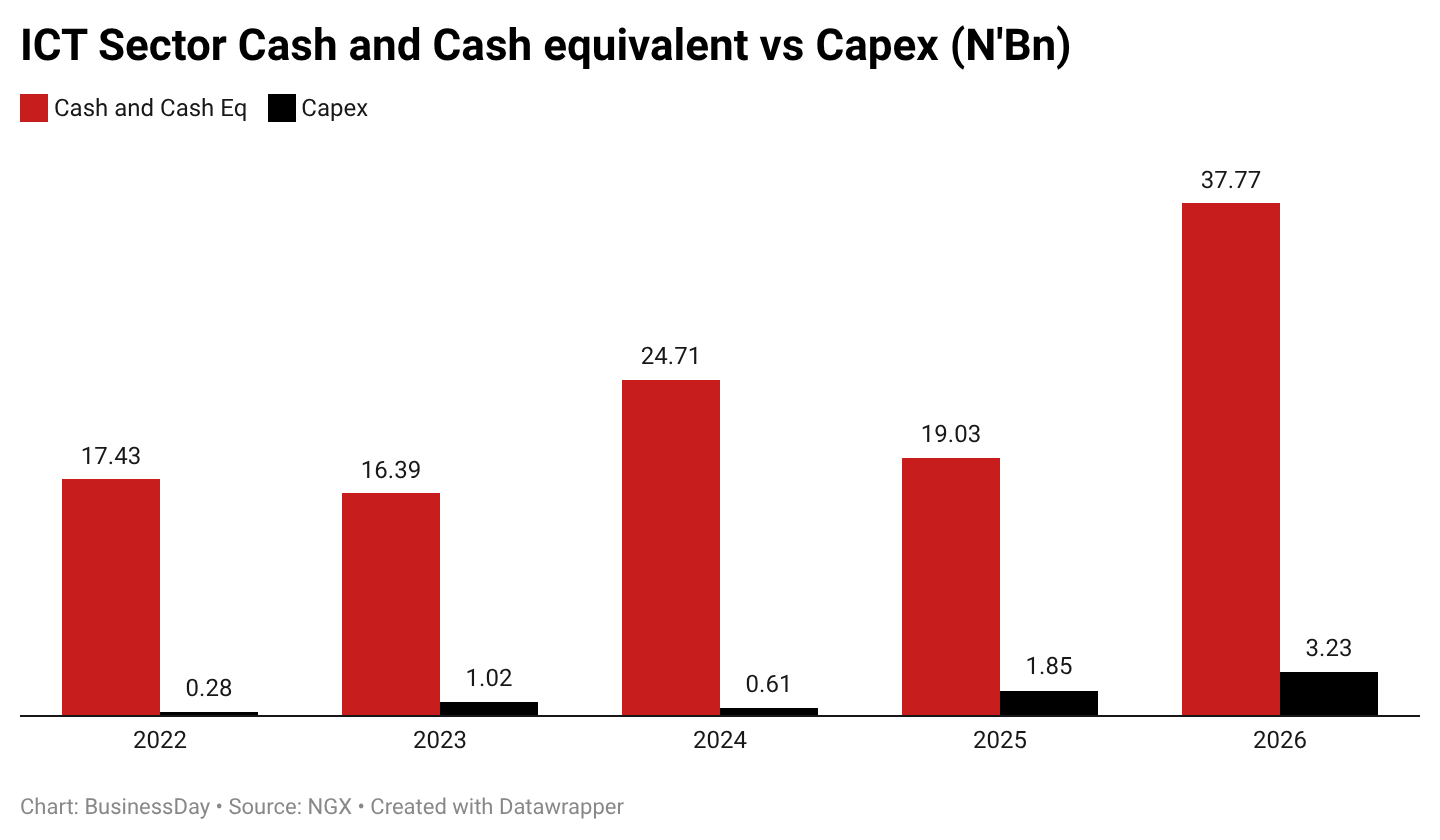
A BusinessDay analysis of six listed technology companies — Chams Holding Company, CWG, E-Tranzact International, Legend Internet, NCR Nigeria and Omatek Ventures — shows that combined capital expenditure (CAPEX) rose to N3.23 billion in the first half of 2026, from about N1.85 billion in H1 2025, representing an increase of roughly 75 percent.
At the same time, combined cash and cash equivalents nearly doubled to N37.8 billion, from about N19 billion a year earlier, pointing to a significant strengthening of the sector’s financial capacity to invest.
Despite the higher investment in fixed assets, the aggregate CAPEX-to-cash ratio fell to 8.56 percent in H1 2026 from 9.75 percent in H1 2025.
This suggests that the companies entered the period with substantially greater liquidity than the amount they committed to capital expenditure. In other words, cash accumulation grew much faster than investment in physical assets.
The figures also reveal sharply different strategies among the companies, with some prioritising aggressive investment while others maintained a more conservative approach to capital deployment.
Cash build-up strengthens investment capacity
The sharp increase in liquidity is significant because Nigerian technology companies continue to operate against a backdrop of high financing costs and elevated technology and imported equipment costs.
Nigeria’s real GDP expanded 3.89 percent year-on-year in Q1 2026, up from 3.13 percent in Q1 2025, while headline inflation moderated to 15.91 percent in June.
However, the improvement in macroeconomic conditions has not eliminated the cost pressures facing businesses. Technology companies remain exposed to expensive equipment, imported inputs and financing, making internally generated cash an increasingly valuable source of expansion funding.
This is particularly important given the relatively modest level of foreign capital entering the sector. National Bureau of Statistics data showed $11.33 million in capital importation into IT Services in Q1 2026, suggesting that domestic cash generation remains an important funding source for listed technology companies.
The implication is that companies with stronger cash-generation capabilities have a growing advantage. They can finance infrastructure and equipment purchases without depending entirely on costly external funding.
Chams emerges as clearest cash-to-CAPEX story

Chams Holding Company Plc recorded the most dramatic change in capital allocation among the companies reviewed.
Its cash and cash equivalents jumped from just N252 million in H1 2025 to N4.52 billion in H1 2026, representing an increase of more than 1,600 percent.
At the same time, the company moved from virtually no capital expenditure in H1 2025 to N1.82 billion in H1 2026.
That pushed Chams’ CAPEX-to-cash ratio to 40.2 percent, the highest among the companies reviewed.
The ratio means that Chams’ H1 2026 capital expenditure was equivalent to about two-fifths of its cash balance at the period under review.
The spending is particularly notable because Chams has been shifting toward infrastructure-heavy businesses. Its H1 2026 revenue reached N17.48 billion, with data card products supply and biometrics-related businesses among its major revenue drivers.
The combination of rapidly rising cash and increased investment suggests that Chams has moved from a period of tight capital deployment into a more expansionary phase.
However, the company’s 40.2 percent ratio also means its capital intensity is considerably higher than that of its peers. If the investment translates into higher capacity, revenue and cash generation, it could strengthen future earnings. If not, the large jump in CAPEX could weigh on returns.
CWG shows why higher cash does not always mean higher CAPEX
The company increased cash and cash equivalents from N5.63 billion in H1 2025 to N7.40 billion in H1 2026, a 31.6 percent increase.
But its CAPEX fell from N526 million to N132 million, representing a decline of roughly 74.9 percent.
Consequently, its CAPEX-to-cash ratio plunged from 9.35 percent to 1.78 percent.
This means CWG spent less than N2 in capital expenditure for every N100 held in cash during H1 2026.
The low ratio could point to a more asset-light growth strategy, particularly given the company’s increasing emphasis on software and technology services rather than traditional hardware-led operations.
In H1 2025, the company was in an aggressive phase of its multi-year repositioning, investing in technology infrastructure, platforms and hardware. That investment coincided with a 53 percent increase in revenue to N37 billion and a 113 percent increase in profit before tax to N4.68 billion.
The shift is strategically important. CWG’s customers include financial institutions, large enterprises and public-sector organisations whose technology requirements are increasingly driven by digitalisation, automation and efficiency.
E-Tranzact highlights the advantage of capital-light growth
eTranzact International Plc remained the largest cash holder among the companies analysed.
Its cash balance climbed from N12.50 billion in H1 2025 to N23.69 billion in H1 2026, an increase of 89.5 percent.
At the same time, CAPEX declined modestly from N1.33 billion to N1.23 billion.
As a result, its CAPEX-to-cash ratio fell from 10.62 percent to 5.19 percent.
This is significant because eTranzact was responsible for more than 62 percent of the combined N37.77 billion cash balance held by the six companies in H1 2026.
The company therefore has substantial liquidity relative to its current capital expenditure requirements.
Its strategy has increasingly centred on payments infrastructure, switching, merchant acquiring and digital transaction services. eTranzact has also been moving away from its historical dependence on lower-margin airtime sales toward payment and infrastructure businesses.
The fall in its CAPEX-to-cash ratio therefore does not necessarily indicate weaker investment. Rather, it could reflect a business model in which growth increasingly depends on technology platforms and payment infrastructure rather than heavy physical assets.
With more than N23 billion in cash, eTranzact has one of the strongest liquidity cushions among the listed technology companies.
Legend faces a different investment equation
Legend Internet: new entrant with high investment intensity
Legend Internet Plc recorded its first meaningful cash and CAPEX position in the dataset, with N165 million in cash and N50 million spent on PPE in H1 2026.
This translated into a 30.3 percent CAPEX-to-cash ratio, the second-highest among the companies.
Although its absolute numbers are small compared with Chams, CWG and eTranzact, the ratio indicates that Legend Internet committed a significant portion of its available cash to fixed assets.
That could be consistent with a company at an earlier stage of building or expanding its physical and network infrastructure.
NCR, Omatek reveal the limits of cash-led expansion
NCR Nigeria Plc increased its cash holdings substantially but did not record CAPEX in the periods under review.
Cash and cash equivalents rose from N643 million in H1 2025 to N1.99 billion in H1 2026, representing an increase of more than 200 percent.
Yet the company reported zero CAPEX in both periods, leaving its CAPEX-to-cash ratio at 0 percent.
While Omatek Ventures Plc recorded the weakest cash position among the companies, with just N3 million in cash and cash equivalents in H1 2026.
Its cash balance rose from N1 million in H1 2025, but remained extremely small relative to its peers.
The company recorded zero CAPEX in H1 2025 and H1 2026, leaving its CAPEX-to-cash ratio at zero.
The picture is particularly noteworthy because Omatek’s cash position has been volatile over the five-year period, including a negative cash-and-cash-equivalent figure in 2023.
What investors should watch next
The emerging investment pattern among Nigeria’s listed technology companies suggests that cash conversion, rather than CAPEX alone, will become a more important measure of investment quality.
A rise in capital expenditure is not inherently positive if it fails to generate stronger revenue, margins or cash flows.
Similarly, a decline in CAPEX does not necessarily mean a company is retreating from growth. CWG’s experience demonstrates that businesses can move from a physical investment phase into a period of monetising infrastructure already deployed.

Get Newsletter Updates
Enjoying our column?
Subscribe to our specialised **Tax 360** feed to receive fresh reports and analyses directly in your inbox.


