
The K-shaped economy and the AI bubble are sowing the seeds of the next crash.
That’s the message from Henrik Zeberg, a Danish economist who sees a roller coaster ride ahead for the US economy and stock market. In his view, equities are headed for a massive “blow-off top” sometime before the end of the year, with stocks tumbling from their peaks the economy entering a recession.
If thing play out the way his models are forecasting, it could involve the Nasdaq 100 soaring as high as 39,000 by late 2026 — an increase of around 32% — before plummeting back to around 10,600, its 2022 trough, he told Business Insider in a recent interview.
A decline of that magnitude would mark a 72% crash from the peak Zeberg predicts, and would be on par with the dot-com crash that saw the Nasdaq 100 plunge 83% from its 2000 peak to the low in 2002.
“I think we will see a 2000-scenario,” the macro strategist at the investment firm Swissblock said, speculating that a sharp drop in markets could later be followed by broader distress in the financial system, such as in banking and private credit. “I think that run is going to be quite devastating,” he added of the AI bubble bursting.
Zeberg, who’s studied business cycles for 20 years, said he drew much of his thesis from an economic model he created, which analyzes the state of the economy and finds parallels with past cycles. The model — which correctly predicted the 2020 downturn and dismissed a recession when investors were worried about one in 2022 — now shows the US is heading into an economic contraction, Zeberg said.
That’s at odds with what recent economic data is showing on the surface. Hiring in the US blew past expectations in August, with the US adding 162,000 jobs, nearly triple economists’ estimates. GDP growth, meanwhile, is expected to accelerate to 4.7% in the third quarter, more than triple its pace in the second quarter, according to the latest estimate from the Atlanta Fed.
But those positive data points are largely a distortion stemming from the growing gap between top earnings and lower- to middle-income households, Zeberg said, pointing to signs that the real economy is struggling under the surface:
1. Warning signs flashing in the job market
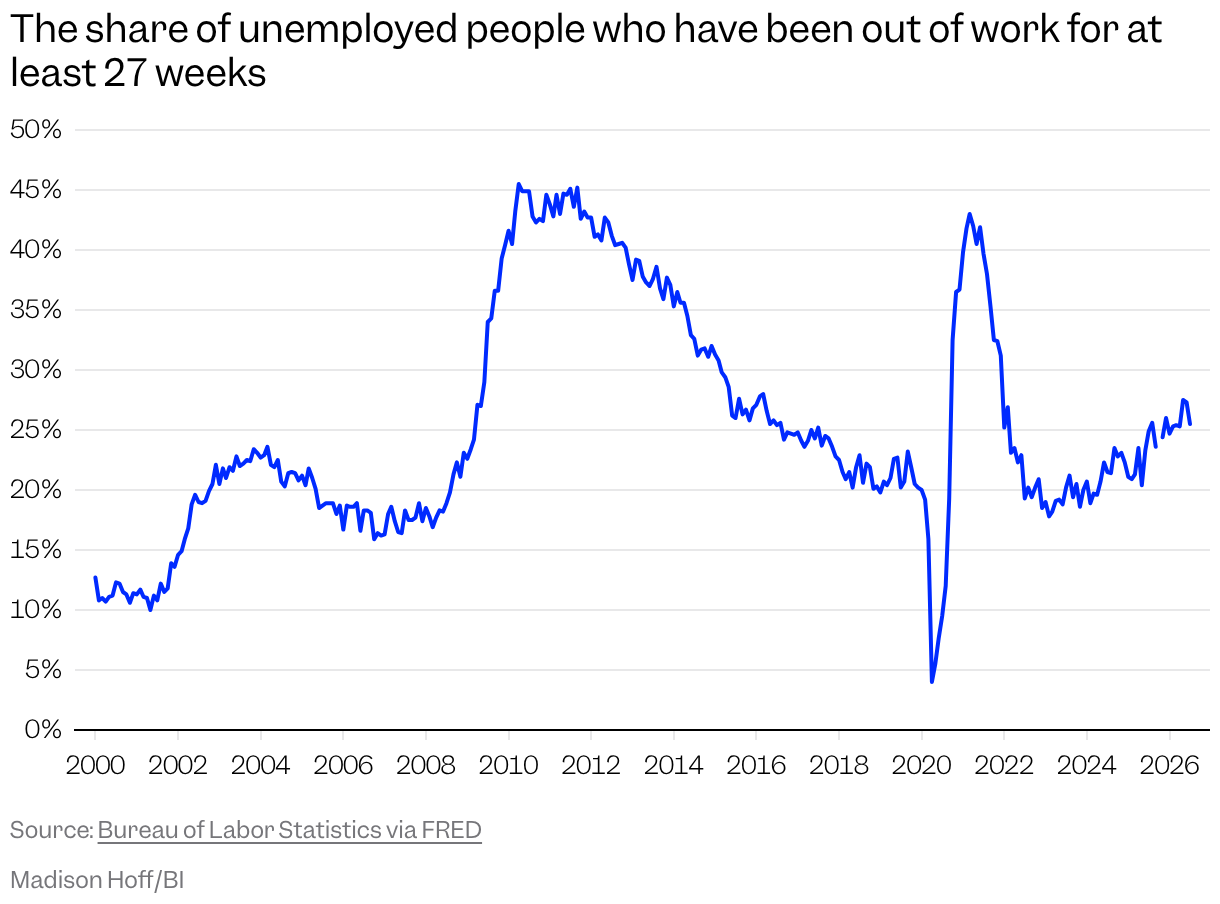
Job growth crushed expectations last month, but the labor force participation rate has generally declined in recent years, falling to a 50-year low in July.
The long-term unemployment rate — the measure of workers who have been unemployed for at least 27 weeks — has also climbed higher, clocking in at 27% in August, according to data from the Bureau of Labor Statistics.
Most of the job gains for the past year may be revised away, Zeberg speculated. Last year, numbers were revised to show the US added 911,000 fewer jobs from April 2024 to March 2025 than initially reported.
2. The housing market has weakened
Housing, considered to be a major engine of the economy, has been sluggish in the years since the pandemic, with higher mortgage rates, stubbornly high prices, and general economic uncertainty curtailing transaction activity.
Existing home sales fell 2% in August, according to data from the National Association of Realtors, even as a 10-year record of homes for sale sits idle on the market.
“Housing is the most rate-sensitive sector in the economy. It is a financed asset. When money gets expensive, housing feels it first,” Zeberg wrote in a post explaining his thesis on Substack.
3. US consumers are showing signs of pain
Zeberg said more lower- and middle-income Americans were showing signs of distress due to factors like higher inflation and rising borrowing costs.
A second-quarter survey conducted by Primerica found that 7% of middle-class Americans said their income was falling behind the cost of living. 58% they wouldn’t be able to cover an emergency expense of at least $1,000.
The personal savings rate has also collapsed over the last five years, with Americans saving an average 3% of their disposable income in July, down from 9.5% in 2021, according to the Bureau of Economic Analysis.
Most growth in the US is attributed to the tech sector and the cohort of top earners, Zeberg said. Fixed investment in the IT sector alone accounted for 5% of GDP in the second quarter, per an estimate from Fitch Ratings.
“It’s not a real boom,” he said of the strength of the US economy. “Normally, corporate profits can keep going up even into the recession, but the moment the story breaks for the consumer, that’s the moment it’s breaking for the businesses as well.”
How the crash could play out
NYSE
Zeberg said the issues facing the broader economy would catch up to financial markets in four stages. Here’s how he thinks the coming year could play out:
Phase 1: Euphoric bull market
Timing: Present to late 2026
What happens: The US economy continues to weaken, but any hint of bad economic news causes investors to price in rate cuts, which sparks a “vertical” rally in stocks, Zeberg predicts. Other assets, like crypto and gold, would also soar, while the US dollar falls in value as investors price in lower rates, he added.
In the final stages of the rally, Zeberg thinks the Nasdaq 100 could climb to 37,000 to 39,000.
The market is currently more focused on rate hikes instead of cuts. Investors are pricing in a nearly 90% probability that the Fed will raise rates by 25 basis points at its policy meeting next week, according to the CME FedWatch tool.
Phase 2: Stocks hit a peak
Timing: Q4 of 2026
What happens: The economy will likely roll over “for real” in October or November, due to weakness in the labor market and other areas. That causes the Fed to step in and cut interest rates, leading the US dollar to fall further in value, Zeberg said.
The US Dollar Index, which measures the value of the greenback against a basket of foreign currencies, could fall to a level of around 93 to 94, Zeberg predicts. Once the US dollar hits that level, stocks will likely hit a peak, he added, citing his technical analysis framework.
Equities could then see a “violent” drop over the course of three to four weeks, Zeberg said. He speculated that the drop will likely be triggered by a single event, such as a tech giant missing on earnings.
Phase 3: Stocks see a “fake bounce”
Timing: Q1 to Q2 of 2027
What happens: US stocks resume their path higher temporarily as investors attempt to recover from the year-end sell-off. At the same time, the US economy will enter a recession “invisibly,” Zeberg said.
After a brief rally, Zeberg expects stocks to resume their decline and Treasury yields to drop rapidly as markets price in economic weakness and support from the Fed.
Meanwhile, distress could begin to surface in other areas of the economy, Zeberg said, pointing to the possibility of more loans being marked down in the private credit sector while funds continue to halt redemptions.
Phase 4: Black Swan event
Timing: Q2 to Q3 of 2027
What happens: Markets could see a final reckoning in the form of a Black Swan event, Zeberg said, pointing to structural problems like high leverage in financial markets and the circular nature of many AI deals as potential sources.
At that point, stocks will tumble back to 2022 lows, while the US dollar soars as investors around the world scramble to store their wealth in dollar-denominated safe havens.
What investors should do
Zeberg said he would be watching for two signals to tell when investors should head for the hills:
- When the Dollar Index hits 93-94, which indicates rate expectations have fallen to levels that suggest the market peak is near
- When short-dated bond yields start to plummet, which suggests that the market is pricing in rapid interest rate cuts due to economic weakness
Zeberg said he’d revisit this thesis if yields were to stabilize around their current levels, or if activity in the housing or job market picked up meaningfully in the coming months.
Zeberg’s thesis lies on the fringes of Wall Street, where most forecasters are expecting the AI boom to last for at least several more years. Still, more investors are turning a cautious eye toward the strength of the US economy, with concerns swirling around inflation as oil tops $100 a barrel again.