
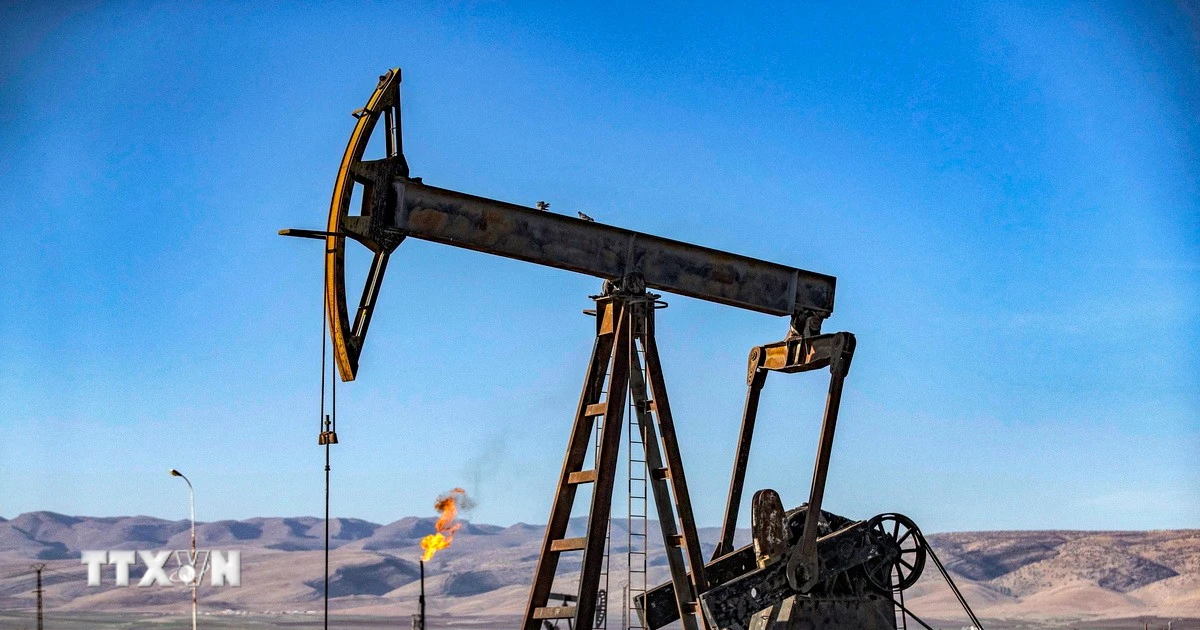
The global energy market is experiencing significant volatility as Brent crude oil prices once again surpass the $100 per barrel mark.
This three-digit milestone immediately became the focus of intense attention from investors and the media, raising concerns about macroeconomic stability.
However, a recent analysis on the financial platform Seeking Alpha suggests that instead of panicking over a superficial figure, the real factor determining the extent of damage to the economy is not how high the oil price reaches, but how long that price level will be maintained.
Oil prices have re-entered the $100/barrel mark.
Looking back at developments since the beginning of the year, the upward trend in Brent crude oil prices reflects a turbulent journey.
Since January 2026, Brent crude oil prices have increased by more than 60%, at one point peaking above $118 per barrel in late March 2026.
Despite a sharp downward correction to around $70/barrel in June 2026, the market quickly reversed and re-established the $100/barrel mark.
In the latest developments, Brent crude and West Texas Intermediate (WTI) crude oil prices surged by more than 2% in early trading this week, driven by new Houthi attacks on Saudi Arabia and attacks on ships in the Gulf, with Brent crude surpassing $107 per barrel.
Earlier, crude oil prices had risen 8% over the past week, marking the first time they had surpassed $100 a barrel since July.
This escalation stems from increased geopolitical risk as conflict between the US and Iran flares up, notably the attacks on oil tankers in the Kharg and Jask regions and the subsequent retaliatory actions.
The conflict did not stop there but spread to neighboring countries such as Jordan and Saudi Arabia, particularly with attacks by Houthi forces in Yemen targeting Saudi Arabia’s energy infrastructure, causing fires and temporary operational disruptions.
Notably, a drone strike forced Saudi Arabia to shut down the East-West oil pipeline. This strategic pipeline allows the world’s largest oil exporter to divert shipments to avoid the Strait of Hormuz.
According to informed sources, this disruption risks reducing global oil supply by up to 4%.
These developments are occurring against the backdrop of tightening physical supply in the market.
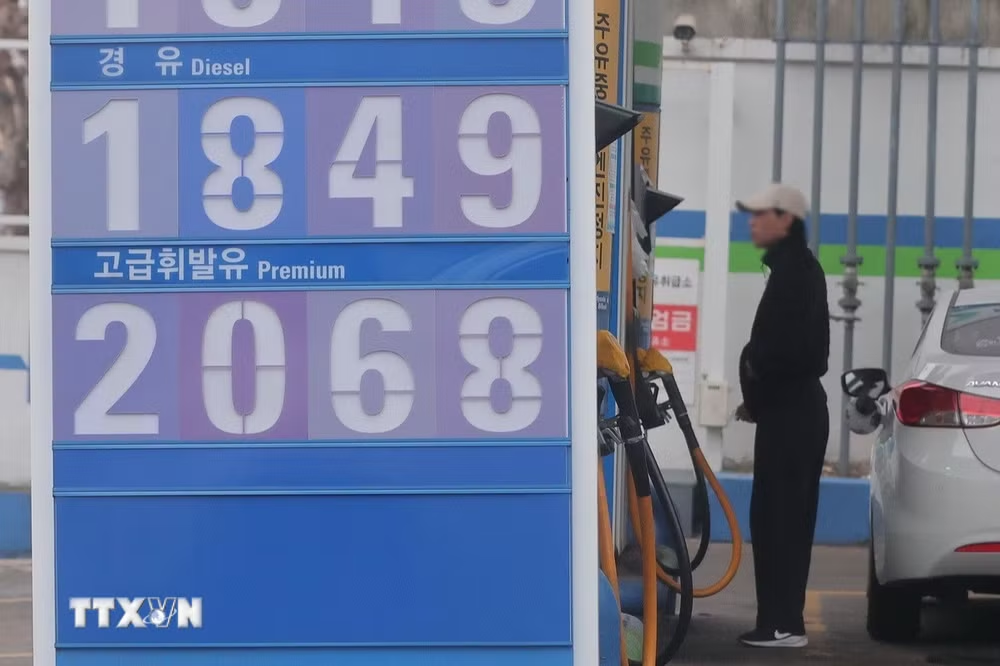
According to Bloomberg data, Iran’s crude oil exports are projected to plummet from around 1.9 million barrels per day at the end of 2025 to approximately 247,000 barrels per day in August 2026.
At the same time, the total output of the Organization of Petroleum Exporting Countries (OPEC) continued to remain lower than pre-conflict levels, while oil reserves in countries belonging to the Organization for Economic Cooperation and Development (OECD) and the US Strategic Petroleum Reserve (SPR) simultaneously shrank.
Meanwhile, the situation in key shipping lanes is also showing signs of deterioration.
The UK Maritime Trade Reporter (UKMTO) said a cargo ship in the Strait of Hormuz was hit by artillery fire, causing a fire and forcing the entire crew to evacuate.
In other developments, Iran reported an attack on a commercial vessel off its coast. Simultaneously, Houthi forces advanced toward the strategic island of Perim near the Bab el-Mandeb Strait – a transit route for 4-5% of the world’s oil supply in recent times, adding further instability to international shipping.
Market observers are currently monitoring the pace of Saudi Arabia’s restoration of the East-West pipeline, as well as whether tensions surrounding these two strategic waterways show signs of easing. Meanwhile, Oman has announced that a planned meeting between Gulf states and Iran to discuss the situation in the Strait of Hormuz has been postponed.
What really matters?
The market’s surface reaction to $100 a barrel is typically one of panic, immediately triggering concerns about the risk of renewed inflation, pressure for tighter monetary policy from the Federal Reserve (Fed), and the burden of costs on consumers.
However, the reality is that the difference between $99/barrel and $101/barrel, or even between $90/barrel and $110/barrel, does not make much difference in economic terms if the fluctuation is only short-lived.
Airlines will still calculate fuel costs based on the actual price of Brent crude oil, regardless of whether it is at $99 per barrel or $101 per barrel.
Families don’t suddenly change their daily routines just because they see a round number appear on the television news. The Fed also has no rule that dictates it must intervene in policy simply because oil prices exceed $100 per barrel.
According to an analysis on Seeking Alpha, the core factor determining the actual economic impact is the duration of the high price. A price of $110 per barrel lasting only three days might generate sensational headlines, but it would cause far less real damage than if oil prices remained stable at $90 per barrel for six months.
The prolonged high oil prices are the main factor eroding corporate profits, increasing transportation costs, driving up consumer goods prices, and hindering the cooling of inflation.
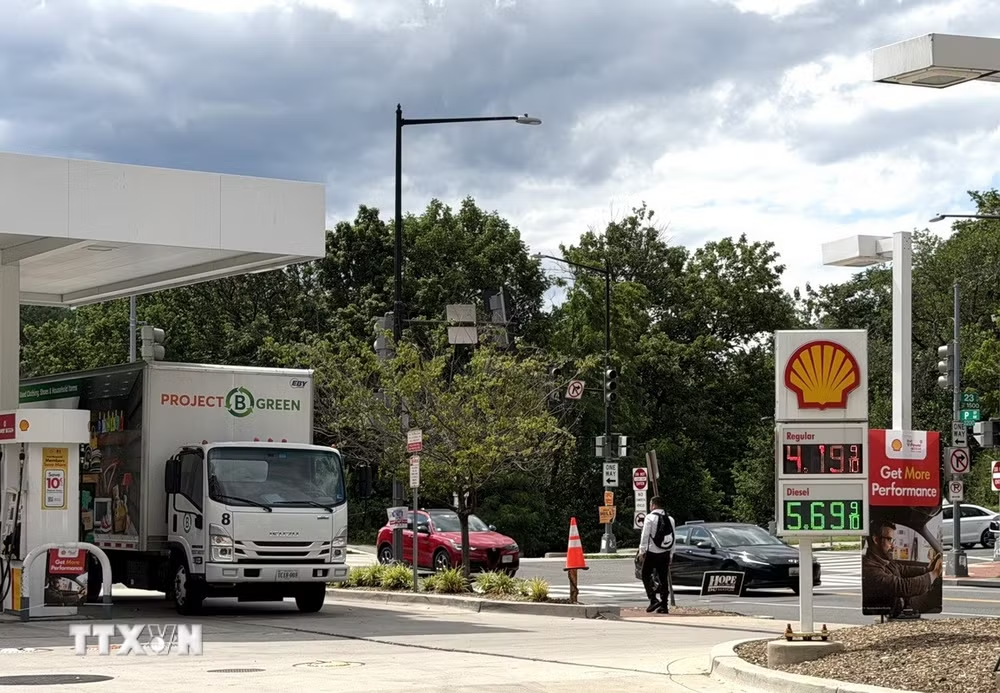
According to the article, the cumulative impact of oil prices is illustrated by calculating the difference between the actual oil price and the base price of $70/barrel, multiplied by the number of days it remains at that level.
In Scenario A (short-term surge), where oil prices jump to $110/barrel in 10 days and then fall to $75/barrel in the following 170 days, the cumulative impact over this period is limited to 1,250.
Conversely, in Scenario B (prolonged high anchoring), oil prices do not need to reach $110/barrel but only need to remain at $90/barrel continuously for 180 days, with a cumulative impact of up to $3,600 – nearly three times higher than the short-term price shock scenario.
In Scenario C (severe crisis), if oil prices remain at an average of $107.5 per barrel for 180 days, the cumulative impact would reach $6,750, putting immense pressure on the economy.
The signal confirming the nature of this price surge is clearly evident in the structure of Brent crude oil’s futures price curve. The market is in an extremely steep forward selling offset – a phenomenon where the spot price of an asset is higher than the price of a futures contract.
While spot prices are nearing $100 a barrel, 12-month contracts have fallen below $80 a barrel, and 24-month contracts have dropped to around $74 a barrel. The spread between short-term and long-term delivery has widened to approximately $25 a barrel, significantly larger than the previous month.
This large discrepancy suggests that investors and market participants currently view this price shock primarily as stemming from a short-term shortage of physical supply, rather than a structural shift toward a sustained high price level.
What scenarios are there for oil prices?
Given the signals from the futures price curve and the impact of time on the economy, the key question now is not just what the price of oil is, but how long this price level will be maintained.
Based on the correlation between physical supply trends and geopolitical risks, the analysis on Seeking Alpha outlined three main scenarios for the oil market outlook in the near future.
The first scenario, and the most positive and least risky for the economy, is the cooling-off and normalization scenario. This scenario occurs when geopolitical tensions between the US, Iran, and other parties involved gradually ease, combined with the gradual recovery of maritime traffic through the Strait of Hormuz. Once supply chain risks are resolved, Brent crude oil prices are projected to fall to $70-80 per barrel.
The positive macroeconomic impact of this scenario is that global inflationary pressures will significantly decrease, bond markets will recover, and much-needed cost cooling will be achieved for interest-rate-sensitive economic sectors.
This scenario is reinforced by recent remarks from US President Donald Trump. Speaking on the sidelines of the Amgen Irish Open golf tournament at his golf course in Doonbeg, Ireland on September 13, Trump reiterated his view that fuel costs would fall sharply after the war in Iran ends, and predicted that the conflict would end shortly after or possibly before the US midterm elections.
In contrast to the superficial panic surrounding triple-digit price levels, the most dangerous scenario that investors often underestimate is a prolonged period of high prices.
In this scenario, the market might not see any further sharp spikes or sensational headlines, but Brent crude oil prices would remain consistently high, around $85-95 per barrel, for months. As a result, retail gasoline prices would remain expensive, consumer price inflation would struggle to cool down, thus tightening the Fed’s room for interest rate cuts.
While it may seem calmer than a crisis breaking out, the prolonged high oil prices are silently eroding corporate profits and consumer purchasing power week after week.
Ultimately, the worst-case scenario for the global economy is a large-scale supply crisis. This scenario would be triggered if conflicts continue to escalate to the point of causing serious damage to critical energy infrastructure in the Middle East or if the Strait of Hormuz is heavily blockaded. In that case, Brent crude oil prices would be pushed higher and remain consistently above $110 per barrel.
A shortage of crude oil in the physical market would directly threaten the profit margins of the entire business sector, reignite inflation, and force central banks to tighten monetary policy, pushing the global economy to the brink of recession.
In short, the $100/barrel mark may create temporary waves of panic in the media and financial markets. However, the true measure of macroeconomic health lies not in the superficial three-digit number, but in the “sustainability” of the price level.
In the context of significant geopolitical pressures on physical supply, the duration of price increases and futures price movements are crucial signals that help investors and policymakers accurately identify the nature of risks and develop timely response scenarios.
Source: https://www.vietnamplus.vn/gia-dau-vuot-107-usd-moi-thung-va-3-kich-ban-cho-kinh-te-vi-mo-post1136130.vnp