
Nigeria employment and economic landscape is undergoing a structural shift toward a skills-based economy, where individual competence, domain specialization, and problem-solving abilities supersede conventional job titles.
This transition formed the central message for Adora Ikwuemesi, PhD, founder and director of Kendor Consulting, at the Next Frontier annual conference, titled: Beyond Boundaries for founders, small business enterprises, job seekers and investors,convened by Chigbo Okeke, founder, Job Role Consulting.
The aim of the conference is to bridge entrepreneurial ideas with capital, and connect talent with opportunity to build the next frontier of Nigeria’s economy.
As Ikwuemesi puts it, earning capacity in the modern job market is fundamentally tied to actionable skill sets rather than traditional job roles, as sustainable income generation now depends on applying personal expertise to solve clear market problems.
“We are in a skills economy; not in the job market. A good part of work and earning a living comes directly from your skills set, knowledge, and ability to solve specific problems which is what actually constitute your human capital and generate revenue”, she said.
To demonstrate this, the conference provided grant for early-stage startup founders after a pitch competion.
Read also:Nigeria’s fintech leaders push AI, skills, trust into next phase
Building sustainable businesses from ideation to execution
The seed capital was granted to bridge the gap between initial concept validation and market execution
Out of over 40 applicants, Ann Tame, founder of Washup Weekly, a laundry pickup platform won the first prize of N700,000 to scale her app’s logistics capacity.
Adelani Adeyinka Adelaja, founder of DelayFree, a courier delivery aggregator and cost comparison platform emerged as second runner-up with a grant of N300,000 to expand his customer acquisition efforts.
Other finalists who pitched high-potential ventures included Future Ahiate of Cafers, Buhari Salisu of Vision Link AI, and Yusuf Oladejo of DSGlobal Elevare.
The conference also brought together corporate leaders and entrepreneurs to share practical strategies for building sustainable enterprises in Nigeria.
They include Sola Oladunjoye, CEO of Aigle Limited; Sandra Iheanacho, CEO of MBryan Consulting; Chinonso Ogbogu, founder Sabi Writers, and Tayo Adenuga-Taiwo, CEO of FibreWorks Telecoms Network.
Others include, Nigel Newman, co-founder and managing director of Big Five Assessment; Oludaisi Joseph, CEO of Kapacity Innovative Concepts; Kelechi Enyioha, enterprise and digital transformation leader; Babatunde Akin-Moses, founder and CEO of Sycamore Capital Group; Ikechukwu Oragwu, founder of Liquiditty Platforms; and Uche Ogbolu, head of human resources at First Ally.
Read also:How sustainability skills can unlock West Africa’s next insurance growth wave
According to Ikwuemesi, entrepreneurs should avoid spreading themselves thin across unaligned income streams, while urging them to focus on small, highly defined target markets.
Emphasizing lean execution over heavy upfront infrastructure, she added:
“If you do not have a client, you do not need a website yet; but a paying customer first. If nobody has paid for anything, you are not in business yet. Test your business case by selling the service first before investing heavily in building the full infrastructure.”
Other experts advised business owners to engage in continuous low-risk experimentation, agile technology integration, and prudent capital structures to drive sustainable national transformation.
During the panel session titled ‘Avoiding Mistakes Early On’, Oladunjoye, advised business owners against making poor business decisions, weak financial controls, and ignoring customer feedback which can routinely destroy early-stage ventures.
He urged business owners to master one core product line before pursuing vertical expansion. Stressing operational discipline, he noted:
Read also: FCMB, JSAID target business skills gap threatening interior design growth
“We realised that the strength is in the boredom. When you start something and get the urge to want to expand or try another vertical, realise that until the first phase is able to survive without you, it is not time to move on.”
The panelists also addressed the danger of committing capital without prior market evidence, citing an example where a six-month billboard campaign failed to generate customer growth for a digital platform, Adenuga-Taiwo emphasized the necessity of risk management:
“Even if you are convinced it is going to work, look at the downside and be very careful. Don’t let your drive, get in your way, because as a business owner you are motivated almost blindly for you to succeed”.
Read also: African founders in UK get new platform to pitch, raise capital, build partnerships
Enterprise growth and capital restructuring
On enterprise growth and capital structuring, Akin-Moses explained that business owners in Nigeria must incorporate operating constraint such as power instability and road congestion into their core planning rather than treating them as unexpected disruptions.
He highlighted how digital tools and strategic partnerships allow companies to expand distribution without incurring the overhead of physical branch networks.
Sharing Sycamore Capital Group’s trajectory, Akin-Moses illustrated how building a credible financial record over time enables access to debt markets, saying, “All we did was learn a lot of stuff, ask the right questions, get the right advisers and have teammates in the market, and we were able to raise N6.8 billion through commercial paper.”
In the panel session titled ‘Using Artificial Intelligence’, technology experts Nigel Newman, Oludaisi Joseph, and Kelechi Enyioha demonstrated how small businesses can leverage simple AI tools to automate repetitive tasks and optimize workflows regardless of age bracket.
Read also: LSETF drives innovation, awards N10m to female founders
Enyioha noted that automating routine inquiries saves substantial staff hours weekly, while Joseph emphasized that technology acts as an amplifier of existing human expertise rather than a replacement for thinking.
“AI is an amplifier because does not take over your thinking and can’t deliver anything for you if you don’t have domain expertise or domain intelligence. You can’t sit down and be doing something that can be automated and tell yourself you’re working”, Joseph noted
Newman reinforced this perspective by highlighting the measurable financial gains associated with practical technology integration:
“We’ve probably saved about the equivalent of half a million dollars in the last few years by using AI and smartly adopting it in our business processes. AI does not replace human innovation; human brains are extremely creative.”
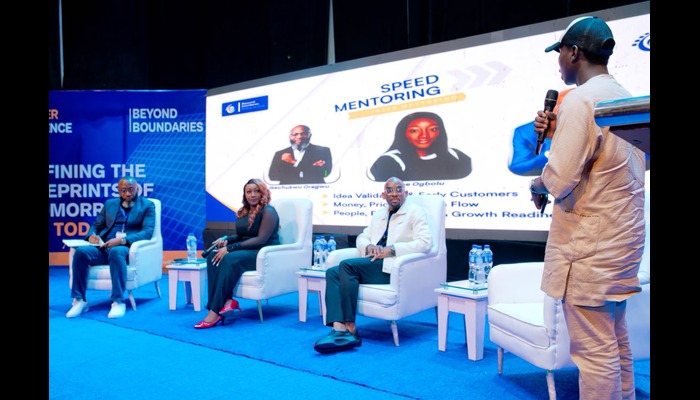
During the speed mentoring session, Oragwu, Ogbolu, and Okeke advised emerging founders to establish strong internal structures early and seek guidance from experienced mentors to shorten their learning curve.
Okeke concluded by emphasizing the necessity of ongoing guidance when navigating complex business environments saying,
“A mentor is very key. There are so many mistakes that I would have not made if I had people mentoring me. Do not limit yourself to one mentor, but seek guidance from people with expertise in different areas.”

Ngozi Ekugo holds an MSc in Management from the University of Hertfordshire. She is also an alumna of University of Lagos, Queen’s College, and an Associate Member of CIPM. Her experience includes a brief exposure in the Human Capital Management division of Goldman Sachs in London. She draws on her cross-sector experience to cover employment trends, career opportunities and international mobility.

