
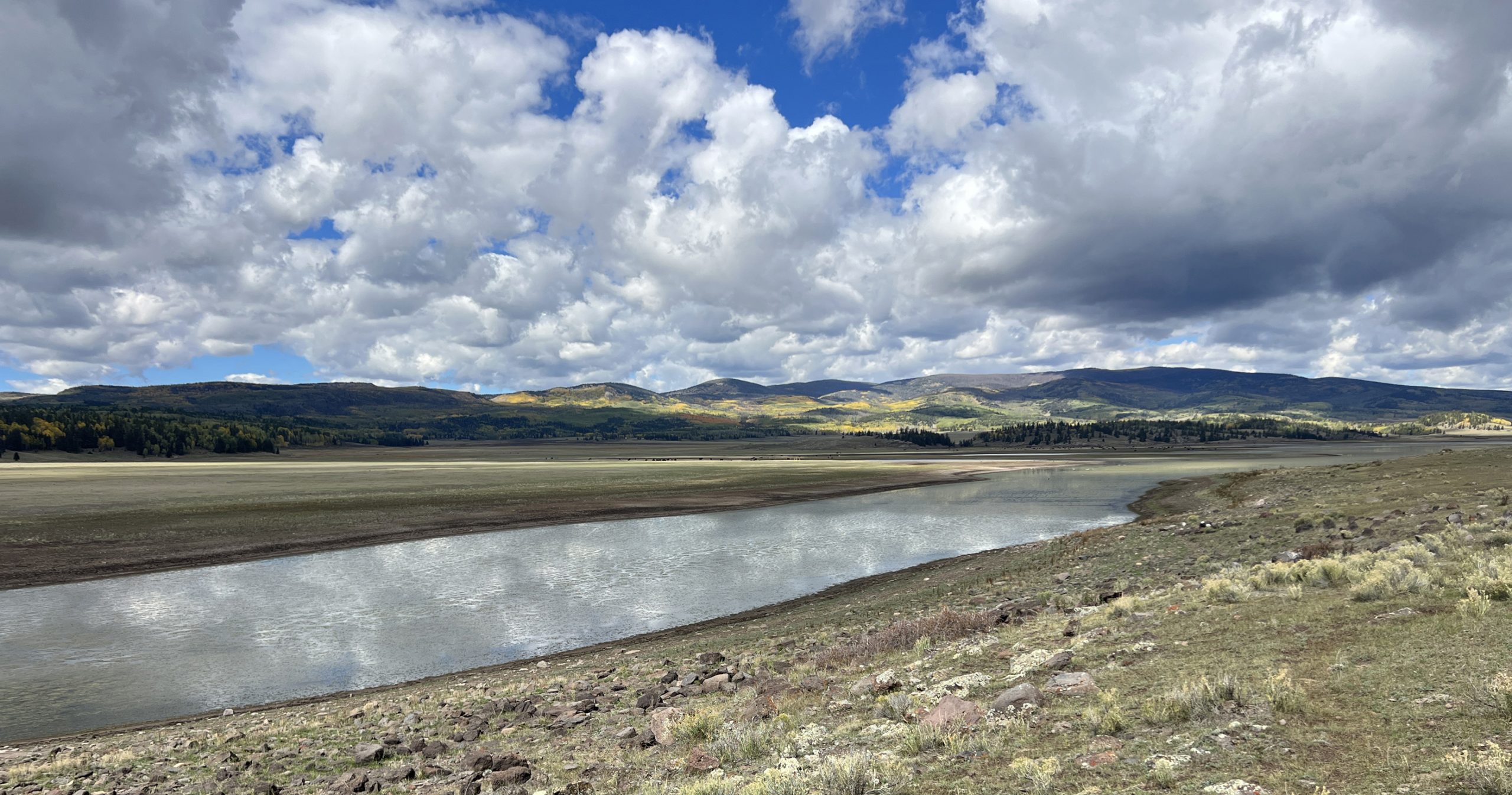
Anna Vargas noted it first. There was more water in La Jara Reservoir on Saturday than when she had been weeks earlier. That in itself was a blessing.
Then there was the discovery of a piece of volcanic glass obsidian by Loretta Mitson that excited the group, along with evidence of a habitation site lord knows how many thousands of years ago just above the thin reservoir.


Vargas and Mitson were part of a caravan of conservationists, archeologists and public officials who took a field trip to mark National Public Lands Day in the La Jara Basin.
They had another purpose as well.
Back in November 2025, the Colorado State Land Board voted to transfer ownership of the La Jara Basin property to a trio of public agencies — Colorado Parks & Wildlife, U.S. Forest Service and U.S. Bureau of Land Management — through a $49.5 million transaction funded through federal tax appropriations, state tax dollars and money from agencies like Colorado Great Outdoors.
Vargas and her boss, Chris Canaly, executive director of San Luis Valley Ecosystem Council, organized the outing that brought along Mitson, one of the Valley’s noted historians; Colorado State Sen. Cleave Simpson; Saguache County Commissioner Tom McCracken; and Mick Daniels and Estaban Salazar from San Luis Valley Great Outdoors, among others, to put attention back on the transaction. The expectation is that the thousands of pages of paperwork involved will be signed, money transferred, and the deal finalized by year’s end.
“We are setting the table for what is going to be happening, we hope soon,” said Canaly, promising a grand event for next summer when all the paperwork is complete.
State Land Board office manager Jenny Minich told Alamosa Citizen that a more definitive update on the closure of the transaction should be available in the next couple of months.
“I think it’s going to be quite a wonderful gathering,” said Canaly in anticipation of the finality of the deal and a celebration of the La Jara Basin to come.

We always get the question, ‘What’s going to change up here?’… At the end of the day, if we’re successful, hopefully people won’t notice any change at all and that’s kind of the core of conservation.
Allen Law, Western Rivers Conservancy
How the La Jara Basin ended up in the hands of the state of Colorado is unique. Then how the state through its land board eventually came around to transferring ownership to federal partners and Colorado Parks & Wildlife rather than sell the land holdings to a private party is another tale.
“This property is really unique within their ownership because when states would come into being, the federal government would deed them a certain amount of land in every township and they were supposed to use those lands to raise money for schools in the frontier states,” said Allen Law of Western Rivers Conservancy, who joined the public lands day trip.
“And how La Jara came to be is, some of those sections that should have been state sections were already homesteaded or they were on reservation lands or treaty lands or things like that. So those sections weren’t available. The federal government instead gave the state land board a big block of, I think they call them in lieu of lands, and that is what the core of this place, La Jara, is. It was basically like the ‘Oops, we already gave away a bunch of your land. We’ll make it up to you here.’”

Cattle grazers and outdoorsmen of all sorts — fishermen, hunters, backpackers — have used the La Jara Basin for generations. The decision to move the property away from state land holdings was fraught with the idea that the state could sell the property into private hands to achieve the highest sale price.
But behind the scenes was Erin Minks, then-aide to Sen. Michael Bennet in the San Luis Valley. It was Minks who began to inform her colleagues of the importance of maintaining La Jara as public lands and that the senator needed to lead the charge.
What followed was a series of federal appropriations starting with fiscal year 2023 that saw the U.S. Forest Service and Bureau of Land Management squirreling away dollars for the eventual purchase of the lands that surround the reservoir. The federal money, $43.5 million, is coming through the U.S. Department of Interior’s Land and Water Conservation Fund, which is used to “safeguard natural areas, water resources and cultural heritage.”
“We always get the question, ‘What’s going to change up here?’” said Law of Western Rivers. “Everybody’s vision is that what happens up here stays pretty much the same.
“That has always been the goal, is we want the community use to continue. We want the grazing to continue. We want folks to be able to cut wood, hunt, fish, camp, all of those things. So really at the end of the day, if we’re successful, hopefully people won’t notice any change at all and that’s kind of the core of conservation.”


Once finalized, the U.S. Forest Service will take over 21,821 acres and BLM will manage 21,704 acres of the La Jara Basin. CPW, in turn, will manage the reservoir area.
Vargas read aloud a land acknowledgement as the group stood in a circle, acutely aware of their surroundings and the meaning of their Saturday journey to La Jara Reservoir.
“On this day, we gratefully acknowledge the Indigenous peoples on whose ancestral homelands we gather,” Vargas read. “We acknowledge that our sustenance and prosperity is derived from the lands of our peoples and ancestors who have been caretakers of the San Luis Valley.”
A bigger celebration to come.