
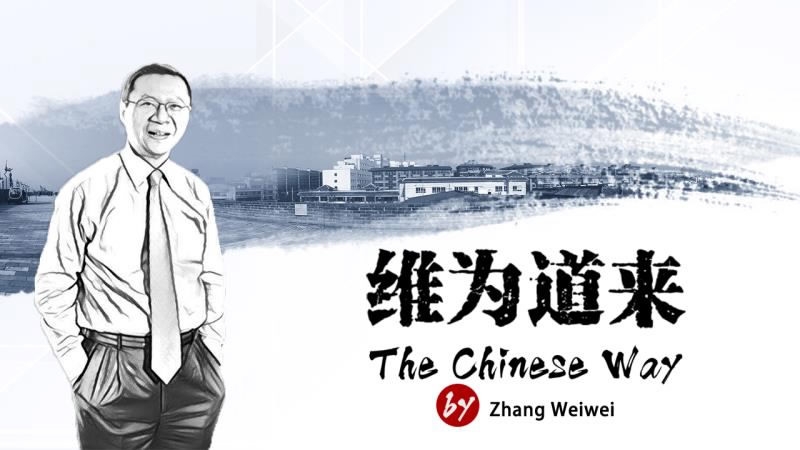
Editor’s note: Zhang Weiwei is a Chinese professor of international relations at Fudan University, and a senior research fellow at the Chunqiu Institute. He is the author of “The China Wave: Rise of a Civilizational State”. “The Chinese Way” by Zhang is a 10-part CGTN Digital series casting a critical eye over the governance of modern China. Professor Zhang identifies merits and flaws in the Chinese system and contrasts the China model with Western equivalents.
– China links resource allocation of market economy with macro regulation of socialist economy
– Central government, local governments and enterprises are key economic engines
China combines market forces with the power of the state to drive the economy. Scholar Zhang Weiwei argues that while China’s economic model is not perfect, it is performing more effectively than its Western counterparts.
The model is officially called the “socialist market economy,” which is essentially a mixed economy, a mixture of the “invisible hand” of the market force and the “visible hand” of the state.
Take Alibaba, the world’s largest e-commerce company, for example. It holds a “Double 11” shopping festival every year on November 11, and last year, the single day event witnessed 266 billion US dollars’ value of e-commerce for the company – that’s larger than the total annual e-commerce value of India.
Jack Ma is undoubtedly extremely talented and Alibaba, as a private company, is extremely successful. But the “Double 11” is also a showcase of China’s mixed economy.
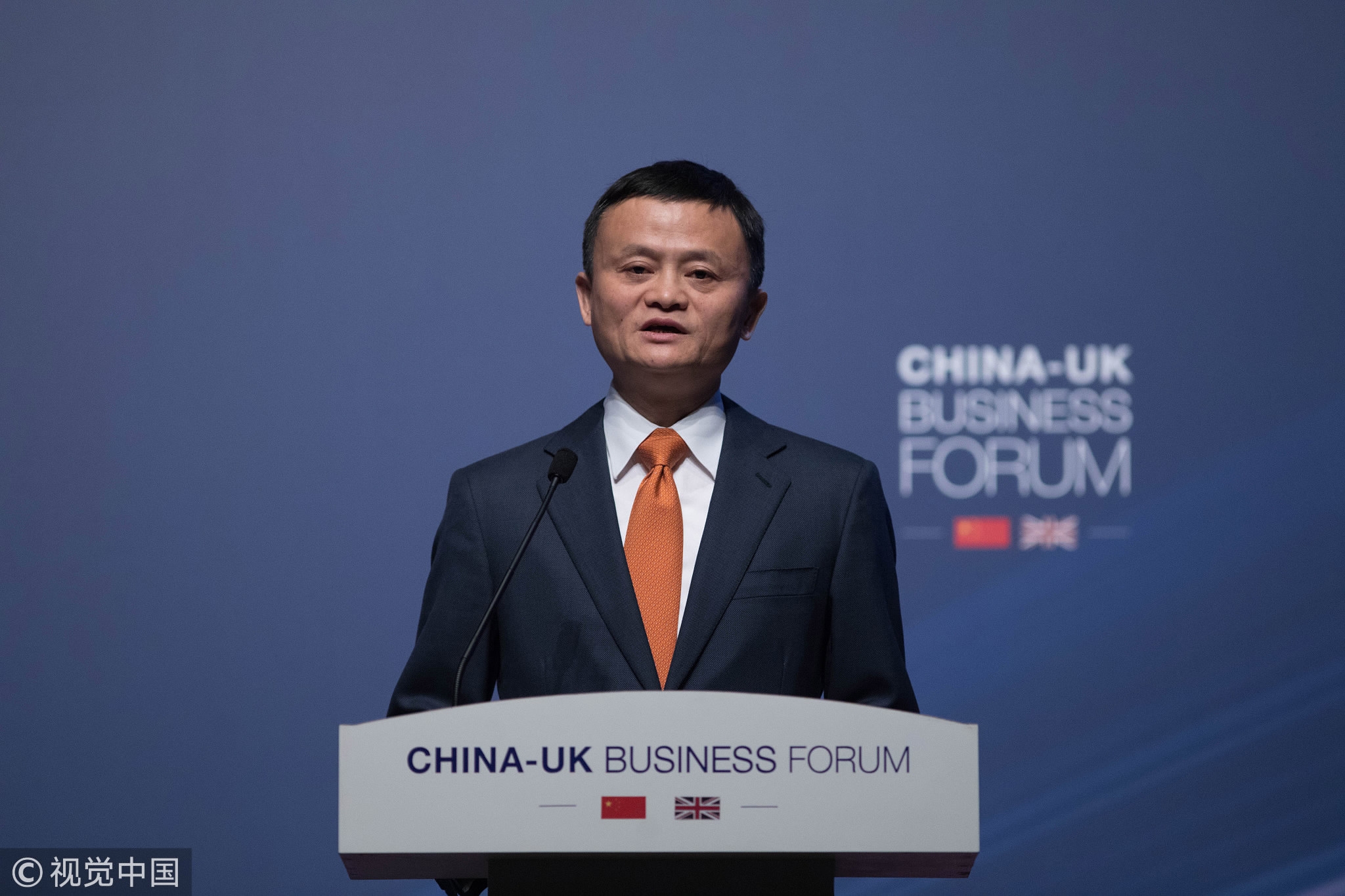
Jack Ma, chairman of Alibaba Group Holding Ltd., speaks at the China-UK Business Forum in Shanghai, China, February 2, 2018. /VCG Photo
Jack Ma, chairman of Alibaba Group Holding Ltd., speaks at the China-UK Business Forum in Shanghai, China, February 2, 2018. /VCG Photo
In addition to the role of private company Alibaba, the state has done many things: the first-rate infrastructure, including the world’s largest network of bullet trains, highways, and paved roads for all Chinese villages; the world’s largest 4G WiFi networks which have already reached each and every village; the state policy for the internet governance which protects China’s infant industries. Had it not been for all of this, it would have been America’s Amazon day, not Alibaba’s.
The role of state in providing compulsory education for the young, electricity supply for all in China, and the state’s huge investment in the next generation of IT technologies such as 5G and 5G standards cannot obviously go unnoticed.
The list goes on and on.
China has largely established the socialist market economic system over the past four decades, and the system has, in relative terms, the efficiency of resource allocation in a market economy and the capacity for macro-regulation in a socialist country.
China’s system has the efficiency of resource allocation seen in a market economy and the capacity for macro-regulation seen in a socialist economy.
– Zhang Weiwei
In fact, the Chinese economy has three engines: the central government, local governments and enterprises.
The central government is responsible for strategic planning and ensuring overall political and economic stability; local governments compete with each other via taxation, land policies and other policies to create business-friendly environment; and enterprises are the driving force in pushing forward the economy.
So the “three-in-one model” is a typical part of the Chinese economic model.

Zhongnanhai leadership compound in Beijing /VCG Photo
Zhongnanhai leadership compound in Beijing /VCG Photo
An important feature of the mixed economy model may be described as “development administration,” in contrast with public administration. For instance, every five years, China produces a Five-Year Plan through extensive consultations at all levels of the Chinese government and society – an example of “consultative democracy” of which China is very proud. Every year, the Communist Party of China (CPC) holds an annual economic conference, usually held in November. The event is part of a series of institutionalized discussions on economic policies, which create expectations and demand.
A typical Five-Year Plan in China catches the attention of the vast majority of the Chinese society, from private firms to state-owned enterprises to individual shareholders. China’s fast growth is definitely inseparable from these regular and predictable cycles of expectations and demand creation.
I believe Chinese universities may eventually offer courses, and even degrees, in “development administration” just as degrees in public administration are common everywhere.
But the Chinese case may be a bit unique, as the Chinese state, under the “socialist market economy,” commands not only such Keynesian instruments as fiscal and monetary policies, but also other “tools,” which may not be available in other countries, such as public ownership of land, strategic resources owned by the state, and a large performing state sector. These “tools” give the Chinese state greater leverage than perhaps other states.
The mixed economy model is not perfect, but China is the only country not to experience a financial or economic crisis.
– Zhang Weiwei
The mixed economy model is not perfect, but since its inception in 1992, China is the only country, I think, in the world which did not experience a financial, debt or economic crisis.
People’s living standards have been improving dramatically, perhaps the fastest in the world, and China’s contributions to the growth of the world economy are now larger than the combined contributions of the US, Europe and Japan.
So the model is not perfect, but it’s doing better than other models, including the Western ones, to my mind at least.