
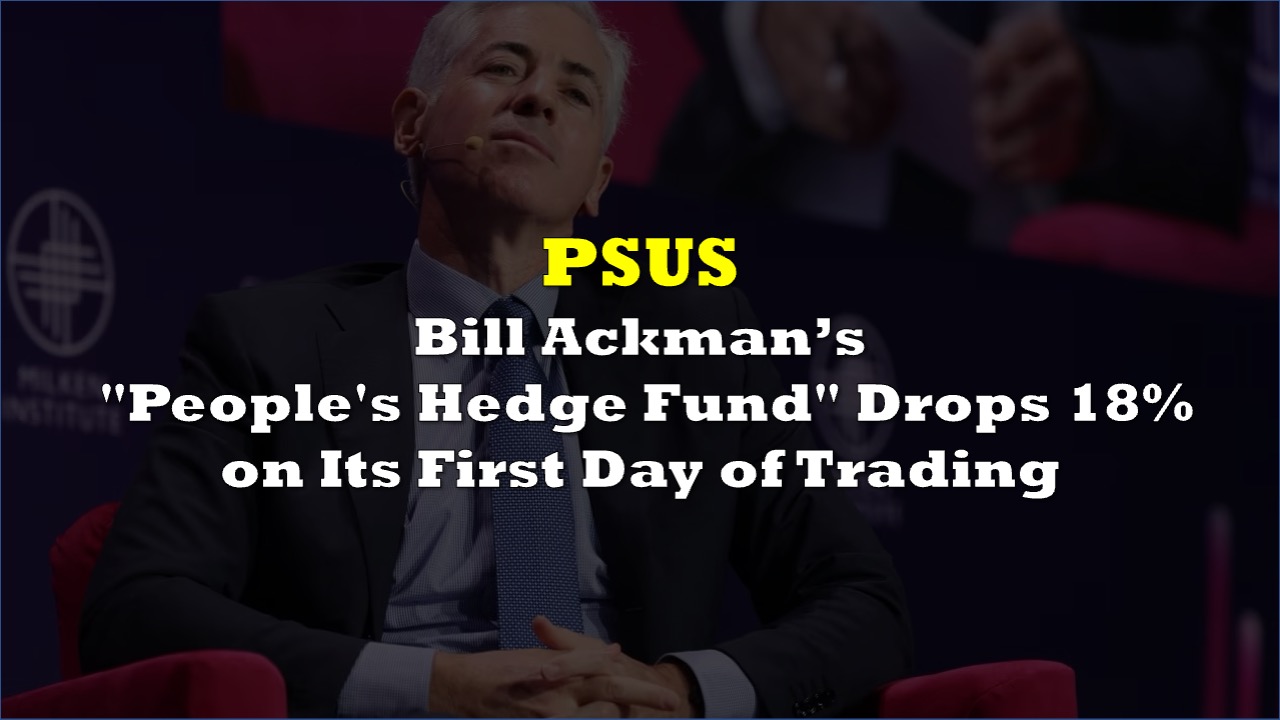
Bill Ackman rang the opening bell at the New York Stock Exchange on Wednesday. By the close of trading, his new fund had lost nearly a fifth of its value.
Pershing Square USA (NYSE: PSUS) closed at $40.90 on its NYSE debut, well below the IPO price of $50 — an 18% drop on the fund’s first day of trading. Shares of the companion asset manager, Pershing Square Inc. (NYSE: PS), ended the day at $24.20.
The combined offering raised $5 billion, hitting the floor of a $5 billion to $10 billion target range — itself a retreat from the $25 billion Ackman had floated when he first began marketing the deal in 2024.
That earlier attempt never made it to market. Ackman pulled the offering days before its planned debut after demand dried up, having already cut the target twice — from $25 billion to $2.5–$4 billion, then down to $2 billion. Wednesday’s listing was his second attempt.
The pitch Ackman built around the revival centered on access. “Hedge funds are sort of known for managing money for rich people,” he told CNBC’s Squawk on the Street on Wednesday. “And now we have the opportunity for someone with $50, could be a long-term shareholder. Usually, the retail gets cut massively back, the institutions are favored. We did the opposite.”
To back that up, Ackman cut the minimum buy-in from $5,000 to $250, partnered with retail brokerages, stripped out performance fees, and prioritized individual investors over institutions in the allocation. The fund targets a concentrated portfolio of 12 to 15 large-cap North American companies, holding Amazon, Uber, and Brookfield as of end-2025.
The longer-term vision is modeled on Warren Buffett’s Berkshire Hathaway — using permanent public capital to take long-horizon positions free from the redemption cycles that define traditional hedge fund management. “We’re going to have an annual meeting, Berkshire Hathaway style, where people come and they ask questions,” Ackman said.
The 18% decline overstates the day-one damage for those who bought in at IPO. Because PSUS investors received one bonus share of Pershing Square Inc. for every five PSUS shares purchased, Bloomberg calculated the net loss for an IPO participant at roughly 9%.
That nuance, though, does little to improve the optics — a fund that spent months promising to put ordinary investors first handed them a double-digit loss before the closing bell.
Information for this story was found via Bloomberg, and the sources and companies mentioned. The author has no securities or affiliations related to the organizations discussed. Not a recommendation to buy or sell. Always do additional research and consult a professional before purchasing a security. The author holds no licenses.