
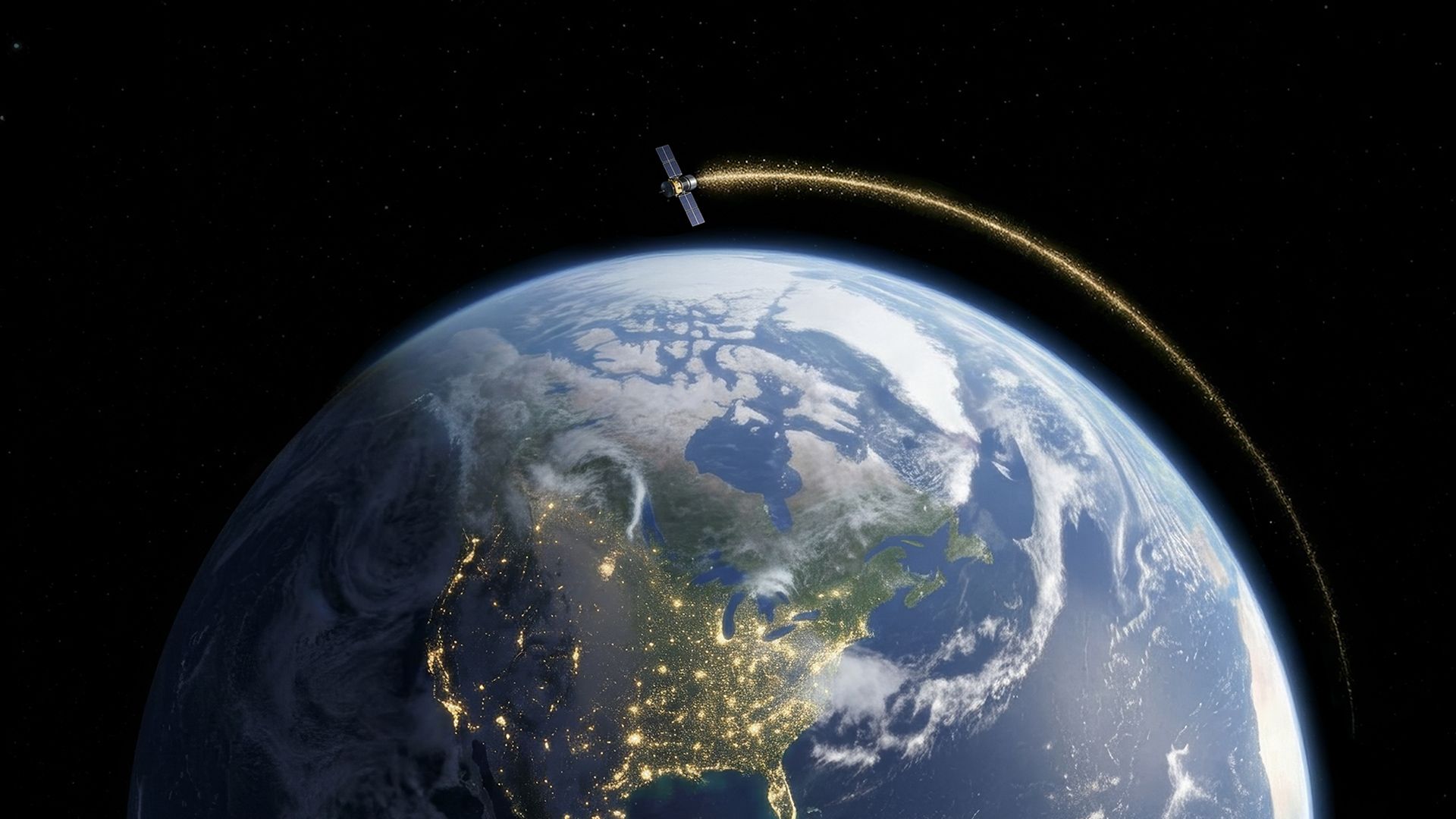
Demand for AI-enhanced products and services is so high that some of the world’s largest tech companies are now looking beyond Earth for solutions. As hyperscalers struggle with power shortages, grid connection delays and land constraints, attention has recently turned to orbital infrastructure as a potential solution.
Recently, Meta reportedly reserved around 1GW of solar capacity as part of its longer-term plans to support future AI data centers, while SpaceX’s Elon Musk has repeatedly discussed ambitions to make orbital infrastructure more accessible.
On paper, the logic is easy to understand, with abundant solar energy to meet power needs and none of the land constraints imposed on Earth. However, engineering for space-bound infrastructure is only part of the worry, and some security and infrastructure experts warn the industry could be dramatically underestimating the operational risks involved.

According to Acre Security CEO Kumar Sokka, the biggest challenge might not be compute, launch economics or cooling, but rather resilience.
Who’s going to look after orbital infrastructure? And how?
Terrestrial data centers are built around one critical assumption – that if something were to go wrong, someone can physically read the hardware to make the necessary changes. Technicians can’t exactly hop on a rocket to replace failed components, swap power systems or restore infrastructure as easily.
As a result, a hardware failure that might take hours to resolve on Earth could become a months-long problem in space, dependent on launch schedules, robotic repair systems and even complete satellite replacement.
Operators would also have to consider space debris, radiation exposure and thermal extremes on top of hostile maintenance environments.
To better understand the resilience and security implications of moving AI infrastructure into orbit, I spoke with Acre Security’s Kumar Sokka about why orbital compute may fundamentally challenge what we know about AI compute today, how outage recovery changes when hardware becomes inaccessible, and why the industry could be trading one type of constraint or risk for another.
- Hyperscalers have deep pockets and the brightest minds. Surely they’ve considered resilience? What could go wrong?
These are genuinely excellent engineering teams, and the rigour they’ve brought to terrestrial infrastructure over the last two decades is real. We work alongside that infrastructure every day.
But the resilience frameworks they’ve built are all grounded in one assumption: someone can physically reach the hardware. That’s what makes layered access control, physical redundancy, and rapid component replacement possible. The moment infrastructure moves to orbit, that assumption disappears.
A routine fix that takes four hours on the ground becomes a three-to-six month problem involving a launch window. What we’re seeing with recent announcements about compute demand outpacing what terrestrial power and land can deliver tells us this isn’t a theoretical conversation anymore.
The engineering ambition is real, and the physical security frameworks need to keep pace with it.
- How would data centres in space differ from existing satellites when it comes to risk mitigation and redundancy?
The architecture is fundamentally different. Satellites are purpose-built, designed to operate independently, and constellations are built so that if one node fails, traffic routes around it. Data centres don’t work that way.
You’re running interdependent workloads where a single compute job may span thousands of processors, and a partial failure can bring the whole job down.
The fault tolerance models that work well for independent satellite nodes don’t translate cleanly to complex, tightly coupled compute infrastructure. That gap hasn’t been fully addressed yet, and it’s where we think the industry needs to invest serious thinking.
- Could hot-swappable redundancy or 50% extra capacity solve the maintenance problem?
In principle, yes, but economics can create real tension. On the ground, spare capacity is relatively inexpensive. You run N+1 configurations, you keep hardware in a warehouse, the cost is manageable.
In orbit, every kilogram of redundant hardware carries a launch cost. And hot-swapping in a vacuum, in microgravity, with active thermal management requirements, requires automated repair capability we don’t yet have at scale.
The ISS was specifically designed for human maintenance and still requires EVAs for hardware work. If you’re talking about the scale some operators are projecting, the maintenance model needs to be fundamentally reimagined before the infrastructure gets there.
- How should the industry evolve its strategy to protect launch-and-forget, unreachable hardware?
This is the question we find most interesting, because orbital infrastructure inverts a lot of what physical security is built around. Our discipline is fundamentally about controlling access, who gets in, what they can reach, how you monitor the perimeter.
In orbit, that model flips: no one can get in, including the operators. So the strategy has to shift from protect-and-respond to predict-and-pre-empt. That means self-diagnosing systems, AI-driven anomaly detection that identifies component degradation before it becomes failure, and hardware designed from day one for graceful degradation rather than hard failure.
You also have the debris environment to account for, tens of thousands of tracked objects, millions of smaller fragments, all at extraordinary velocity. You can’t fence that perimeter. You can only design around it, and you have to do that thinking before the hardware launches.
- Isn’t colocation on the same orbital platform acceptable in a hybrid system with Earth-based capacity running concurrently?
If you’re genuinely treating orbital compute as supplementary, with full failover capacity maintained on the ground, then the single-point-of-failure risk is managed. But the underlying business logic creates pressure in the other direction.
The argument for space infrastructure in the first place is that terrestrial capacity can’t meet demand. Once that becomes true, the economics push operators toward dependency rather than redundancy.
If you’re running production workloads in orbit that genuinely can’t run elsewhere, the hybrid framing starts to break down. What was designed as a backup becomes a critical dependency, and that shift can happen gradually without anyone making an explicit decision.
- Acre protects Google, AWS and other hyperscalers. Isn’t space an opportunity for your business?
It’s something we’re actively thinking about, but I’d be honest that our focus right now is on getting the unified platform vision right here on the ground.
We’re building infrastructure that brings access control, intrusion detection, video, and visitor management together in a way that works across enormously complex, distributed facilities, and that work isn’t done. What space does is sharpen the thinking.
The principles we’re developing, unified monitoring, anomaly detection across interdependent systems, designing for environments where you can’t always send someone in to fix a problem, those translate.
When the industry is ready to have a serious conversation about orbital security strategy, we want to be the organisation that’s already thought it through. But the most valuable thing we can do right now is build the platform foundation that makes that possible.

Follow TechRadar on Google News and add us as a preferred source to get our expert news, reviews, and opinion in your feeds.