
Close Menu
Aspire Market Guides
  • Home
  • Alternative Investments
  • Cryptocurrency
  • Economics
  • Equity Investments
  • Mutual Funds
  • Real Estate
  • Trading
What's Hot

Aging infrastructure closes three pools in Lincoln – KOLN | Nebraska Local News, Weather, Sports | Lincoln, NE

May 26, 2026

Casio’s silver-dial Edifice watch hits all-time low price of only $72 on Amazon, down 40%

May 25, 2026

Morgan Stanley questions AI’s impact on US economic elasticity

May 25, 2026
Facebook X (Twitter) Instagram
Trending:
  • Aging infrastructure closes three pools in Lincoln – KOLN | Nebraska Local News, Weather, Sports | Lincoln, NE
  • Casio’s silver-dial Edifice watch hits all-time low price of only $72 on Amazon, down 40%
  • Morgan Stanley questions AI’s impact on US economic elasticity
  • Best gilt mutual funds to invest in May 2026
  • Hidden 401(k) Fund Costs Could Cause Many Savers to Lose Thousands in Retirement
  • Hedge Fund and Insider Trading News: Chase Coleman, Chris Hohn, Ray Dalio, Philippe Laffont, Berkshire Hathaway, Greenvale Capital, eToro Group Ltd (ETOR), and More
  • Bigger Discounts Seen on Land Sales – Green Street News
  • 11 Best Medical Technology Stocks to Buy Right Now
  • UNSMIL: Structured dialogue’s economic track meetings conclude, recommendations to be announced in June
  • Calamos Dynamic Convertible And Income Fund Q1 2026 Commentary (CCD)
Tuesday, May 26
Facebook X (Twitter) Instagram
Aspire Market Guides
  • Home
  • Alternative Investments
  • Cryptocurrency
  • Economics
  • Equity Investments
  • Mutual Funds
  • Real Estate
  • Trading
Aspire Market Guides
Home»Economics»Morgan Stanley questions AI’s impact on US economic elasticity
Economics

Morgan Stanley questions AI’s impact on US economic elasticity

By CharlotteMay 25, 20263 Mins Read
Share
Facebook Twitter Pinterest Email Copy Link


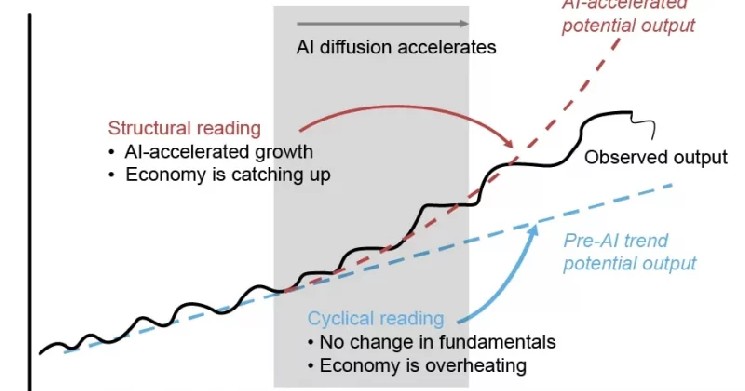
Here’s something economists don’t see every day: companies spending more money precisely when things get more expensive. Morgan Stanley’s Andrew Sheets, the firm’s Global Head of Fixed Income Research, laid out the case in a May 11 podcast that AI infrastructure spending is fundamentally rewriting how the US economy responds to price signals.

The core observation is striking. Copper prices are up 40% year-over-year. Gas turbines have climbed 50%. Memory chips have surged between 150% and 300% in just twelve months. And demand for all of it keeps rising.

The $800 billion question

Morgan Stanley now anticipates $800 billion in AI-related capital expenditure from major US technology firms in 2026. That figure is nearly double the previous year’s estimates and roughly triple what was spent in 2024. The 2027 projection climbs even higher, to $1.1 trillion.

Sheets described this spending pattern as “uniquely price insensitive.” In plain English: companies building AI infrastructure don’t flinch at higher costs. They just keep buying chips, data centers, and power equipment regardless of what the invoice says.

Good news, bad news

Sheets framed the situation as a “classic good news, bad news story.” The good news is obvious enough. When hundreds of billions of dollars flow into capital spending, it props up GDP growth, supports employment in construction and manufacturing, and generates corporate earnings. Morgan Stanley’s midyear outlook projects a 7% rise in US business spending in Q4 2026, with 8% growth forecast for 2027, driven in significant part by AI-related capex.

Now for the bad news. When a massive sector of the economy stops responding to price signals, inflation gets harder to tame. If companies keep buying copper and memory chips no matter the cost, producers have little incentive to moderate pricing.

There’s also the credit market angle. Sheets flagged the potential for widening credit spreads in corporate bond markets. Companies financing massive buildouts through debt issuance put pressure on the broader fixed income landscape. If enough firms are borrowing heavily to fund AI infrastructure, the risk premium on corporate bonds could expand, making borrowing more expensive across the board.

What this means for investors

For fixed income investors, the inflationary impulse from AI spending could keep interest rates elevated longer than consensus expects. If the Fed is trying to cool the economy while a trillion-dollar spending engine operates with apparent immunity to monetary tightening, the traditional transmission mechanism of rate hikes starts to break down.

Worth noting: Sheets was explicit that this analysis pertains to traditional financial markets. He made no reference to digital currencies or crypto assets in his assessment.


Source link

Related Posts

Economics

UNSMIL: Structured dialogue’s economic track meetings conclude, recommendations to be announced in June

May 25, 2026
Economics

PEPES Seminar – Oct 17th

May 25, 2026
Economics

Digital Twin Economics | NIST

May 25, 2026
Economics

President Mahama cuts sod for construction of 24-Hour Economy Market in Bole

May 25, 2026
Economics

Dynamic changes in the structure and concentration of the international grain and oilseed trading industry – Wilson – 2025 – Applied Economic Perspectives and Policy

May 25, 2026
Economics

UVM MPA Program Hosts Talk on U.S. Foreign Policy in a Changing World Order

May 25, 2026
Add A Comment
Leave A Reply Cancel Reply

Editors Picks

Aging infrastructure closes three pools in Lincoln – KOLN | Nebraska Local News, Weather, Sports | Lincoln, NE

May 26, 2026

Casio’s silver-dial Edifice watch hits all-time low price of only $72 on Amazon, down 40%

May 25, 2026

Morgan Stanley questions AI’s impact on US economic elasticity

May 25, 2026

Best gilt mutual funds to invest in May 2026

May 25, 2026
SUBSCRIBE TO OUR NEWSLETTER

Get our latest downloads and information first. Complete the form below to subscribe to our weekly newsletter.


I consent to being contacted via telephone and/or email and I consent to my data being stored in accordance with European GDPR regulations and agree to the terms of use and privacy policy.

Featured

10,000 Bitcoin worth $760M transferred to exchanges, potential selling pressure

May 1, 2026

CZ Says NFTs and DAOs Are Coming Back and the Next Version Will Look Different

April 11, 2026

Old vs. New Tax Regime: Your FY26-27 Savings Decision

May 6, 2026
Monthly Featured

Post Office marks first Gold Fair Payment Code Award

April 14, 2026

MFDF’s Navigating the DOL's Proposed Rule on 401(k) Plan Exposure to Alternative Investments – WilmerHale

May 15, 2026

Sanne de Laat’s eight gives Denmark gold in compound mixed team at Puebla 2026

April 11, 2026
Latest Posts

Aging infrastructure closes three pools in Lincoln – KOLN | Nebraska Local News, Weather, Sports | Lincoln, NE

May 26, 2026

Casio’s silver-dial Edifice watch hits all-time low price of only $72 on Amazon, down 40%

May 25, 2026

Morgan Stanley questions AI’s impact on US economic elasticity

May 25, 2026
SUBSCRIBE TO OUR NEWSLETTER

Get our latest downloads and information first. Complete the form below to subscribe to our weekly newsletter.


I consent to being contacted via telephone and/or email and I consent to my data being stored in accordance with European GDPR regulations and agree to the terms of use and privacy policy.

© 2026 Aspire Market Guides.
  • Contact us
  • Privacy Policy
  • Terms and Conditions

Type above and press Enter to search. Press Esc to cancel.

SUBSCRIBE TO OUR NEWSLETTER

Get our latest downloads and information first.

Complete the form below to subscribe to our weekly newsletter.


I consent to being contacted via telephone and/or email and I consent to my data being stored in accordance with European GDPR regulations and agree to the terms of use and privacy policy.