
Here’s what you’ll learn when you read this story:
- A redevelopment project near a stream in the Netherlands revealed over 3,000 artifacts spanning from the Stone Age to World War II.
- Experts labeled 600 of the finds “of particular significance,” meaning that researchers have a bounty of pieces to investigate more fully.
- Most of the artifacts were small, but many are in “exceptionally good condition” and highlight cultural evolution over centuries.
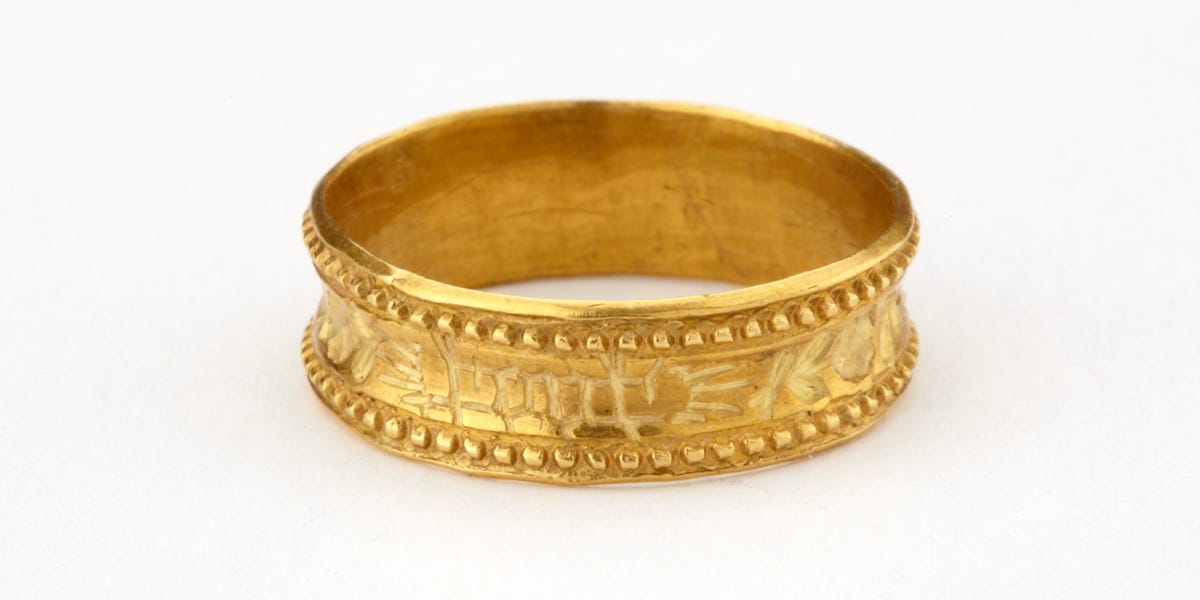
A nondescript Dutch valley has become a treasure trove of world history, with researchers churning up over 3,000 artifacts spanning the Stone Age to World War II. Experts unearthed ancient tools, a shockingly shiny gold ring from the fourth century C.E., and what they believe is a historical precursor to the zipper.
Plans called for the creation of a nature reserve in the Nieuwe Drostendiep stream valley in the Netherlands, but before work on it began, archaeologists were called in to ensure that the location’s historical and scientific value would be thoroughly preserved. Out of more than 3,000 artifacts discovered—which include everyday objects from an impressive range of time—the experts believe at least 600 are “of particular significance.”
“The scale, variety, and exceptionally good condition of the finds make them truly remarkable,” the provincial government of Drenthe (where the finds were made) wrote in a translated statement. Discoveries included tools from the Stone and Bronze ages, jewelry from the second century B.C.E. through the Middle Ages, and items from the Eighty Years’ War and Word War II.
Provincial officials wrote that stream valleys have been key locations for many archaeological finds because they were often used as travel routes and sources of food—some even held spiritual significance. Discovering noteworthy artifacts in such areas isn’t surprising, then, but the work at Nieuwe Drostendiep “exceeded all expectations” in terms of the quantity and quality of the haul. Experts said the “excellent” state of preservation resulted from the soil layers going largely undisturbed throughout history.
“We take pride in the rich history of our beautiful and unique Drenthe landscape,” Yvonne Turenhout, a provincial executive member, said in a statement. “These remarkable finds underscore that value once again.”
Each of the pieces requires more work, especially as crews clean and catalogue the items before researching them further (and potentially showing them in a local museum). While the ancient tools and the wide array of jewelry offer plenty of intrigue, experts are particularly fond of a find from either the 10th or 11th century C.E. Crews discovered a fibula pin—an item used to fasten clothing that’s now considered the precursor to both the button and the zipper. And a distinctive gold ring from the third or fourth century C.E. still shines, thanks to gold’s ability to withstand rust and tarnishing.
Historical finds aren’t anything new for archaeologists in the Netherlands—or metal detectorists, for that matter. A recent find of 100 gold and silver coins turned out to be 1,300 years old, its bounty once used in ritual proceedings serving pagan gods, known as the “devil’s money.” Even older was the recent discovery of the grave of a Roman soldier in a Dutch town square, complete with diverse grave goods. Of course, finds don’t have to be ancient to be intriguing. Another discovery made within the last year in the Netherlands featured a distinct 1,000-year-old sword. But few single sites have yielded such a sweeping cross-section of human history as the Nieuwe Drostendiep valley—a reminder that even the most unassuming landscapes can hold millennia of stories, waiting just beneath the surface.
Tim Newcomb is a journalist based in the Pacific Northwest. He covers stadiums, sneakers, gear, infrastructure, and more for a variety of publications, including Popular Mechanics. His favorite interviews have included sit-downs with Roger Federer in Switzerland, Kobe Bryant in Los Angeles, and Tinker Hatfield in Portland.