
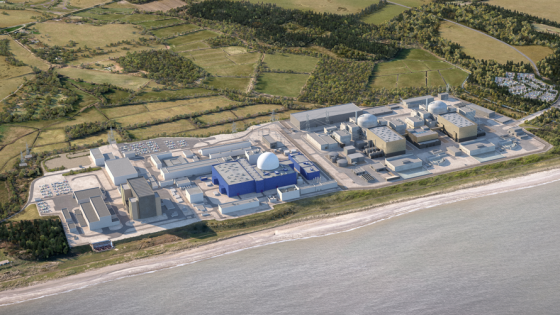
Members of Parliament on the House of Commons Public Accounts Committee (PAC) have quizzed representatives from Sizewell C and the government on the project’s progress.
Sizewell C chief executive officer Nigel Cann used the session on Tuesday (16 June) as an opportunity to provide updates on several areas of construction, including the roads and railways needed to support the construction of the nuclear power plant on the Suffolk coast.
Department for Energy Security and Net Zero (DESNZ) officials also appeared before the committee, including permanent secretary Jonathan Brearley, second permanent secretary Clive Maxwell and director of new nuclear projects Caroline Botwood.
Cann described the risks he sees Sizewell C facing between now and putting the foundations in for unit 1, something termed “J-zero”. The two planned units will produce 3.2GW of electricity, enough for 6M homes.
“It is a long project – over 10 years – so we absolutely need to focus. I describe my challenges between now and what we call J-zero, which is putting the foundations in for unit 1, as being about retiring the equipment risk by putting as much equipment built in Orwell, which is our one million-square-foot warehouse that we have got ready to go, and retiring the risk in the enabling works.
He also said he wanted to “modularise” Sizewell C. It has previously been described by Sizewell C as a large modular reactor.
Cann said that in pursuit of improving productivity at the site, he wanted to “modularise as much as possible”, between now and J-zero.
“We want to take as much welding off site and take as much stuff into factories as we can so that, when we get to the construction on site, it is absolutely optimised.”
Cann also set out some of the infrastructure which will be needed ahead of other construction activities, including railway and roads.
“A big focus for us is to get as much of the infrastructure in place as possible. We have 11km of rail track into the site, and we are bringing in engineering trains as we speak,” he said.
“By the end of June, we expect to get two trains a day into the site, and we are looking to get four trains a day by the end of the year.”
He told MPs they have also tried to focus on the on-carriageway schemes.
“There has been a big focus on trying to get the A12 roundabouts in place, and now they have been finished, you will see a marked improvement in the road infrastructure at Yoxford and Friday Street,” he said.
“With some of the off-road schemes, we are making sure that we get the right contractual agreements in place.
“We are probably a little bit behind in setting the link road and the two-village bypass, but we made the conscious decision to make sure that we get the right price rather than rush in with a low level of design. We have a high level of design, and we are now going to competitive tender. We will make sure that we get the best possible value for the road schemes.”
Cann went on to provide details on what Sizewell C calls its “cut-off wall”, which will be “the impervious wall around the outside of the site”, within which dewatering of the site can take place.
He went on: “It is about 1,600m [long] and 50m deep. That then allows us to pump out the water in the middle of it and start the deep excavation.
“The sea wall is an enabler for that … the critical path is getting that in and getting the pump on.”
Pressed for a deadline for finishing the sea wall, Cann said: “The sea wall piling should be done by the end of this month [June].”
Cann later said that Sizewell C was “making plans to have a combined substation for Sizewell B and Sizewell C”, and said Sizewell C was working with National Grid on the project.
Member of Parliament for Great Yarmouth and Restore Britain party leader Rupert Lowe and PAC chair Geoffrey Clifton-Brown both expressed concerns about the lack of transparency from Sizewell C regarding parliamentary and public scrutiny of potential future cost overruns.
“How are you going to keep this committee and, more importantly, parliament in close touch, on a dynamic basis, with whatever cost overruns you are experiencing,” Lowe asked.
“Otherwise, we are going to end up with a nasty little shock some way down the line, when most of us will have forgotten this conversation ever took place.”
Clifton-Brown echoed Lowe’s question.
Government and Sizewell C representatives explained the reports they produce for shareholders and members of internal governance structures, but admitted that they would only be informing the public of any cost overruns, if they occur, once a year via an annual report.
Clifton-Brown responded by saying: “Can I suggest, Clive, that that is not adequate? Even HS2 produced six-monthly reports, and even they were late because things were going wrong.
“We need to see regular updates to parliament. What can I extract from you in that respect?”
Botwood and Maxwell confirmed they would “take away” the request for more accountability.
“That is a fair point”, Maxwell added.
Like what you’ve read? To receive New Civil Engineer’s daily and weekly newsletters click here.