
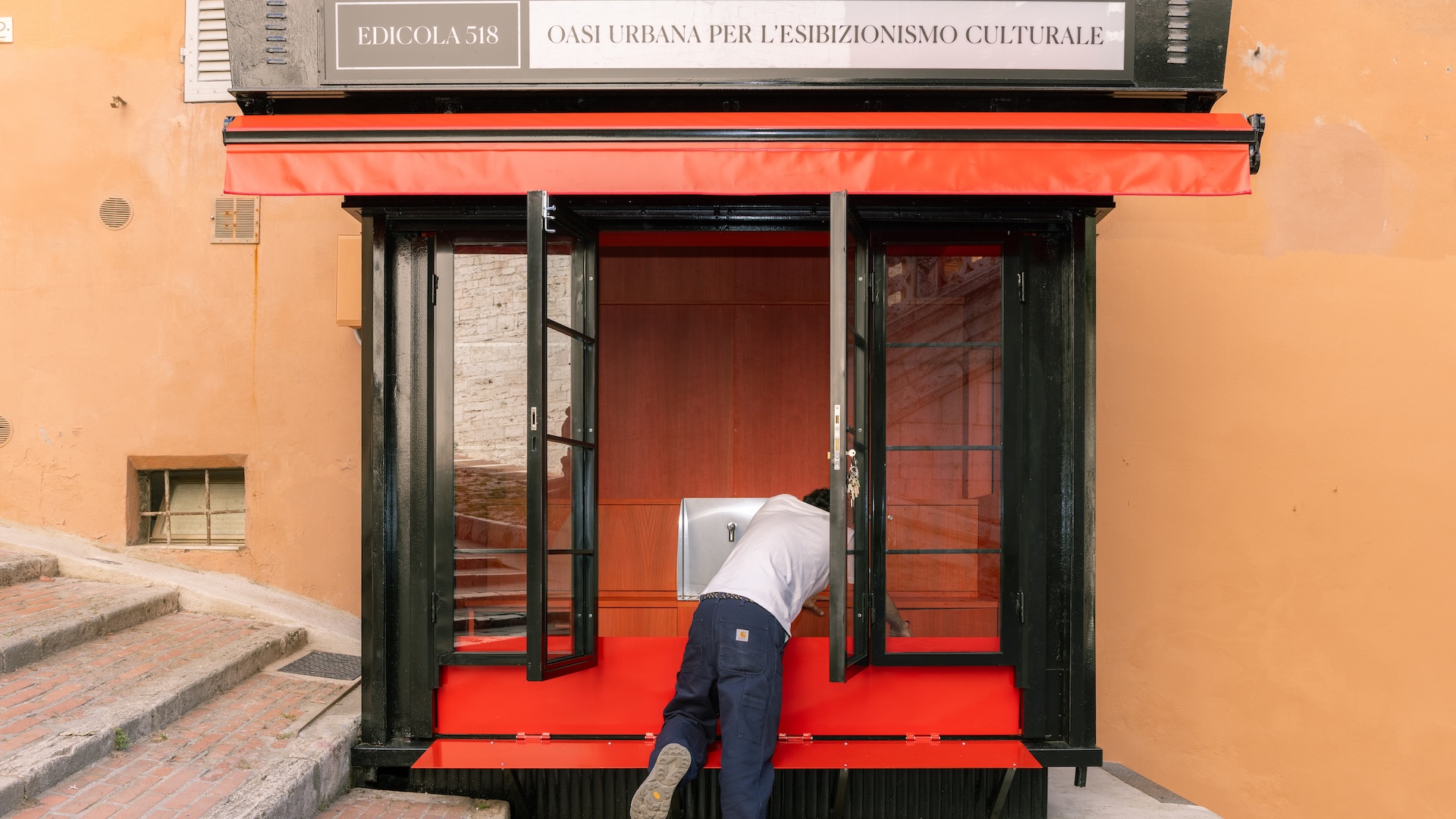
Across Italian cities, thousands of newsstands remain standing without functioning. Once embedded in the rhythms of urban life – occupying strategic corners, piazzas and transit routes, operating as nodes where information, commerce and daily ritual converged – these small structures have been left behind by the collapse of print media without being reclaimed by anything else. Survived as fragments of a previous urban arrangement, physically present but socially suspended, those miniature architectures – whose original purpose has dissolved – continued to enlarge their spatial potential, but without any direction.
Edicola 518 in Perugia (Umbria region of Italy, in the center of the peninsula) offers a contribution worth examining in this context: founded a decade ago as an independent kiosk for books and magazines, positioned along the historic staircase of Sant’Ercolano – where, according to local legend, the city’s patron saint was decapitated by Roman soldiers – it has spent ten years operating at the edge of what a newsstand can be, curating independent publishing, building a local audience, occupying one of the city’s most charged urban thresholds.
Edicola 518, Design Giuseppe Arezzi © Giovanni Emilio Galanello
Edicola 518, Design Giuseppe Arezzi © Giovanni Emilio Galanello
Edicola 518, Design Giuseppe Arezzi © Giovanni Emilio Galanello
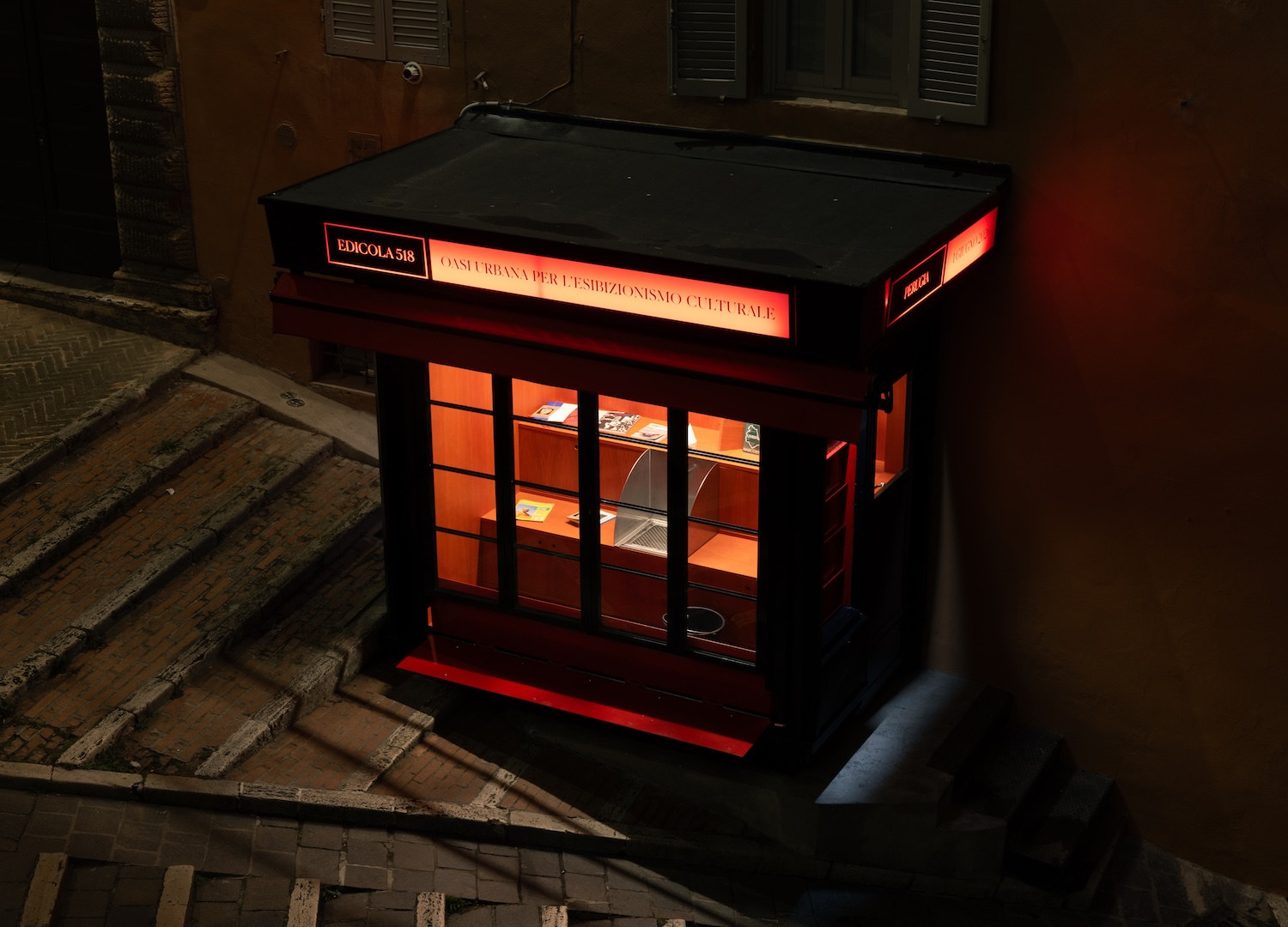
Edicola 518, Design Giuseppe Arezzi © Giovanni Emilio Galanello
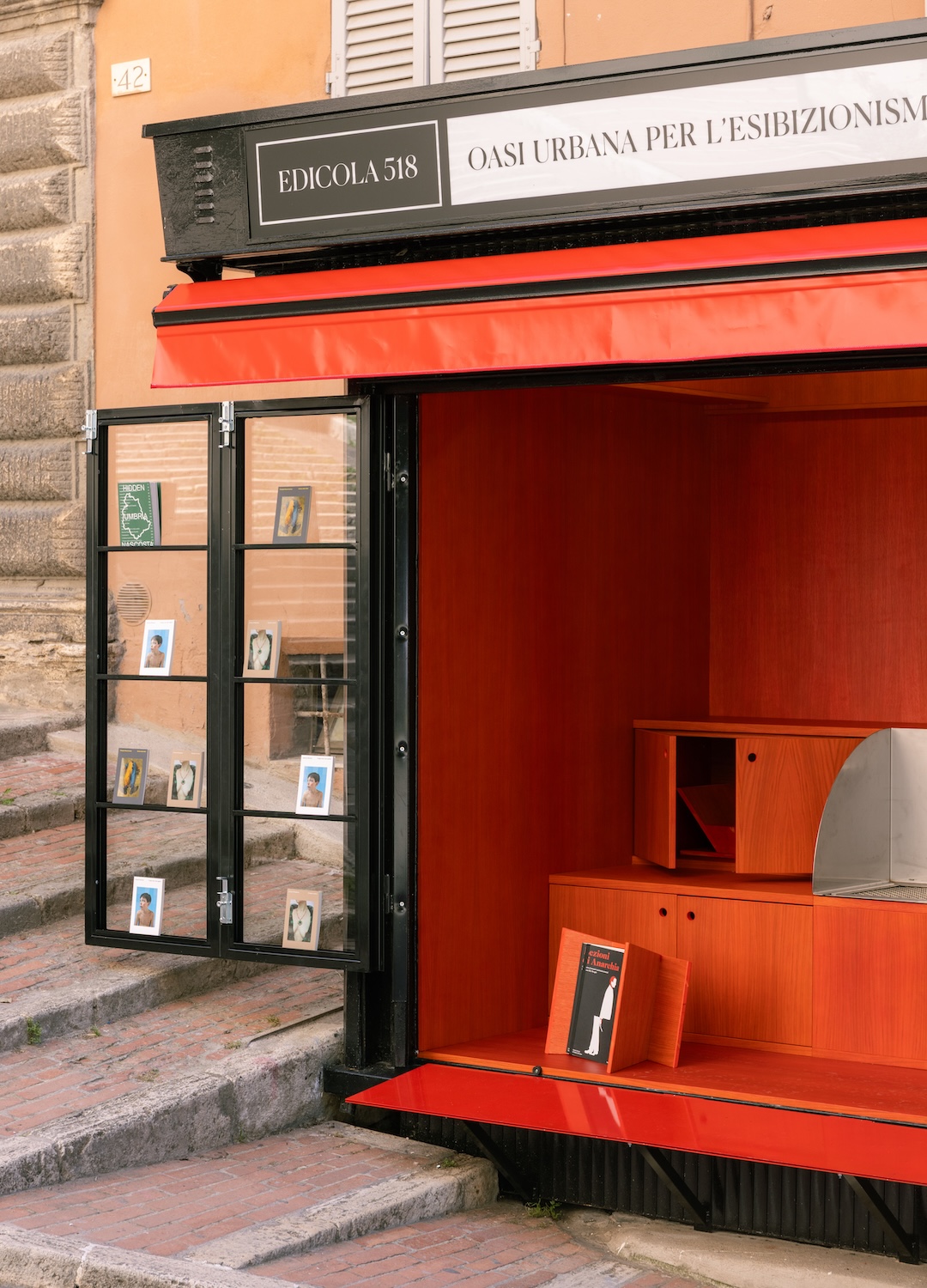
Edicola 518, Design Giuseppe Arezzi © Giovanni Emilio Galanello
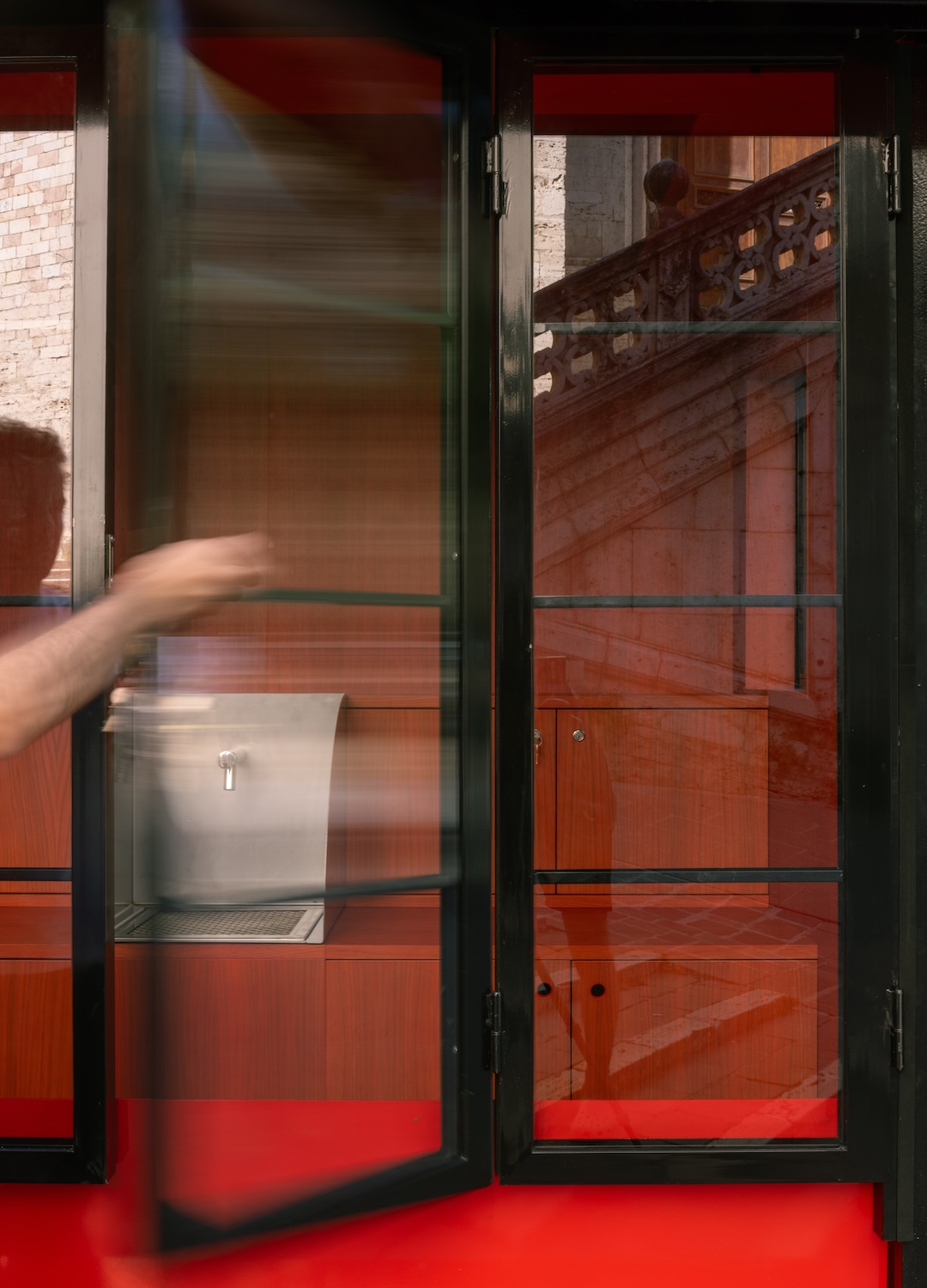
Edicola 518, Design Giuseppe Arezzi © Giovanni Emilio Galanello
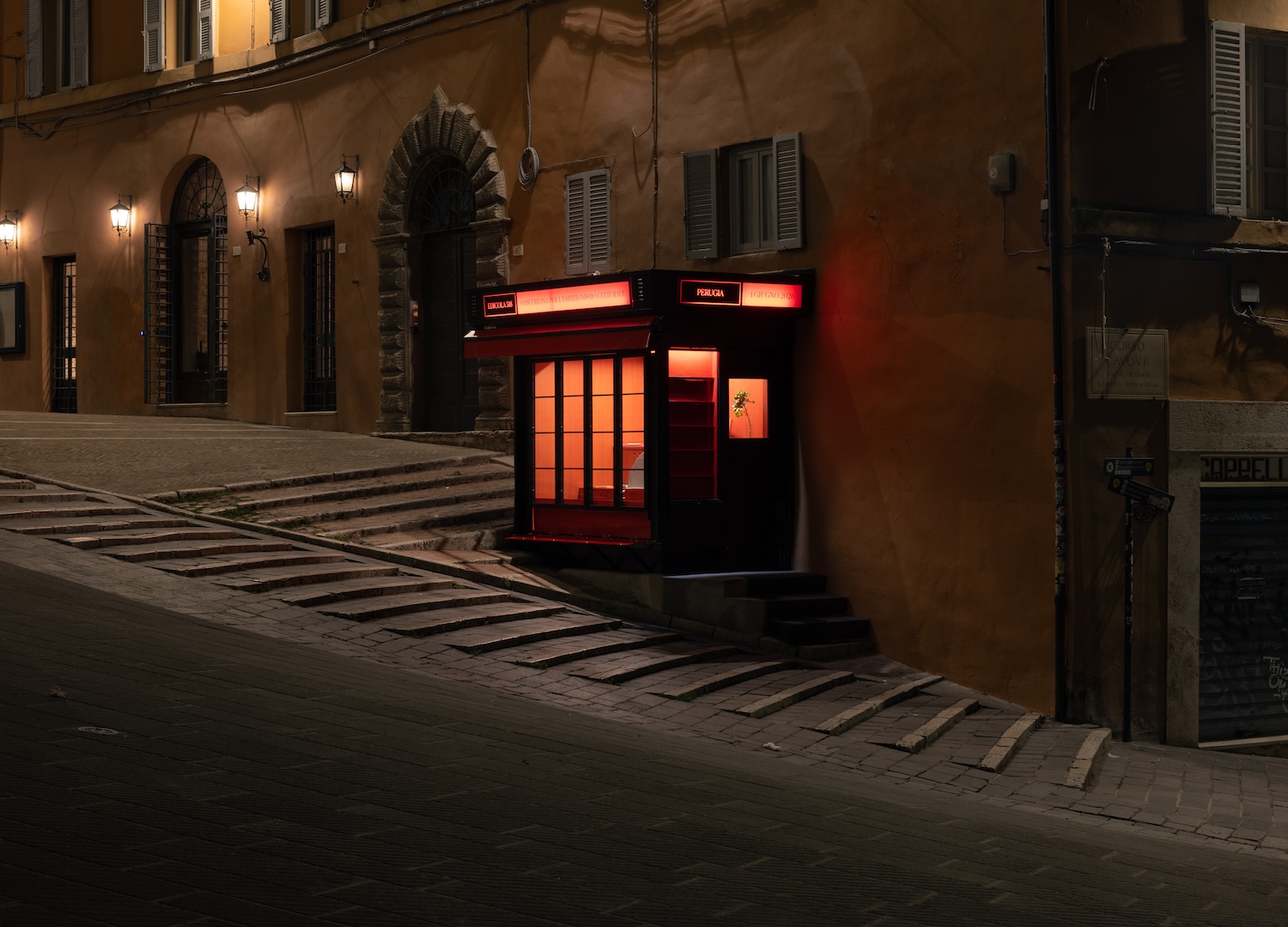
Edicola 518, Design Giuseppe Arezzi © Giovanni Emilio Galanello

Edicola 518, Design Giuseppe Arezzi © Giovanni Emilio Galanello
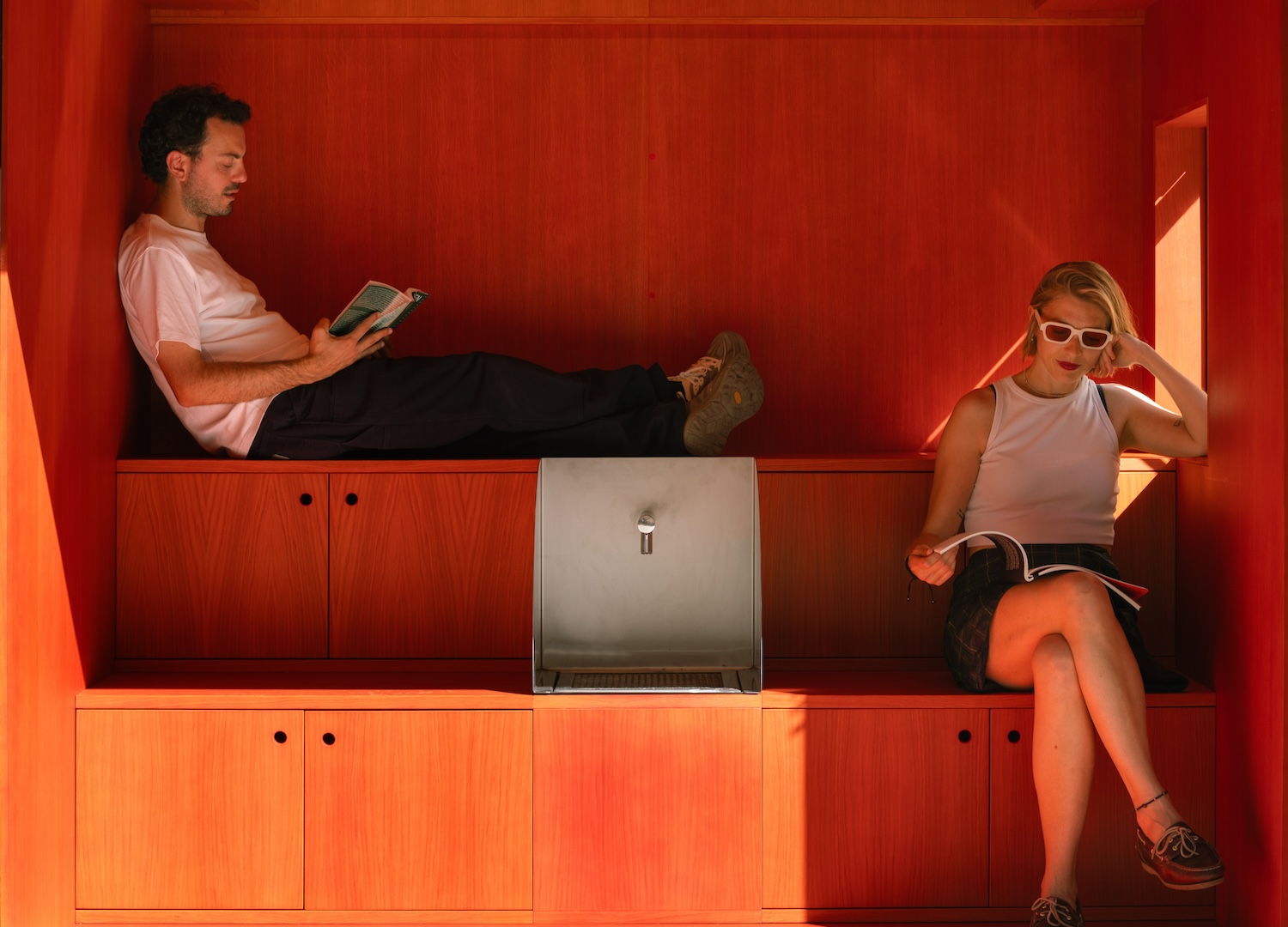
Edicola 518, Design Giuseppe Arezzi © Giovanni Emilio Galanello
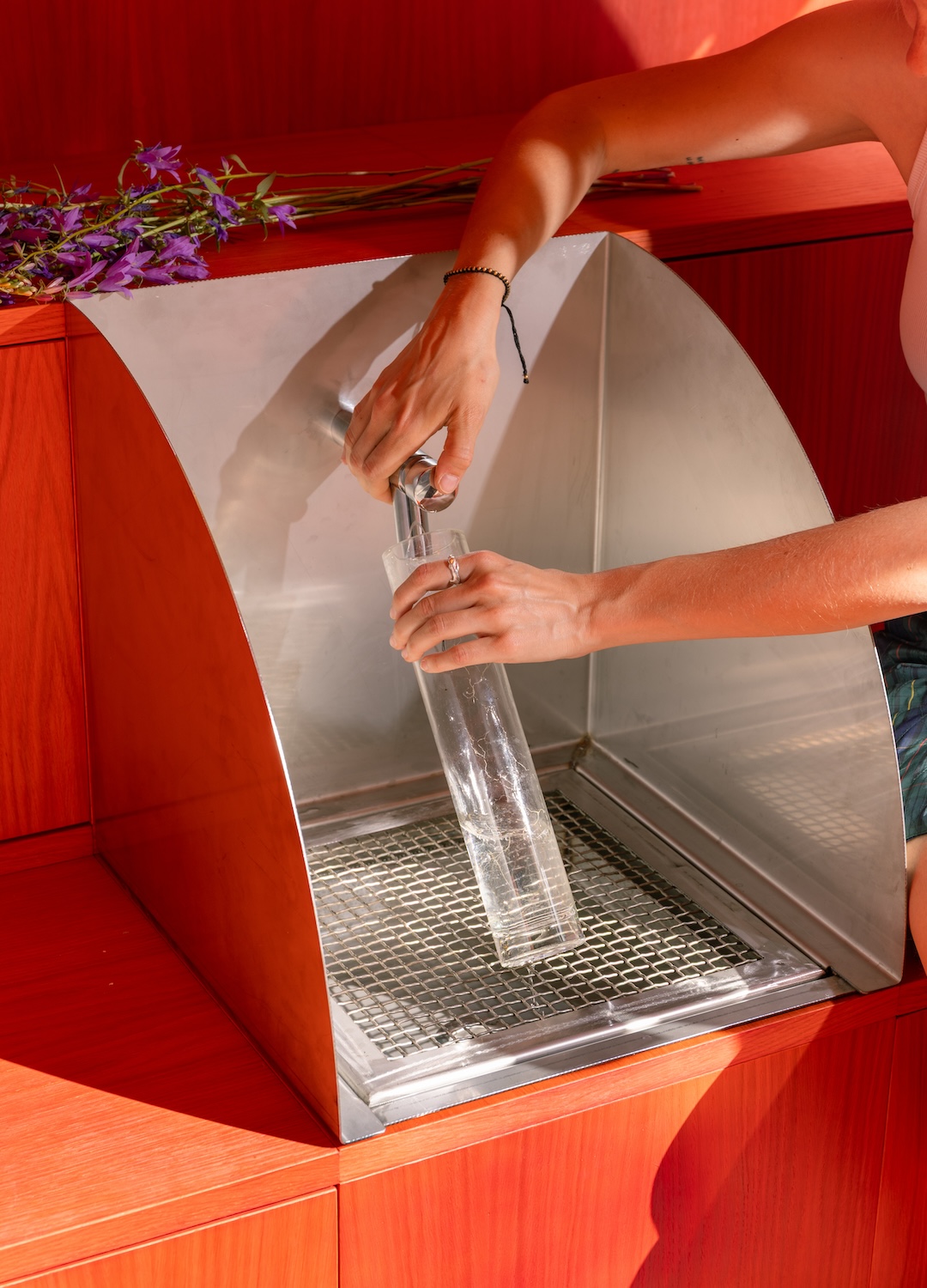
Edicola 518, Design Giuseppe Arezzi © Giovanni Emilio Galanello
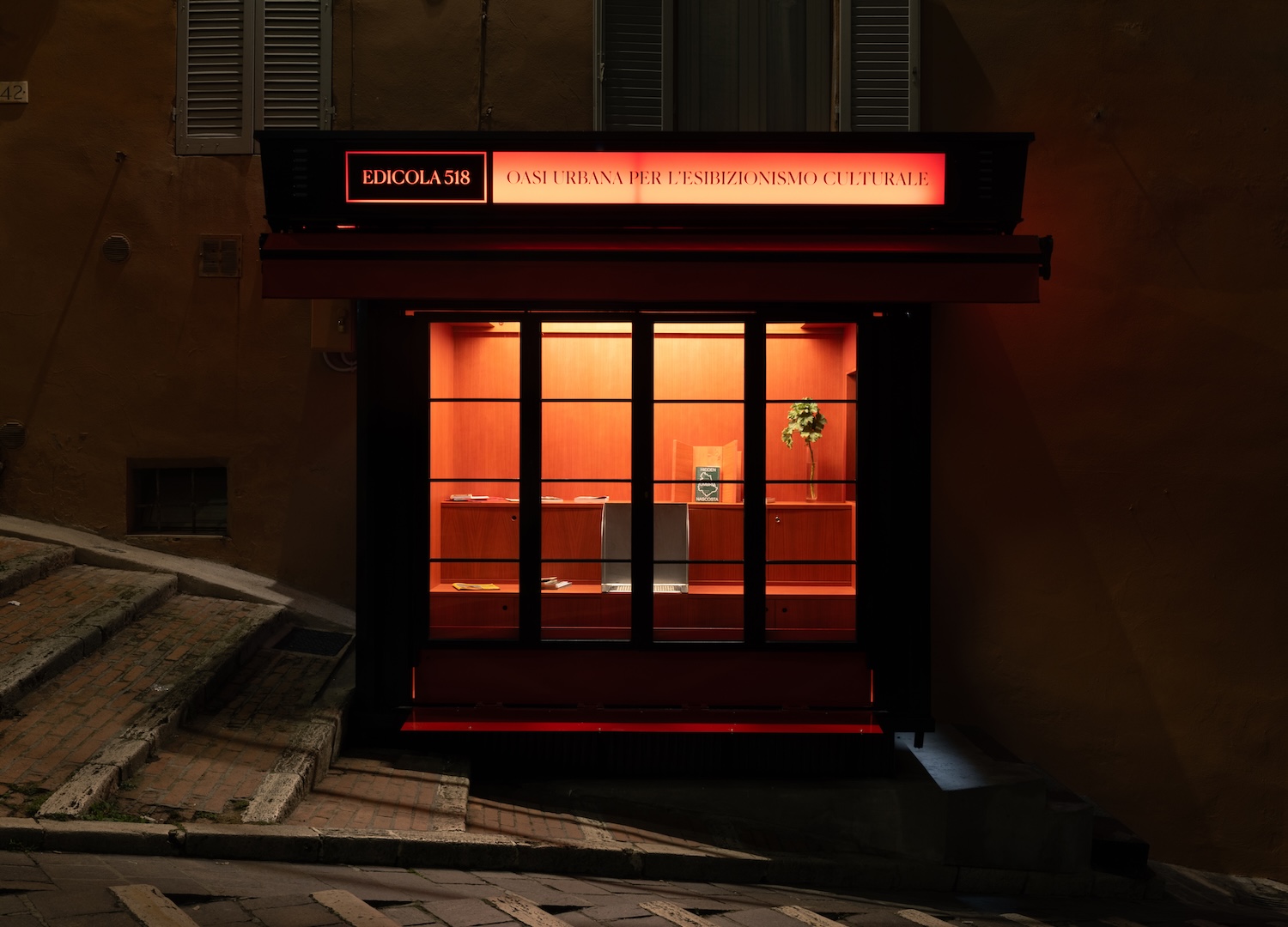
Edicola 518, Design Giuseppe Arezzi © Giovanni Emilio Galanello
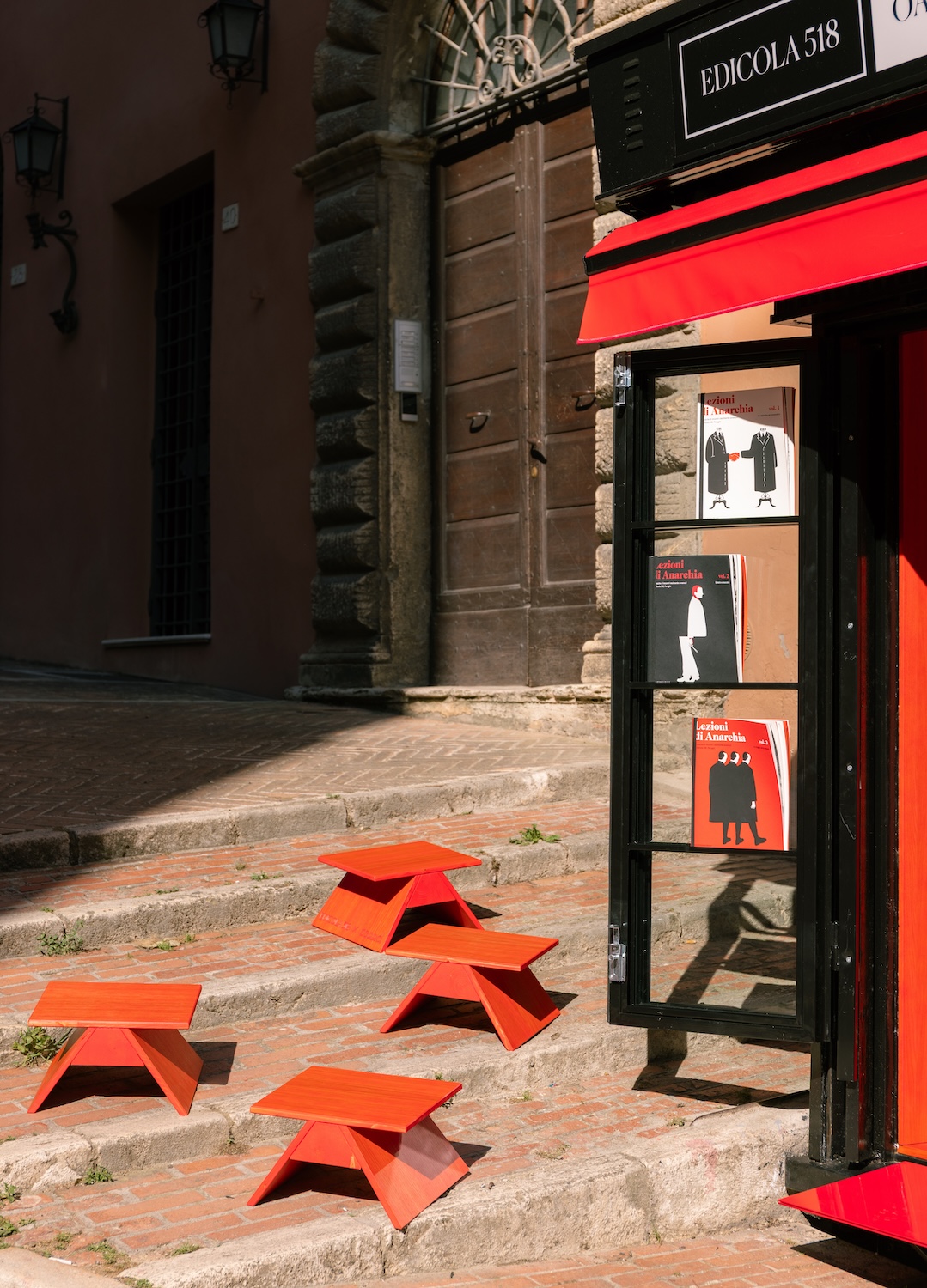
Edicola 518, Design Giuseppe Arezzi © Giovanni Emilio Galanello
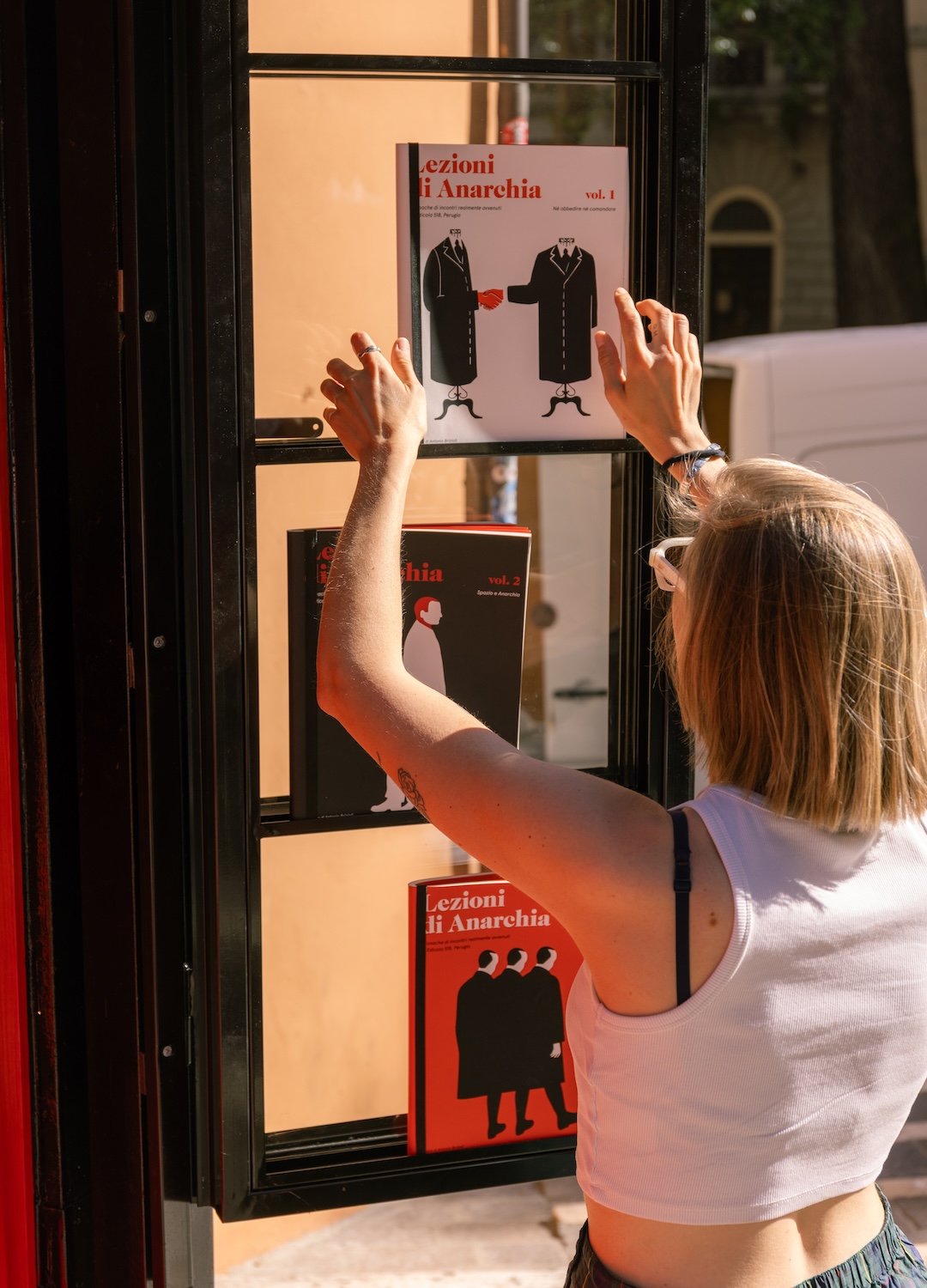
Edicola 518, Design Giuseppe Arezzi © Giovanni Emilio Galanello
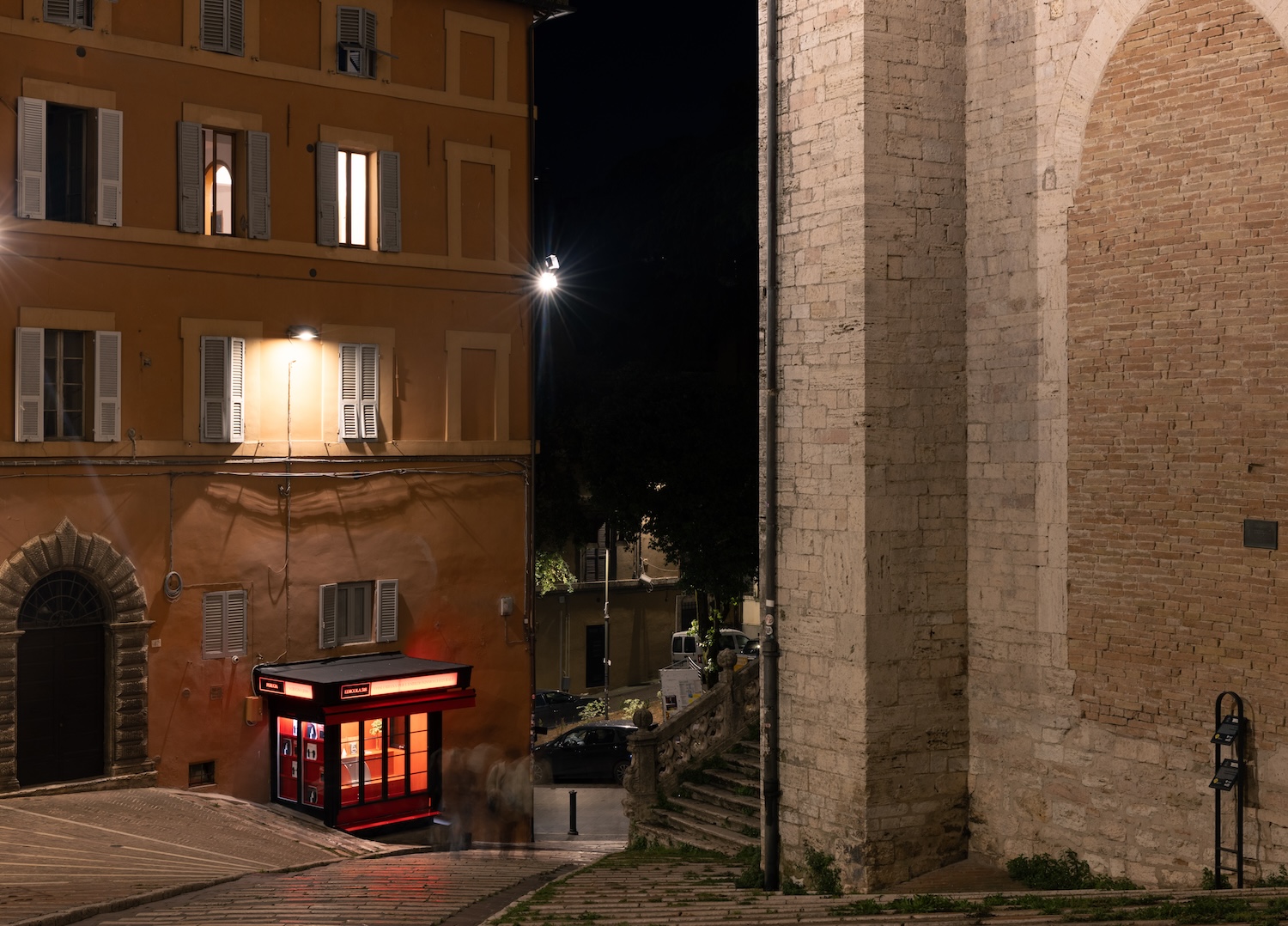
Edicola 518, Design Giuseppe Arezzi © Giovanni Emilio Galanello
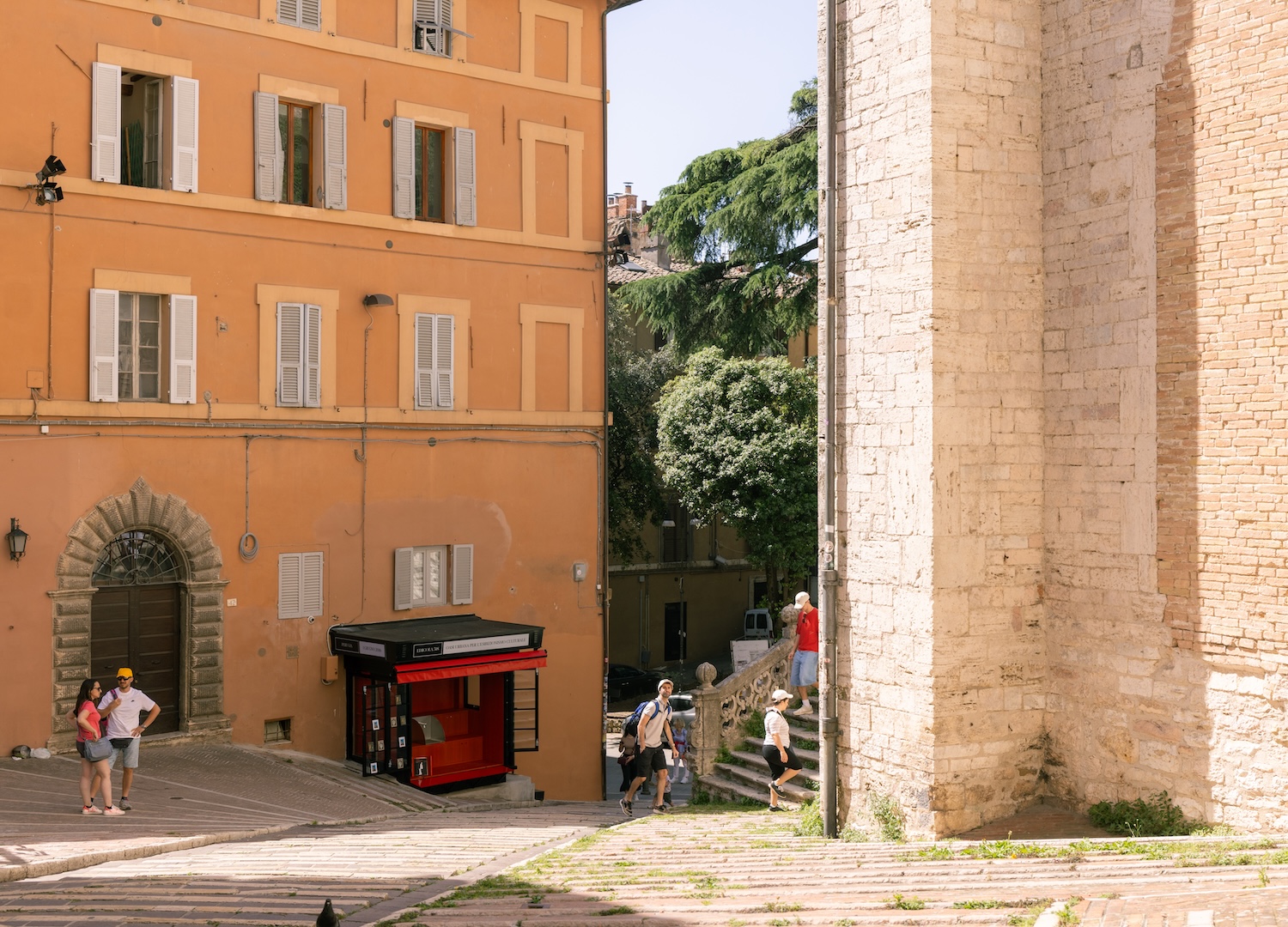
Edicola 518, Design Giuseppe Arezzi © Giovanni Emilio Galanello
Listening before building
When the Direzione Generale Creatività Contemporanea del Ministero della Cultura launched its open call Laboratorio di Creatività Contemporanea, Edicola 518 applied with a proposal titled L’Edicola che Vorrei – the newsstand I would want – and won. The result, designed by Giuseppe Arezzi, reopened on 1 June 2026, with the support of Seed Festival and Umbra Acque, is what Arezzi describes as an “urban oasis for cultural exhibitionism.”
But the brief itself, the new destination for this space, was not designed in isolation – over the course of the preceding year, the collective had mounted whiteboards across the city inviting passersby to write what they wanted from a public space. They ran a self-managed radio, organized improvisation workshops inside the kiosk, held open meetings on its steps, and the functions that eventually structured the renovation – rest, reading, water, self-organized gathering – were not imposed from above but extracted from a process of sustained public listening. Which means that the architecture here did not precede the community but followed it, a sequence that is less common in urban regeneration than it should be.
A kiosk turned inside out
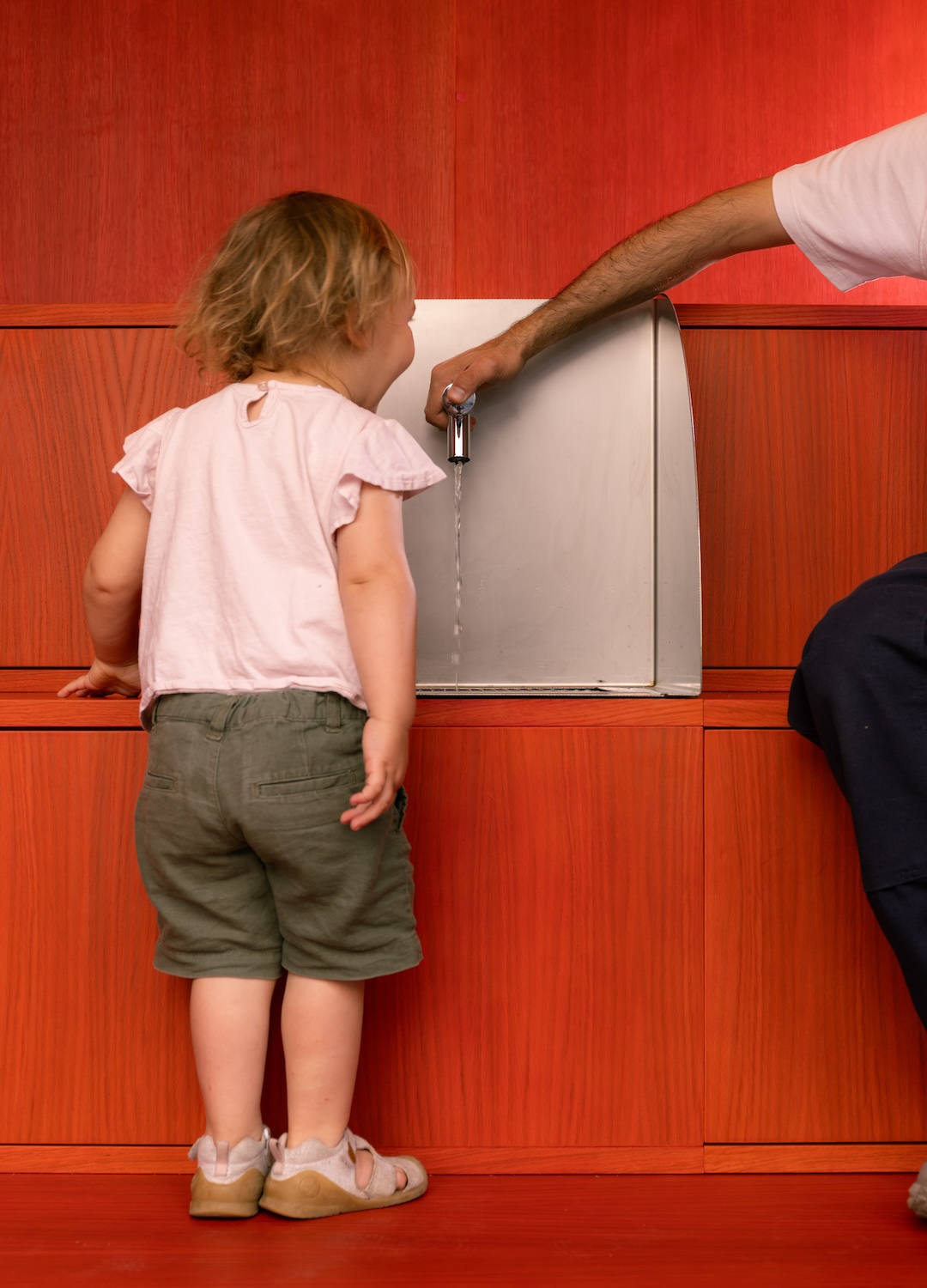
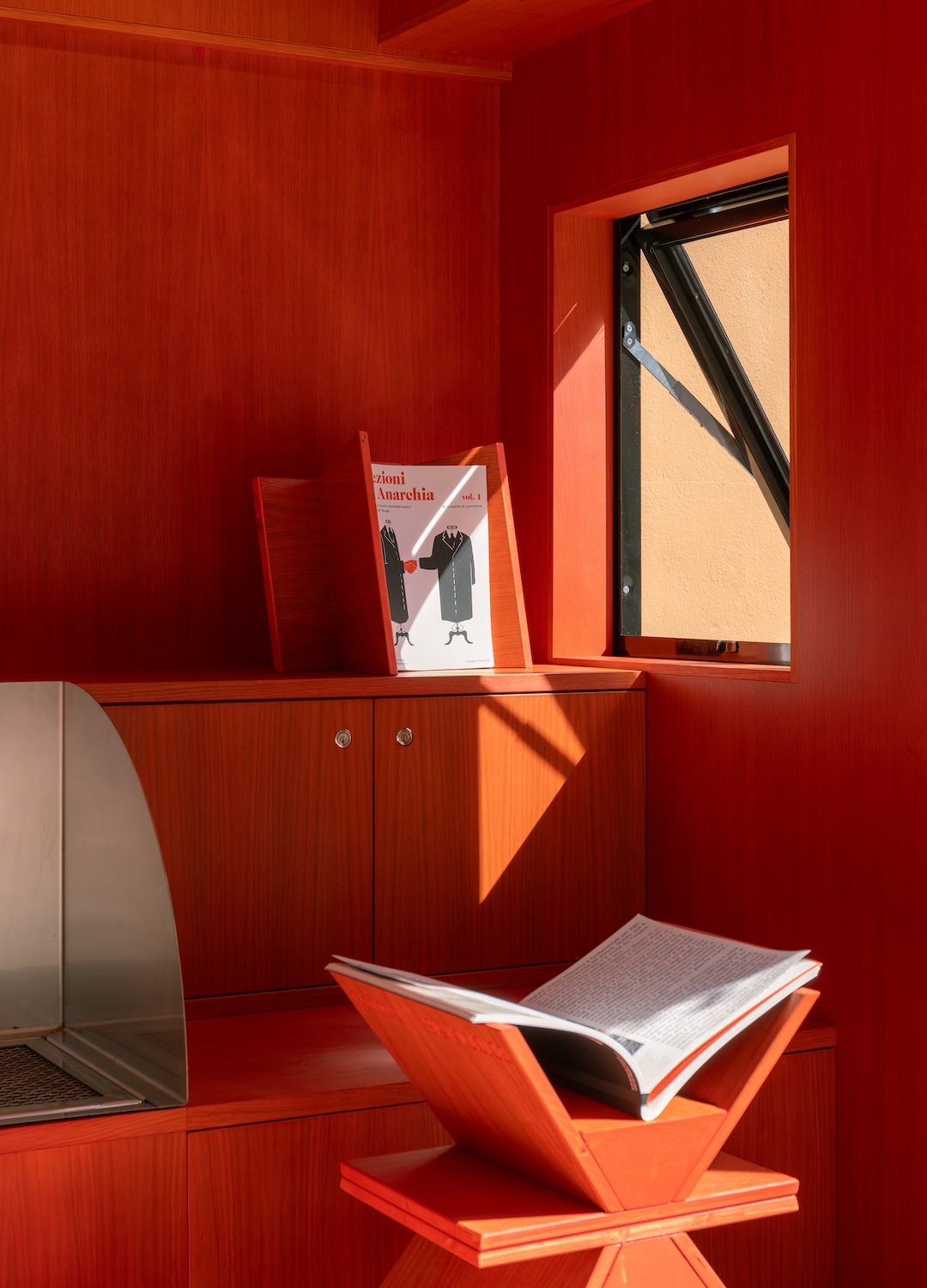
The intervention retains the existing shell – black steel frame, hinged glass panels, a projecting canopy in red – while radically reorganizing the interior logic. What was a closed transactional space has been turned outward: the folding glass doors open wide onto the staircase, collapsing the distinction between inside and outside and transforming the kiosk into a kind of inhabited stage. The interior is lined entirely in tinted wood panelling in a deep red-orange, a chromatic decision that makes the structure immediately legible from a distance and produces, at night, a warm glow that turns the kiosk into an autonomous signal within the medieval fabric of the city.
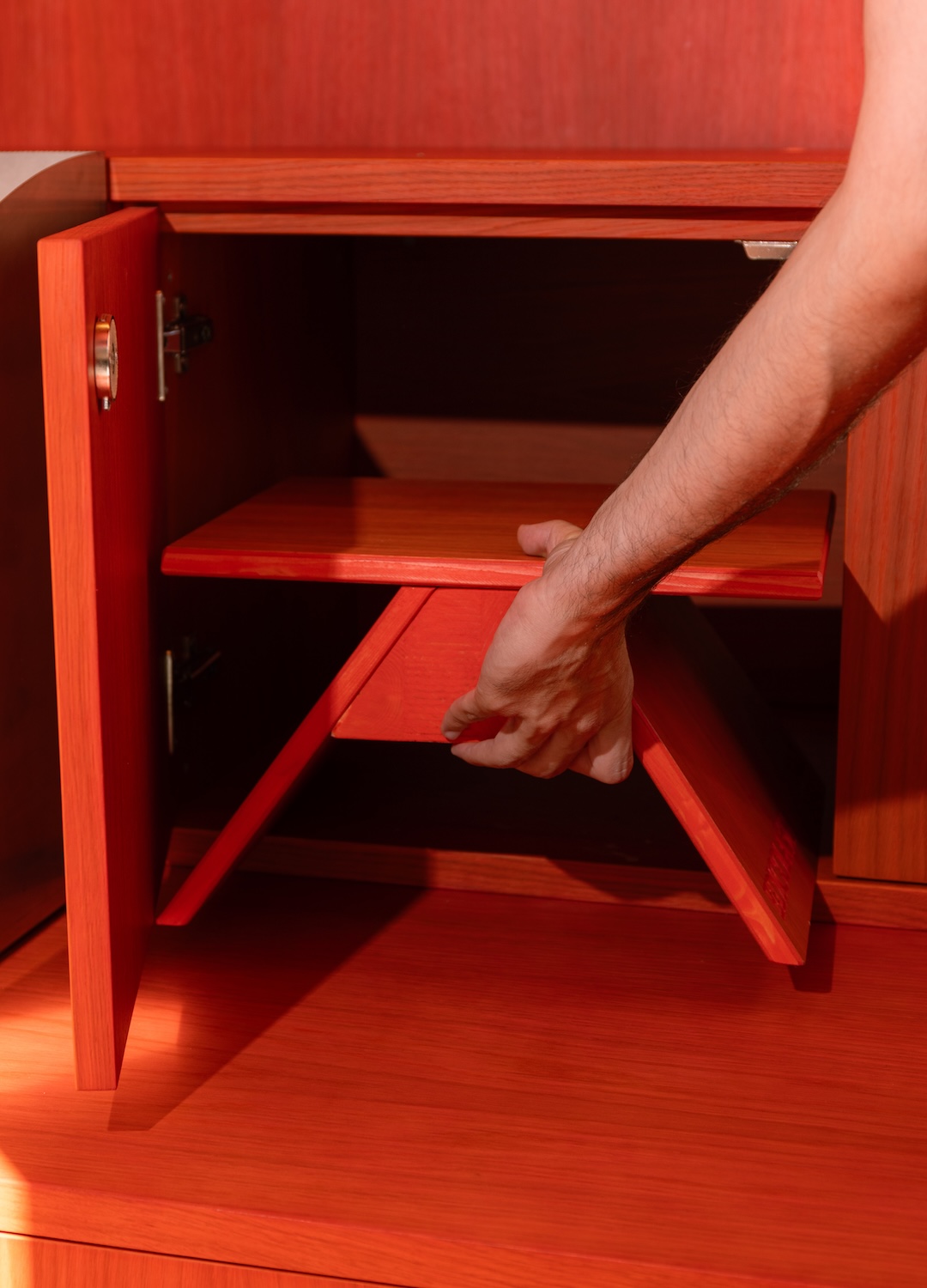
A compact stainless steel drinking fountain with an arched backplate occupies the centre of the bench unit. Folding stools in the same orange-red, stored inside the cabinet doors and deployed onto the steps when the kiosk opens, extend the space of use outward into the staircase itself, blurring the boundary between architecture and street furniture in a way that is less about formal invention than about restoring a kind of urban hospitality that most contemporary cities have quietly withdrawn.
On the rolling shutter, a mural by Nic Alessandrini depicts the head of Sant’Ercolano – an image that has already generated local controversy, and that ties the project to the founding history of its exact location in ways that mere proximity to a famous staircase does not.
The project continues Arezzi’s sustained research into minimum space and multifunctional furniture, a body of work that treats spatial economy not as a constraint to be overcome but as a design condition in itself, similar to the Existenzminimum of Alexander Klein and the rational theories of the beginning of the century, but in a more pop way. An idea that tends to produce objects and environments of greater relational density than their scale would suggest, but where every surface serves multiple functions and every element can also become something else.
And, in this new asset, Edicola 518 has abandoned commercial activity altogether – there is nothing for sale, because the space has been given to the city, in a renunciation of the retail model that is, perhaps, the most architecturally and politically precise gesture the project makes: the kiosk as public infrastructure, without qualification. A space meant to be and work as a space, and nothing else.
What makes the project relevant extends beyond the quality of its interior, however. Edicola 518 was already embedded within the rhythms of a specific neighborhood before the renovation began – it had an existing community of readers, an established curatorial identity, a decade of use behind it. The Laboratorio di Creatività Contemporanea open call provided the institutional and financial framework to deepen that presence architecturally, rather than displacing it with a generic cultural concept.
The risk of a model
It is a distinction worth making, because the model Edicola 518 helped establish has in the meantime been widely replicated – and in that replication a different logic has taken hold, one in which the independent newsstand becomes a vehicle for the valorization of residual urban space rather than a genuine reinvestment in public life. Former kiosks across Italy have been converted into branded pop-ups, micro-retail concepts and temporary cultural venues, exchanging one commercial function for another while the underlying scarcity of places where it is possible simply to be, without consuming, goes unaddressed. The gap between adaptive reuse and adaptive relevance, in other words, is not merely theoretical.
Reactivating these structures requires preserving an architectural object, but also reconsidering how information, community and public life can intersect within cities whose spatial organization is increasingly structured around consumption rather than use. Ten years in and newly reopened, this story suggests one way in which that reconsidering might begin – not with a spectacular gesture, but with the careful elaboration of something already there.