
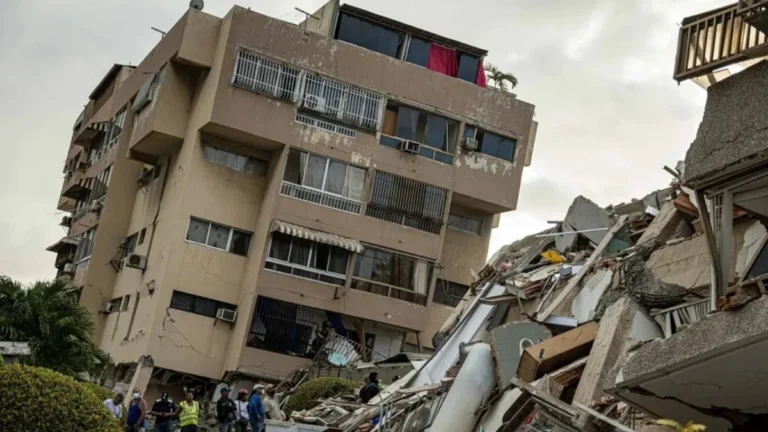
Experts say a rare seismic doublet, combined with shallow ground conditions, intensified infrastructure damage in northern Venezuela and highlighted the need to update seismic standards.
Rescue and assessment efforts continue after a rare seismic doublet caused widespread infrastructure collapse in northern Venezuela. Photo: EFE
July 5, 2026 Hour: 3:08 am
-
-
-
-
-
-
PDF
🔗 Comparte este artículo
Experts say an unprecedented shallow seismic doublet and local ground conditions intensified infrastructure failures in northern Venezuela.
A rare geological phenomenon known as a seismic doublet triggered the collapse of infrastructure in northern Venezuela on June 24 after the interaction of the Caribbean, South American and Cocos tectonic plates, according to geophysical experts.
RELATED: Venezuela Thanks NGOs Supporting Earthquake Response
The event consisted of two consecutive earthquakes measuring 7.2 and 7.5 in magnitude within less than 35 seconds, an unprecedented pattern in Venezuela’s recorded seismic history. The earthquakes prompted the immediate deployment of rescue operations, structural inspections and international humanitarian assistance.
Geological engineer and geophysicist Rodolfo Ayala Sánchez said the earthquakes resulted from the sudden release of energy that had accumulated for decades along the fault system crossing Venezuelan territory. “What has actually happened in Venezuela is what is known as the phenomenon of a seismic doublet,” Ayala said.
He explained that the first 7.2-magnitude earthquake acted as a precursor before the second, stronger quake struck less than 35 seconds later.
“This is a phenomenon that is normally unusual (…) based on previous records, it appears to be the first time it has occurred in Venezuela,” he said.
NASA satellite technology documented surface deformation and ground displacement of up to 40 centimeters along Venezuela’s northern coast. Ayala noted that a magnitude 7 earthquake releases “more than practically 1,000 times” the energy of a magnitude 5 event, causing “a large segment of pre-existing geological faults to move.”
He also noted that seismic hazard maps rely on probabilistic models with return periods ranging from 50 to 250 years, making it impossible to predict the exact timing of such events.
Geological Impact and Coastal Infrastructure Vulnerability
Experts said the scale of the structural damage was closely linked to the shallow depth of the earthquakes, which occurred at less than 20 kilometers below the surface, as well as local soil conditions.
“The soil in La Guaira is generally characterized by a shallow water table, meaning water is close to the surface, and the terrain is not rocky,” analysts explained.
They added that bedrock in some areas lies “sometimes 150, 300 meters or more” below the surface, creating conditions that amplified infrastructure failures.
According to the specialists, the age of many buildings—constructed 30 or 40 years ago when “current technologies and current construction standards did not exist”—as well as possible design shortcomings, also contributed to the damage.
At the same time, they stressed that soil quality remains a decisive factor because “very, very old buildings can remain standing if they have not been severely affected by the earthquake,” with ground conditions varying significantly even within the same city.
Experts identified rescue operations and the recovery of survivors trapped beneath collapsed structures as the immediate priority. They said the next phase should include comprehensive structural audits, revisions to Venezuela’s national seismic building code and seismic microzonation studies to guide future land-use planning.
“We must, without any doubt, update Venezuela’s seismic code (…) we must even envision much more complex scenarios such as the seismic doublet,” Ayala said.
The proposed measures include restricting construction in high-risk areas and strengthening hospitals, schools and energy facilities under the principle of “rebuilding better than buildings previously were.”
Specialists also projected a prolonged post-disaster recovery involving temporary shelters, the relocation of affected residents to safer areas and debris removal, a process they estimated could take between six months and one year.
Drawing on experiences from Central America, the Caribbean and Japan, they warned about the risk posed by aftershocks when structures with different levels of rigidity, such as adobe and reinforced concrete buildings, stand side by side. They also noted that solidarity networks in countries including Peru have begun organizing donations of construction materials for Venezuela.