
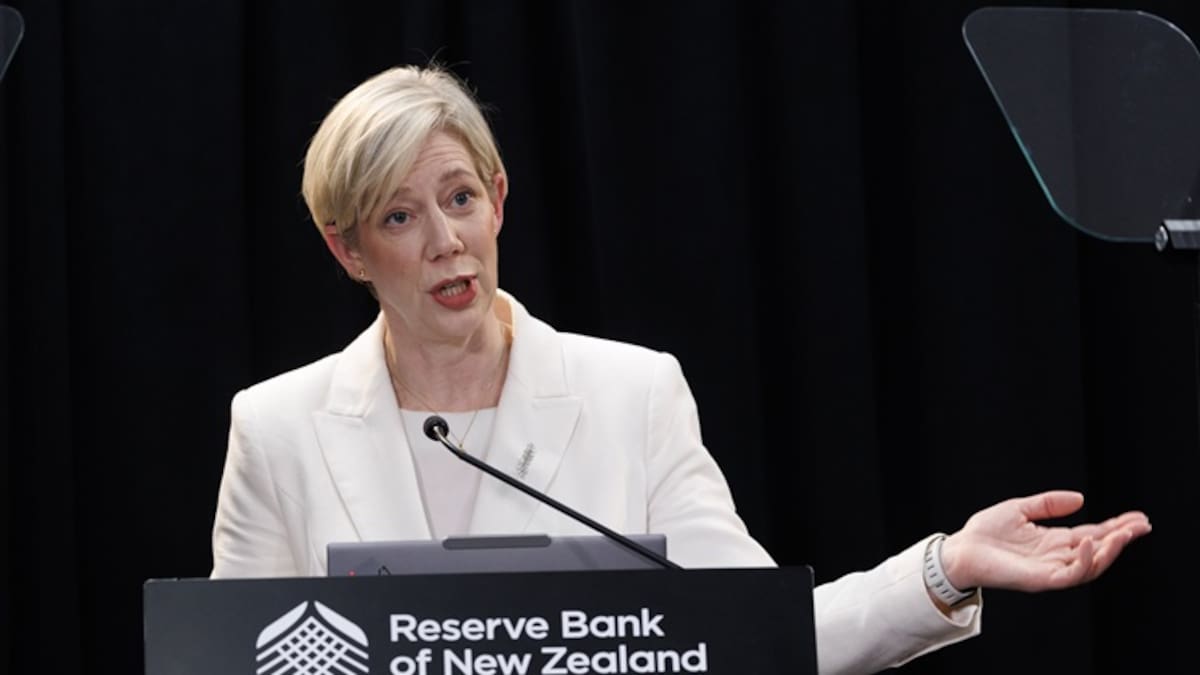
In the central banker world, boring is good, and I’m sure the RBNZ would prefer to be in a period of such inflationary stability that its next few calls were non-events.
But the Iran war and dramatic oil spike of the past few months have put paid to that.
While a hike looked like a near certainty after the May Monetary Policy Statement, fuel prices have fallen further than forecast and have taken some edge off the inflation risk.
Ultimately, this won’t just be a call about when we lift the OCR by 25 basis points; it will be an insight into how the current iteration of the RRBNZ monetary policy committee views inflation risk.
At the May meeting, the Monetary Policy Committee was split three/three on whether to hold or hike.
Governor Anna Breman cast a deciding vote to keep the rate on hold.
The division between economists is stark.
BNZ head of research Stephen Toplis said a hike was needed.
“We are strongly of the view the cash rate needs to get back to neutral relatively quickly to ensure stimulatory monetary policy does not add to inflation,” he said.
“When the cash rate hits neutral, then the RBNZ can ponder the nature of the inflationary pressure and determine what needs to be done next.”
The RBNZ has indicated it currently sees the neutral cash rate at 3%.
But Kiwibank chief economist Jarrod Kerr was every bit as convinced that the OCR should stay on hold for the foreseeable future.
“We’re not likely to see a wage-price spiral or demand-driven inflation. It’s simply a supply shock. It’s something that should simply be looked through,” he said.
Of course, views on what the RBNZ should and what it will do are very different things.
Given the RBNZ’s May forecasts suggested three rate hikes this year, even Kerr believes the OCR will rise, although perhaps not until September.
Markets currently have retained strong odds on a hike, pricing in a 75% chance.
But two major banks, ASB and Westpac, have also shifted their views to reflect the relatively rapid fall in fuel prices in the past few weeks.
What’s bugging young people about the economy?
If we need any evidence for why the past few years have seen an exodus of young Kiwis to Australia, new research from Deloitte offers it up.
According to the Deloitte 2026 Global Gen Z and Millennial Survey, the cost of living bites harder here for young people than almost anywhere surveyed.
The global survey polled more than 22,000 Gen Z and millennial workers on a range of topics, from AI use to workplace expectations.
But it was the cost of living that stood out as a major concern for New Zealand’s younger workers.
Some 56% of New Zealand Gen Zs name it their top worry, versus 38% globally – an 18-point gap.
To recap, New Zealand’s brain drain has been running high for the past few years.
In the June 2025 year specifically, 18 to 30-year-olds accounted for 27,200 (38%) of 71,800 departures, according to Stats NZ.
Housing concerns also appear to be taking a toll, with 72% of Gen Zs and 69% of millennials saying where they can afford to live is now dictating where they can work.
The survey also has 64% of New Zealand Gen Zs and 67% of millennials saying they’ve had to put off big life decisions – kids, marriage, buying a house, the lot – because they can’t afford them.
That’s well above the global average of 55% and 52% respectively.
For the record, the survey defines Gen Zs as those born from 1995 to the end of 2010.
It defines millennials as having been born between 1983 and 1994.
The survey has been running for 15 years and started with millennials but has progressively added Gen Zs as they joined the workforce.
Delayed decisions
Deloitte NZ partner Lauren Foster has been involved with the survey for a decade and said that gives her a good view of what has changed over the years.
“What it shows is a snapshot of how these generations are feeling when it comes to decisions that have an impact on their work life and how businesses need to adapt work to the expectations of millennials and Gen Z,” she said.
Foster said she has seen a sharp uptick in concerns about the cost of living in the New Zealand responses.
“About three years ago, as we had that uptick in inflation, New Zealand millennials and Gen Z definitely felt it and it’s remained high but steady since then,” she said.
One of the other key concerns highlighted in the survey was the concept that people were delaying major life decisions, she said.
“For things like getting married, buying a house, having kids, one of the drivers, at least from what the data in the survey says, is this cost of living because do you want to have a baby if you’re renting a house with a bunch of housemates?
“You know, you’re probably not going to make that decision. So it kind of pushes everything a little bit to the right for this generation.”
Given the demographic challenges facing New Zealand, an ageing population and declining birth rate, it seems this is an issue that could exacerbate our problems.
Attracting talent
Foster hopes the insight from this survey will help employers create work environments to address the issue.
“I would say that New Zealand millennials and Gen Z are still deeply concerned about the cost of living and their financial future both in the short term and the long term,” Foster said.
“And they are to the extent that it is changing some of the choices that they are making around their future. And therefore businesses have an opportunity to take that into account and maybe change some of their benefits programmes or maybe align better with some of the values in order to retain and attract that Gen Z.”
In fact, a feature that might offer some reassurance to younger generations is that the survey is primarily put together to help employers tailor their workplace offering to attract the best young talent.
That seems at odds with the current tough job market and high youth unemployment rate, but Foster points out that these things go in cycles.
“I’ve been talking to a number of HR leaders and I’ve been talking to a lot of people across the business world and they are still struggling to get good talent.
“What it might be is a mismatch. Maybe it’s these new skills, maybe it’s the AI.”
It can be tough out there if you’re not willing to upskill, learn new skills and lean into where the market is going, she said.
“The other thing, I know everyone loves this anecdotally, but I genuinely do feel that we lost quite a critical cohort of talent overseas.
“It’s not just Australia, it’s London, it’s wherever. But I think what we’re seeing now is that Australia is starting to be a little tight. London is getting outrageously expensive and so maybe we have an opportunity as a country to say, time to come home. We’ve got great opportunities here.
“You know, we really want great Kiwi talent to come back and build the next Trade Me, Xero, Henry, whatever it is. And I think we’ve got a great opportunity to do that here.”
Money printing madness
Q: Hi Liam
I am a 21-year-old who has recently finished university. In one of my final papers, I examined the relationship between commercial property prices and increases in the OCR.
During my research, I was spending a lot of time on the RBNZ Past Monetary Policy Decisions page and saw LSAP (Large Scale Asset Purchase) starting in March of 2020 and ending in July 2021.
To me, pretty obviously, QE [quantitative easing] is using a pseudonym. I have researched this and realised that this injection of liquidity reduced bond yields and increased asset prices and inflation.
I have a couple of questions in relation to this.
Is this type of crisis management worth it in the long run, as it increases government debt and inflation? And why is this not talked about in the financial media?
Regards,
Matteo
A: Hi Matteo,
You make some great points. I don’t doubt the amount of QE liquidity and debt that has been pumped into the world since the GFC looks mad to someone of your generation.
In fact, I know plenty of people my age who think it looks mad too.
The tally for US dollars created by the Federal Reserve between 2007 and 2022 is about US$8 trillion ($14t).
So far, only about US$2.4 trillion has been unwound.
“Inflation is always and everywhere a monetary phenomenon.”
If we take Milton Friedman’s famous line at face value then it’s not surprising we find ourselves in a higher inflationary world than we did before all the stimulus was unleashed.
In New Zealand, we didn’t get into QE (or a variation of it) until Covid.
We weren’t in the firing line for the worst of the GFC; our banks (Australia’s, really) held up well.
We got through a rough period (there were finance company collapses and the disastrous Christchurch quakes) with a mix of low interest and extra borrowing.
But by the time Covid hit, it was seen as much less unconventional monetary policy.
Our Reserve Bank had already done some preliminary research in 2018 as it faced the then-relevant issue of deflation.
So to some extent, when Covid hit it was ready to go.
The Reserve Bank ended up deploying $53 billion in large-scale asset purchases (LSAP) – tiny compared to the US but not insignificant for an economy with a GDP of $400b.
It is easy to look back with hindsight and say how terrible this policy was.
I broadly agree with those who think we did too much and kept stimulatory policies (both monetary and fiscal) for too long.
But hindsight makes it all look worse.
I was there (as a journalist) during the GFC and the Covid crisis.
I do want to make the point that both events were shocking and historically unprecedented in their scale.
Across the board, forecasts about what would happen when we locked down our economy proved to be grim.
We coped better than we thought we would.
Doing just the right amount of something is very difficult in the moment.
If your primary focus is heading off a catastrophe, then it logically makes sense to lean towards overdoing it rather than underdoing it.
I think that is what central banks did.
Unfortunately, reversing policy wasn’t as easy as they hoped.
But that wasn’t clear in early 2020 as the virus spread across the world.
What did we learn from it all?
Well, one thing is that QE really does work in a crisis.
The US financial system didn’t collapse in 2008. The US and New Zealand economies didn’t seize up in a pandemic.
Central banks do have the tools to stop economic collapse.
But I think we’ve learned that these tools should be levers of last resort.
I hope I’ll never have to see them used again in my lifetime.

Australian expedition
I’ll be away on holiday next week, so I won’t be filing a newsletter.
I’ll be visiting my daughter in Melbourne, so I will endeavour to find out what’s so good about the place.
Don’t forget to check out the Herald’s new podcast, The Economy of Everything, with Liam Dann and Tamsyn Parker – thanks to CMC Markets.
Liam Dann is business editor-at-large for the New Zealand Herald. He is a senior writer and columnist, and also presents and produces videos and podcasts.
He joined the Herald in 2003. To sign up to his weekly newsletter, click on your user profile at nzherald.co.nz and select “My newsletters”.
For a step-by-step guide, click here. If you have a burning question about the quirks or intricacies of economics send it to liam.dann@nzherald.co.nz or leave a message in the comments section.