
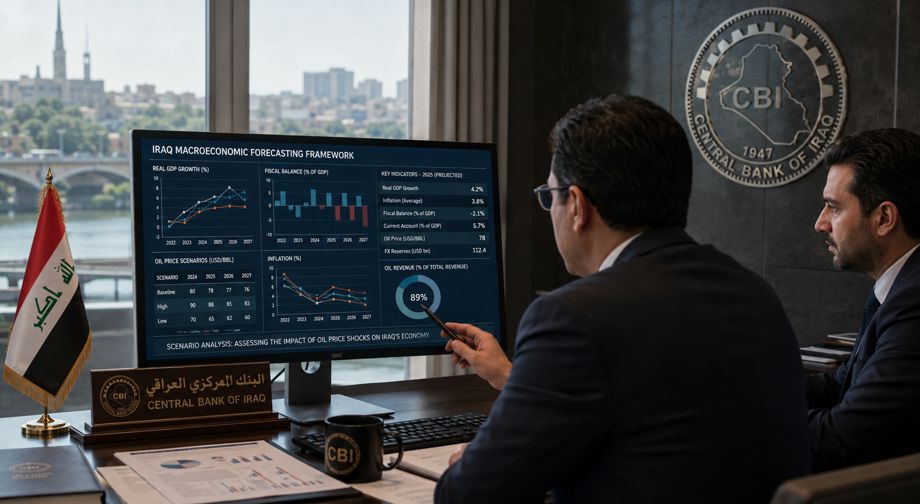
Iraq’s latest collaboration with the International Monetary Fund (IMF) marks more than a technical upgrade to the Central Bank of Iraq’s forecasting capabilities. It represents an important step toward building stronger economic governance in a country where oil continues to dominate public finances and macroeconomic stability. The IMF’s technical assistance programme, delivered through its Institute for Capacity Development (ICD) in partnership with the Middle East Regional Technical Assistance Center (METAC), has equipped the Central Bank of Iraq (CBI) with a customized Macroeconomic Foundations Tool (MFT) that enables policymakers to simulate economic scenarios, improve inflation and exchange-rate analysis, and better understand the transmission of oil price shocks across the economy. While the project focuses on strengthening institutional capacity, its implications extend far beyond the central bank, influencing fiscal planning, investment confidence, public finance management, and Iraq’s long-term economic diversification agenda.
Building a Stronger Policy Framework for an Oil-Dependent Economy
The IMF report underscores that Iraq’s greatest macroeconomic vulnerability remains its heavy dependence on oil revenues. Because oil exports finance the majority of government spending and foreign exchange earnings, fluctuations in global oil prices quickly affect fiscal balances, inflation, exchange rates, public investment, and economic growth. The customized MFT directly addresses this challenge by incorporating a dedicated oil-sector module that links oil production and prices with fiscal, monetary, external, and real-sector developments.
Unlike conventional forecasting models, the tool enables policymakers to simulate multiple economic scenarios, including sudden oil price declines, external demand shocks, or changes in fiscal spending. It also includes nowcasting capability using high-frequency data, allowing officials to monitor rapidly changing economic conditions rather than relying solely on historical statistics. This significantly strengthens evidence-based policymaking by enabling authorities to anticipate risks before they materialize.
For governments facing commodity price volatility, such analytical capacity is increasingly a prerequisite for maintaining fiscal discipline and macroeconomic stability.
Why Better Economic Data Matters for Iraq’s Development
One of the report’s strongest messages is that sophisticated forecasting models alone cannot guarantee better policymaking without reliable statistics. Iraq continues to face significant weaknesses in national accounts, particularly expenditure-based GDP data measured at constant prices. These gaps reduce forecasting accuracy and limit policymakers’ understanding of how household consumption, investment, government expenditure, and trade interact within the broader economy.
The IMF recommends stronger cooperation between the Central Bank of Iraq, the Central Statistics Organization (CSO), and METAC to improve quarterly and monthly economic data collection and modernize national accounts. Better statistical systems would allow more accurate projections of inflation, growth, fiscal balances, and external accounts.
For policymakers, stronger data infrastructure reduces uncertainty in fiscal planning and monetary policy. Development partners, including multilateral development banks and bilateral donors, also benefit because better statistics improve project appraisal, debt sustainability analysis, and programme monitoring. Reliable data further enhances transparency, an increasingly important consideration for sovereign credit assessments and international investment decisions.
Greater Coordination Could Unlock Investment and Private-Sector Growth
The report also highlights that forecasting improvements will generate their greatest value only if accompanied by stronger coordination across government institutions. It recommends closer collaboration between the Central Bank of Iraq and the Ministry of Finance so that macroeconomic projections incorporate the latest budget assumptions and medium-term fiscal plans.
Such coordination could significantly improve the quality of economic decision-making by aligning fiscal and monetary policies around common macroeconomic assumptions. More credible projections on inflation, growth, exchange rates, and government spending would reduce uncertainty for businesses and financial institutions.
For private-sector stakeholders, improved macroeconomic forecasting offers several advantages. Banks gain stronger signals for credit risk management, investors receive greater visibility into economic conditions, and businesses can make more informed decisions regarding capital investment, pricing, and expansion. Enhanced macroeconomic transparency may also strengthen Iraq’s attractiveness to foreign direct investment by reducing policy uncertainty and demonstrating improved institutional capacity.
Nevertheless, the report also warns of institutional risks. Significant staff turnover within the Central Bank’s forecasting team during 2023 temporarily slowed implementation of the project, illustrating how capacity-building efforts remain vulnerable when institutional knowledge is concentrated among a limited number of specialists. Sustained training and knowledge transfer, therefore, remain essential to preserving long-term gains.
A Foundation for Long-Term Economic Reform
Beyond immediate forecasting improvements, the IMF initiative provides Iraq with an institutional platform that could support broader economic reforms over the coming decade. Continued operational use of the Macroeconomic Foundations Tool, regular presentation of baseline and shock scenarios to senior management, and integration of the framework into routine macroeconomic reporting will help institutionalize evidence-based policymaking.
For international development partners, the project demonstrates how targeted technical assistance can produce long-lasting institutional improvements without requiring major financial investments. Rather than financing physical infrastructure, the programme strengthens the analytical capabilities that underpin sound fiscal management, monetary policy, and economic reform.
Looking ahead, policymakers should prioritize strengthening statistical systems, expanding high-frequency economic data collection, deepening collaboration between fiscal and monetary authorities, and continuously updating the forecasting framework to reflect evolving economic conditions. As Iraq gradually pursues economic diversification beyond hydrocarbons, the forecasting model can also be expanded to better capture the growing contribution of non-oil sectors.
Ultimately, the IMF’s technical assistance should be viewed as more than a forecasting exercise. It represents a strategic investment in Iraq’s economic institutions, improving the country’s ability to anticipate shocks, manage fiscal risks, support monetary stability, and build investor confidence. If combined with stronger data quality, institutional coordination, and sustained reform efforts, the initiative could become an important pillar of Iraq’s broader transition toward a more resilient, diversified, and sustainable economy.