
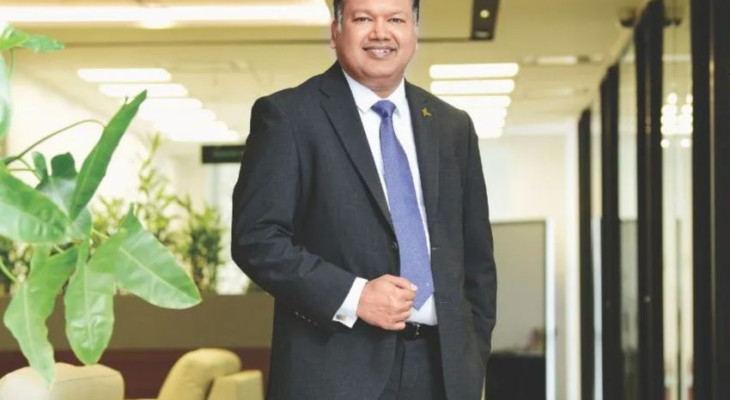
For centuries, glasses corrected a limitation quietly, without anyone noticing an industry had been built around it. Romal Shetty, CEO of Deloitte South Asia, opened his address with that image to frame a much larger argument: that disability inclusion, like vision correction before it, is not a charitable afterthought but the foundation of an entire market waiting to be built — deliberately, and fast at the Purple Economy White Paper launch by Deloitte and EnAble India.
“Spectacles and not one of us looks at a person wearing glasses and sees a disability. Yet that is exactly what glasses once corrected,” Shetty said. “The market caught up and the stigma disappeared. Glasses did that by accident over centuries. Today we’re here to do it on purpose and to do it in a decade, not centuries. And that is the purple economy.”
Moving disability out of the wrong column
Shetty’s central argument is that disability has long been misfiled in the national ledger — bracketed with welfare and compliance rather than growth. The report, built with EnAble India drawing on the organisation’s 25 years of work, attempts to correct that.
“For far too long disability has been placed in the wrong column of our national ledger. We filed it under welfare, under compliance, under charity,” he said. “This report… moves to where it belongs.”
He anchored the case in three numbers. The first: disability exclusion costs economies between three and seven percent of GDP, through lost productivity, suppressed consumption and talent left on the sidelines. “This is not really a social [issue], it’s actually a macroeconomic leak,” Shetty said.
The second number is 100 million — a conservative estimate of persons with disabilities in India. “100 million consumers, workers, entrepreneurs and innovators that the economy has not yet been designed to see,” he said.
The third is $150 billion — the addressable market in India today across healthcare, education, assistive technology, daily living and financial services. “This is not a projection for 2047. It exists right now,” Shetty said, adding that the global market for the same opportunity stands at $18 trillion. “This is not some small speck of dust, a small drop in the ocean. This is a pretty significant commercial enterprise that can happen.”
Proof from the ground
Anticipating skepticism, Shetty offered three examples of the Purple Economy already operating at scale in India.
The first was Namma Yatri’s Purple Rides, a ride-hailing service designed for persons with disabilities, addressing a segment traditionally ignored by mobility platforms. “In less than a year, over 1,14,000 users were served and more than 20 million rupees in additional revenue,” he said. “Accessibility here created a revenue line.”
The second was Thinkerbell Labs, which built Annie, a device that helps visually impaired children learn braille independently. “They did not treat disability as a niche. They treated it as a market,” Shetty said. “Revenue grew over 150 percent in a single year, expanding to more than 300 centers across 26 states and now going international. So accessibility created a company.”
The third was Torchit, which designs navigation devices for visually impaired users. “By treating persons with disabilities as customers, not as beneficiaries, they more than tripled their revenue and crossed one lakh users,” he said. “Accessibility created a growth business.”
For Shetty, the pattern across all three is the same one that has repeated throughout the history of design. “When you design for those facing the highest friction, you do not shrink the market, you expand it,” he said, pointing to the curb cut, the typewriter, the touch screen and the audiobook as accessibility solutions that became mainstream necessities.
Why India, why now
Shetty argued that India is uniquely positioned to build this market first, for three reasons: scale, infrastructure and ambition.
“No country has a larger population that stands to gain. 69 per cent of our persons with disabilities live in rural India, waiting for systems to reach them,” he said.
On infrastructure, he drew a direct line from India’s existing digital public goods to the report’s proposed framework. “Aadhaar gave identity, UPI gave payments, and the open network, which is proposed in this report, applies the same logic to participation. Credentials, registries, discovery,” he said, “so that a family in a small village does not spend years searching for a service that exists 50 kilometers away.”
On ambition, he tied the opportunity to India’s 2047 development goals. “Viksit Bharat 2047 cannot be built by leaving 100 million people outside the economy,” he said. “Participation is not a welfare goal. It’s a growth strategy.”
Deloitte’s own stake
Shetty was explicit that Deloitte is not positioning itself as a neutral observer of the trend it is describing. The firm has taken what it calls the Purple Pledge through an internal initiative, Project Raynier. “We’re building pathways for over a thousand women with disabilities into the workforce by 2047,” he said. “We’re participants in the economy, in this Purple Economy, and we’re inviting all of you to join us.”
He closed with a three-part call to action for the room: a pledge to make commitments visible, a pilot to redesign one product or service for participation, and a proof point to demonstrate results. “Show your industry that inclusion pays, because proof, not persuasion, is what moves markets,” Shetty said. “Intent becomes proof. Proof becomes standard. Standard becomes scale.”
His final line returned to the report’s central claim — that this is not a new economy, but a fuller view of the existing one. “I promise you this, that once you see the Purple Economy, you cannot unsee it,” he said. “India is not only for India. India is for the world. Why can’t we be the ones that actually build this for the whole of the world?”