

The biggest exams attract the most sophisticated leak networks
| Photo Credit:
SAHIBA CHAWDHARY
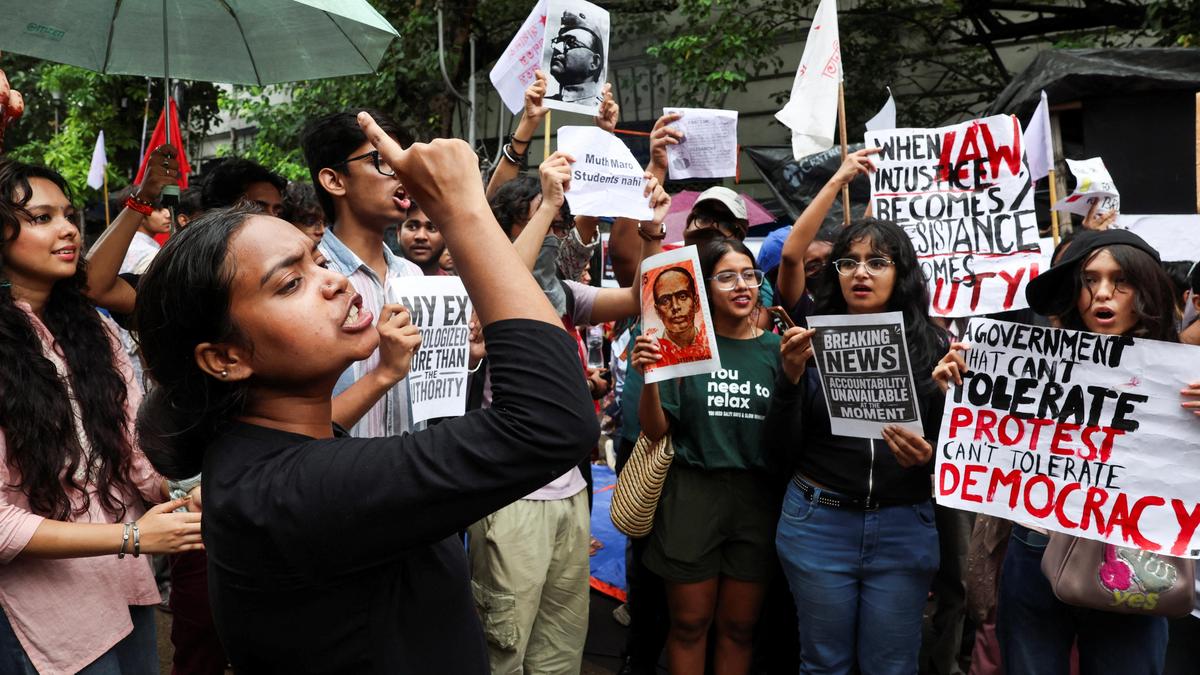
Sonam Wangchuk was carried out of Jantar Mantar on the 21st day of his hunger strike. As Parliament’s monsoon session opened this week, his movement’s march was met with teargas and its protagonist detained. Whether the education minister should go is not the central question — a minister on whose watch this happened twice, no doubt, owes an explanation. The larger one is: why does this keep happening, under governments of every stripe?
The list is grim. Vyapam in 2013. SSC’s Combined Graduate Level exam in 2018. Rajasthan’s REET and Uttar Pradesh’s Teacher Eligibility Test in 2021. Telangana’s TSPSC and Maharashtra’s Talathi recruitment in 2023. UP Police Constable and UGC-NET in 2024. NEET-UG twice: 2024 and again this May 2026. Some investigations count 89 cases over the decade affecting 6.5 crore aspirants. No party has a clean sheet; the failure is shared.
So what is actually going on?
Economists have a name for it. In 1967, Gordon Tullock explored what happens when a government creates something scarce and valuable like a licence, a job, a contract and lets people compete. Anne Krueger called it rent-seeking. People spend money, time, and risk until the cost of competing equals the prize’s value. Much effort creates no new value.
A government job in India is exactly this prize. Fixed in number, worth more across a working life than the informal economy offers. It provides a pension, protection against dismissal, and social standing that can alter a family’s prospects. Roughly 2.2 crore people apply each year; fewer than one in a thousand succeed.
The coaching industry built around this queue is worth close to ₹58,000 crore. Coaching and leak networks are not opposites but the same spectrum, priced differently. Coaching teaches concepts and fills schooling gaps. But much of its growth is about rank: spending to move ahead of the next candidate. Economically, this differs little from paying for a leaked paper. Both buy relative advantage. A leak is where legal spending turns illegal.
The prize need not be a job. NEET is an entrance exam for a medical seat. In 2024, 2.3 million aspirants competed for about 1.09 lakh MBBS seats; odds of twenty-one to one. Given the gateway to a medical career, that seat is worth stealing for the same reason a job is. This explains why the biggest exams attract the most sophisticated leak networks. Because these exams rank candidates against one another rather than against a minimum standard, the incentive to cheat rises with the gap between winning and losing. When 1.08 crore people applied for 32,000 Railway Group D posts last year, the Board was running a tournament where winning meant a stable life and losing meant a precarious one.
High rents create the incentive; weak institutions decide whether it becomes organised crime. China’s gaokao, sat by over nine million students yearly, has recorded only three confirmed nationwide leaks since 1949, achieved through paper-setters quarantined for months, armed convoys, signal jammers, and drones. South Korea grounds domestic flights for the Suneung’s listening test. Neither country has a smaller prize. What differs is the odds of being caught and the will to bear the costs of those measures. Replicating them in India’s federal, resource-constrained system would be expensive, but the question is whether the will exists.
When people offend
Becker’s economics of crime is blunt: people offend when expected gain exceeds expected cost, penalty times probability of detection. India’s 2024 law raises the penalty considerably; it raises the odds of detection far less. Better vetting, tighter paper custody, and prosecutions that conclude would do more than any new prison term.
Fairness is not the only casualty. When a weaker candidate takes a seat or post a stronger one would have filled, the harm is to a health system or police force now carrying someone less capable. A leak sorts by capacity to pay, not capacity to do the job. None of this makes honest preparation worthless; a doctor’s training produces something real. But Tullock’s warning was narrower: duplication, retakes, years chasing rank instead of competence. When 48 lakh people had each put in six months preparing for the cancelled UP Police Constable exam, that cancellation wiped out hundreds of millions of hours. A second cost is harder to price. An exam works only because it convinces millions that a scarce chance will go by rule, not favour. Every leak withdraws from that account. Enough leaks, and candidates stop asking how to prepare, and start asking whether preparing is the point. A system built to reward learning starts, quietly, rewarding access.
Encryption and prison terms alone will not fix this. What would shrink the prize is slower: a private labour market offering something closer to a government job, a pension, protection, wages that do not vanish. According to the PLFS Annual Report 2025, 73.1 per cent of non-agricultural workers are in informal enterprises.
Government jobs have become default insurance, not because they pay well, but because almost nothing else insures a certain life. In the interim, independent exam commissions, randomised paper allocation, and biometric verification would raise the cost of cheating.
Wangchuk’s fast will end within days, and the contest that makes leaking profitable will be exactly where it was. The problem is not that papers are stolen. Every leak begins in a printing room, but the market for it begins much earlier. It is in an economy where one examination decides who receives security and who does not. Until that changes, new encryption will only make the next leak more expensive, not less profitable.
Tiwary is a doctoral candidate, and Dayakar is an Assistant Professor, at Gokhale Institute of Politics and Economics, Pune. Views are personal
Published on July 23, 2026