
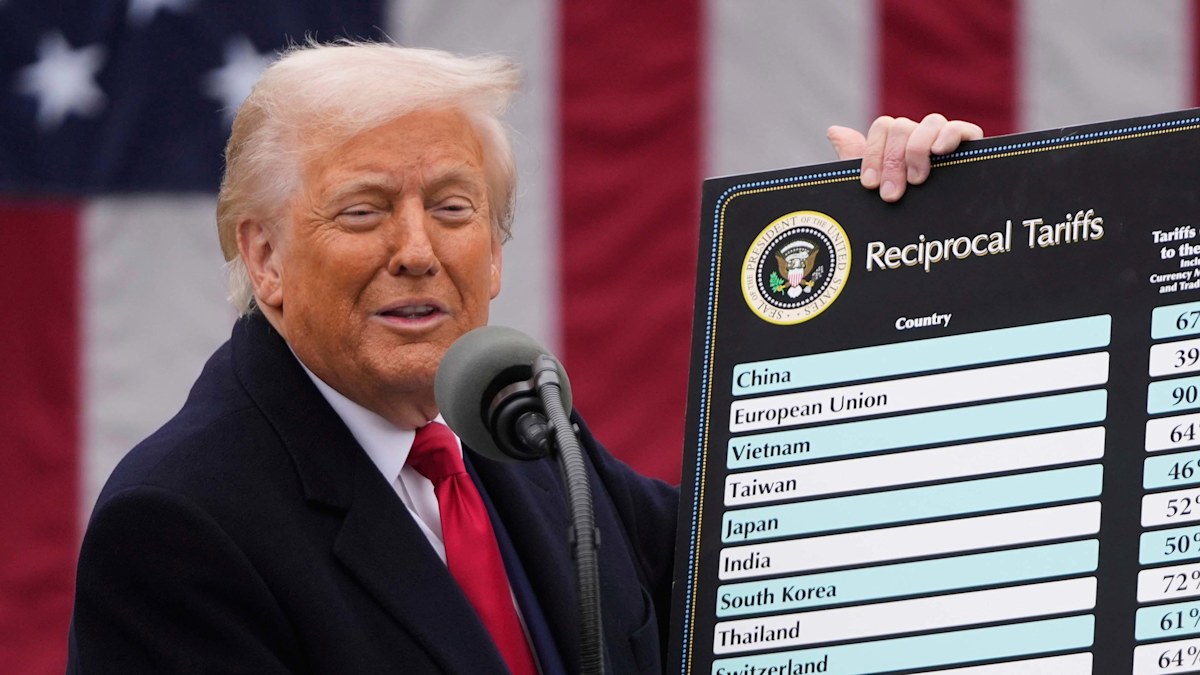
Australia has voiced its disappointment but boasted of its trade position after it was hit with a new round of tariffs by the Trump administration.
In an announcement on Friday, US Trade Representative Jamieson Greer said new import tariffs of 10 per cent to 12.5 per cent would apply to 60 trading partners around the world as the country frames the decision around the human rights issue of modern slavery.

Donald Trump’s administration has unveiled a new round of tariffs. AP
According to the documents provided, Australian imports will be hit with a 12.5 per cent tariff.
Australian Trade Minister Don Farrell said he was disappointed in what was an “unjustified” decision and defended the government’s track record on the issue of modern slavery.
“The Albanese government believes that this imposition of higher tariffs on Australia is completely unjustified, and we will continue to lobby the United States Trade Representative to remove all tariffs on Australian goods,” he told reporters on the sidelines of the Labor Conference in Adelaide.
Farrell, however, talked up Australia’s trade position, noting that exports to the US have increased by 67 per cent since Trump’s so-called Liberation Day in April 2025 and Australian trade reached a record figure of $1.32 trillion last year.
This is partly due to the tariff-free nature of Australia’s three major exports to the US – beef, gold and copper – and a 75-year record low of US cattle herd.
“Never in the history of Australia have we done so much trade, and this government, the Albanese government’s attempt to diversify our trade relationship, will continue,” Farrell said.
Australia boasts a comparative advantage on international trade on primary products, agriculture and critical minerals.
Farrell pushed back on fears that Australia would no longer benefit from that advantage due to Friday’s tariffs.
“I don’t think that significantly has changed because some 60 other countries, who we would consider to be our competitors, have also been subject to this increase in tariffs, so I don’t think the relative position of Australia has changed,” he said.
CNN reported that the latest round of tariffs would take effect from 12.01am Friday – going by Washington DC time, that would be 2pm AEST on Friday.
The announcement comes as a blanket 10 per cent tariff on all exports to the US was due to lapse after Trump’s initial policy was struck down by the Supreme Court.
“President Trump recognises that decades of moral suasion have not eradicated forced labour from global supply chain,” Greer said in a statement.
“The United States has had a forced labour import ban for nearly a century, and rigorously enforces it; it’s well past time for our trading partners to do the same.”
While the US is officially framing this as a human rights issue, other observers have viewed it as a workaround to global tariff imposition that won’t be viewed by the US courts as a presidential overstep.
These tariffs will be imposed under Section 301 of the Trade Act of 1974, which has previously been tested in the courts.
Trump’s “Liberation Day” presentation of “reciprocal tariffs” last year, however, relied on emergency presidential powers, which the Supreme Court ultimately struck down.
“The president is not going to allow his trade policy and overall objectives to be undermined simply because one tool may be limited by a court or something else,” senior White House officials told reporters, according to CNN.

There are exemptions for imports such as steel products. AP
Some countries will receive 10 per cent tariffs, including the UK, Canada, Mexico, and India, which the Office of the US Trade Representative says is due to them taking action on preventing forced labour.
“I am encouraged by the trading partners who have moved quickly to adopt forced labour import prohibitions, and look forward to ensuring their effective enforcement,” Greer said.
There are some exceptions for the blanket tariffs, including “articles of aluminium, of steel or of copper or derivative aluminium or steel articles”, as well as for some vehicle types, semiconductors, and other products.
Some countries have exemptions specific to themselves, but Australia is not one of them.
Australia did provide a submission during the US investigative process which began last year, laying out its own national anti-slavery laws, and again pointing to the US-Australia free-trade agreement.