

A study once claimed machine learning could pick winning mutual funds. It turned out the model had accidentally been given a preview of the future — take that away, and the result vanishes. Professional investment consultants have not consistently demonstrated an ability to spot winning fund managers in advance, and current evidence has not established that AI can pick winning mutual funds any better.
Buried in the code behind a much-cited finance paper sat a single character in the wrong place. Its effect was to hand the model a month it hadn’t earned.
A model choosing funds for February should know only what was on the record by the end of January. This one was shown February’s returns first, then asked to pick February’s portfolio. It picked well. Of course it did.
That one character was carrying a heavy load. It underpinned a 2023 claim in the Journal of Financial Economics that machine learning could build a real, tradable, long-only portfolio of mutual funds earning positive alpha after the costs the study modeled.
A word on terms. “AI” here means statistical machine-learning models, random forests and gradient boosting, trained on fund characteristics. Not a chatbot picking stocks.
That claim mattered well beyond academia. Peer-reviewed evidence that active management can be made to work consistently is precisely what the industry has lacked, and precisely what would undercut the old rules about active management.
What follows is what happened when an independent team tested the claim, how the original authors responded, and what the episode settles about the AI fund-selection pitches now landing in your inbox.
The Claim That Beat the Market
In 2023, a peer-reviewed paper in the Journal of Financial Economics reported that machine learning could identify long-only mutual fund portfolios earning 2.4 percent annual alpha, net of the costs the study modeled. Alpha being return above what the risk model predicts. A substantial number, and it earned the attention it got.
This was no pitch deck. Victor DeMiguel, Javier Gil-Bazo, Francisco Nogales, and André Santos, working across London Business School and three Spanish universities, had cleared peer review at one of the field’s most demanding journals. If the finding held, sophisticated prediction methods could do reliably, in advance, what most active managers have historically failed to do.
The authors did not hedge. “Our findings demonstrate that investors can benefit from active management,” they wrote, “but only if they have access to sophisticated prediction methods.”
The claim had been growing for a while. An earlier 2021 working paper from the same team reported after-fee returns on US equity funds as high as 4.2 percent a year over 1980 to 2018.
The Bug That Broke It
The 2.4 percent long-only claim stood for roughly two years. It stopped standing when six researchers, working from the original authors’ own published code, found a single line that let the model see next month’s returns before making this month’s decision.
Every backtest lives or dies by one principle: what a portfolio holds in any month can draw only on information available at the time. This code broke that rule in the smallest way imaginable. Where it should have pulled the current month’s fund returns, it reached forward and pulled the following month’s instead. In the code itself, the difference is a single character.
Jürg Fausch, Moreno Frigg, Thomas Johann, Emil Mussbach, Christian Westheide, and Wolfgang Drobetz laid the two versions side by side in their replication paper as Algorithm 1 and Algorithm 2.
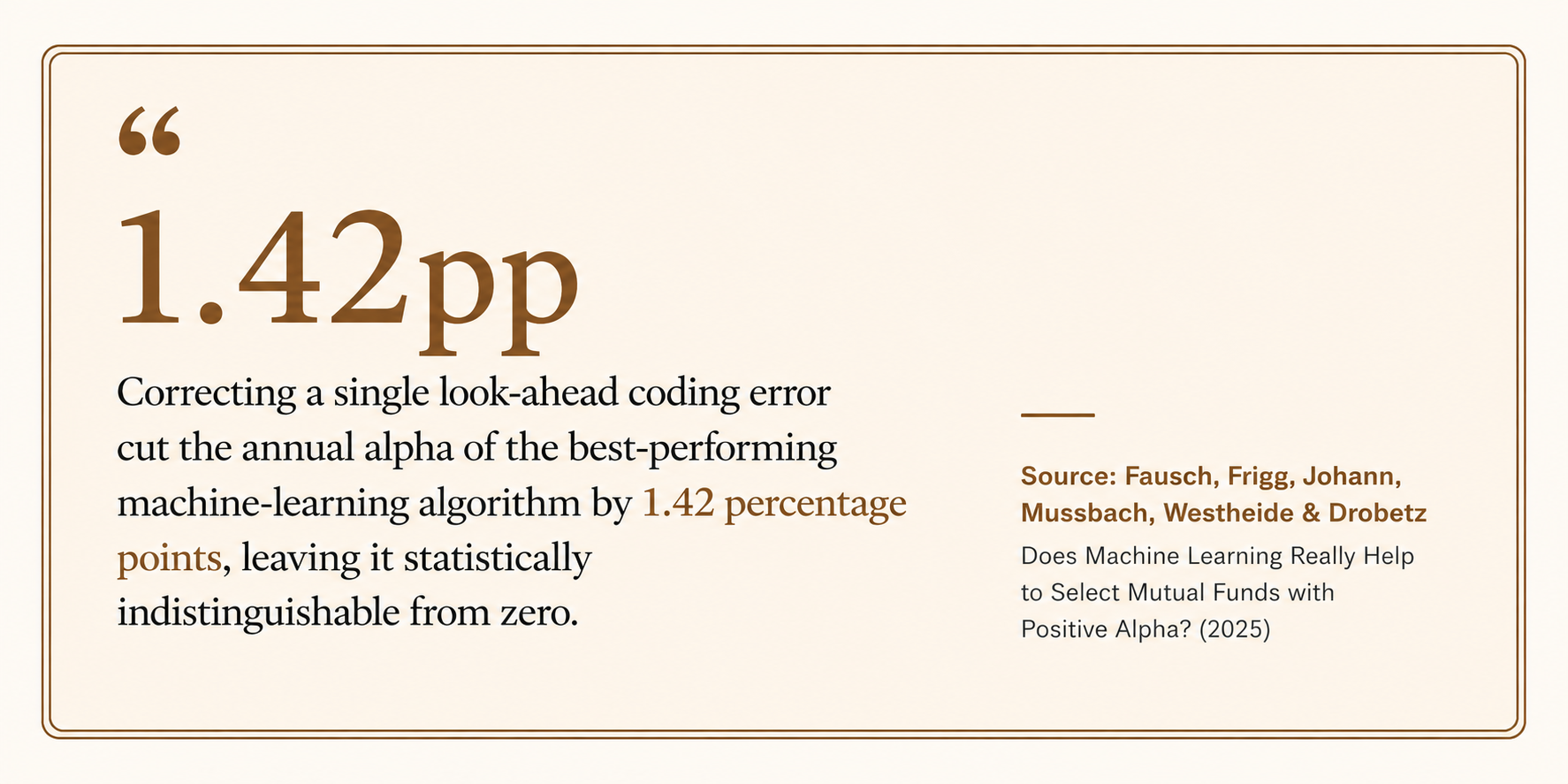
Correcting it took the results apart. Annual alpha for the two best-performing methods, gradient boosting and random forest, fell by 1.37 and 1.42 percentage points. The resulting t-statistics of 1.14 and 1.29 were too small to rule out chance at conventional thresholds, so neither result cleared the bar for statistical significance. “Correcting this error eliminates the statistical significance and reduces the annual alpha by 1.42 percentage points for the best-performing ML algorithm,” the replication team wrote. They found a survivorship bias in the data too, which they called less impactful.
The cumulative figures show the gap most clearly. Over 1991 to 2020, the original paper reported abnormal returns of 78 percent for random forest and 69 percent for gradient boosting. With the bug fixed, the same portfolios returned 34.77 percent and 27.50 percent. Under half, both of them.
One point here matters as much as any number. This was findable because DeMiguel and his co-authors published their code. That is the system working, not a takedown.
The Machine Wasn’t Needed
The coding error is the memorable part of this story. The stronger argument questioning whether AI at all comes from what happened next.
Once the look-ahead bias was removed, a regularized linear method called elastic net matched the more elaborate machine-learning models. In the corrected results it produced a long-short annual alpha of 3.58 percent, ahead of gradient boosting at 3.05 percent and random forest at 3.00 percent. The nonlinear methods held an advantage only at the 36-month forecast horizon, not at 12 months, so this is no claim that simple always beats complex.
It is a claim about what the complexity was buying, which for an investor being sold sophistication is the question that counts. On the one job these models could still do after correction, the technology marketed as cutting-edge performed similarly to decades-old statistics.
The Part That Survived, and Why It Doesn’t Help You
What survived correction was a long-short spread: buy the predicted winners, short the predicted losers. That is a different strategy from the long-only portfolio the original paper had promised.
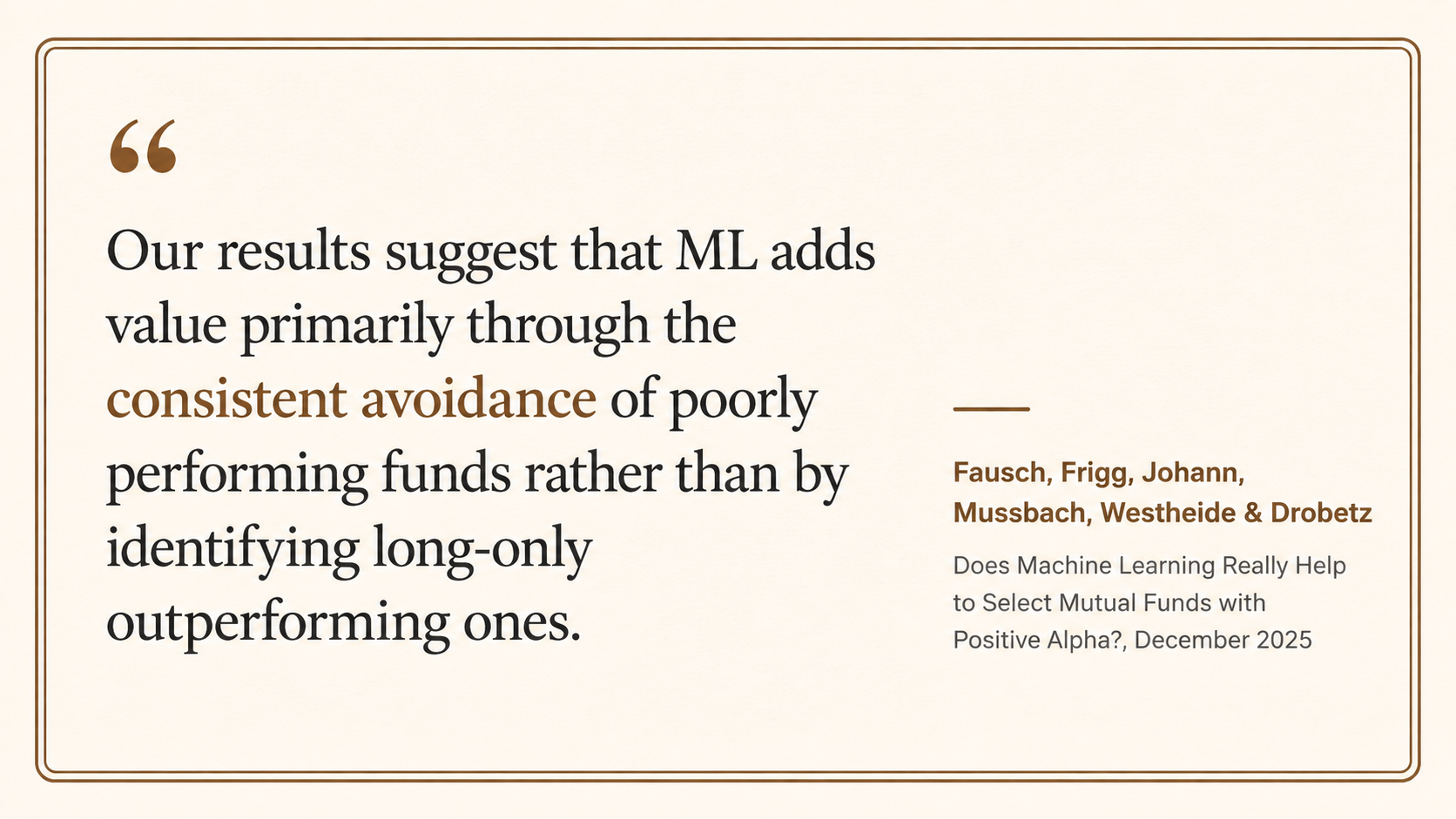
The alphas were real. Random forest returned 3.00 percent, gradient boosting 3.05 percent, elastic net 3.58 percent. They were also concentrated almost entirely in the short leg. The models earned their keep by betting against losers.
Capturing that requires shorting the funds, and here the practical wall goes up. Open-end mutual fund shares aren’t traded between investors on an exchange. As the SEC’s investor education material explains, investors buy and sell them “from/to the fund itself or through a broker or investment adviser, rather than from/to other investors on national securities markets.” No secondary market, no borrow market. And without a borrow market, an ordinary investor has no practical way to short.
The limitation isn’t unique to one paper. Ron Kaniel, Zihan Lin, Markus Pelger, and Stijn Van Nieuwerburgh reported a long-short spread of roughly 40 basis points a month from a neural-network model in a 2023 study in the same journal. A separate study, untouched by this dispute, and subject to the same constraint.
One workaround is worth closing off. The underperformance signal traces to characteristics like past alpha, expense ratios, and factor loadings, inputs that exist only for actively managed funds. An investor who has already chosen evidence over opinions and holds low-cost index funds has no active roster left to screen.
The Comeback
In June 2026, the original authors accepted the coding error and reported that three changes to how the long-only model was built brought a significant positive result back, using the same data.
They did not retreat. Posted on 06/18/2026, their corrigendum states that “although correcting the error eliminates the originally reported long-only alpha, we show that the original result can be restored by refining the estimation procedure.” Three changes do the work: a quarterly rather than annual training panel, which supplies more observations to train on; Bayesian optimization for hyperparameter selection; and quarterly rather than annual rebalancing.
What has been established and what hasn’t both need saying. No numerical tables from the corrigendum are publicly available, so there is no corrected alpha figure to report. No journal correction or editorial note has been issued. No independent team has yet replicated the new specification.
Then there is the sentence in the corrigendum that ought to travel furthest. The authors’ revised conclusion is that machine learning helps select positive-alpha funds, but only for investors with sufficiently sophisticated data and prediction models.
That is their own framing, and it is worth sitting with. It does not describe a retail investor with a brokerage account and a fund screener. It does not describe most advisory firms either. The strongest recent academic case that AI can pick winning mutual funds now arrives with a condition attached that excludes almost everyone who might want to act on it.
What’s Being Sold to You Right Now
None of this has slowed the marketing. AI-branded platforms and funds are still sold on the strength of predictive capability, and regulators have already had to step in.
Before asking whether an AI model works, investors may wish to consider whether the firm is using the model it claims to use at all.
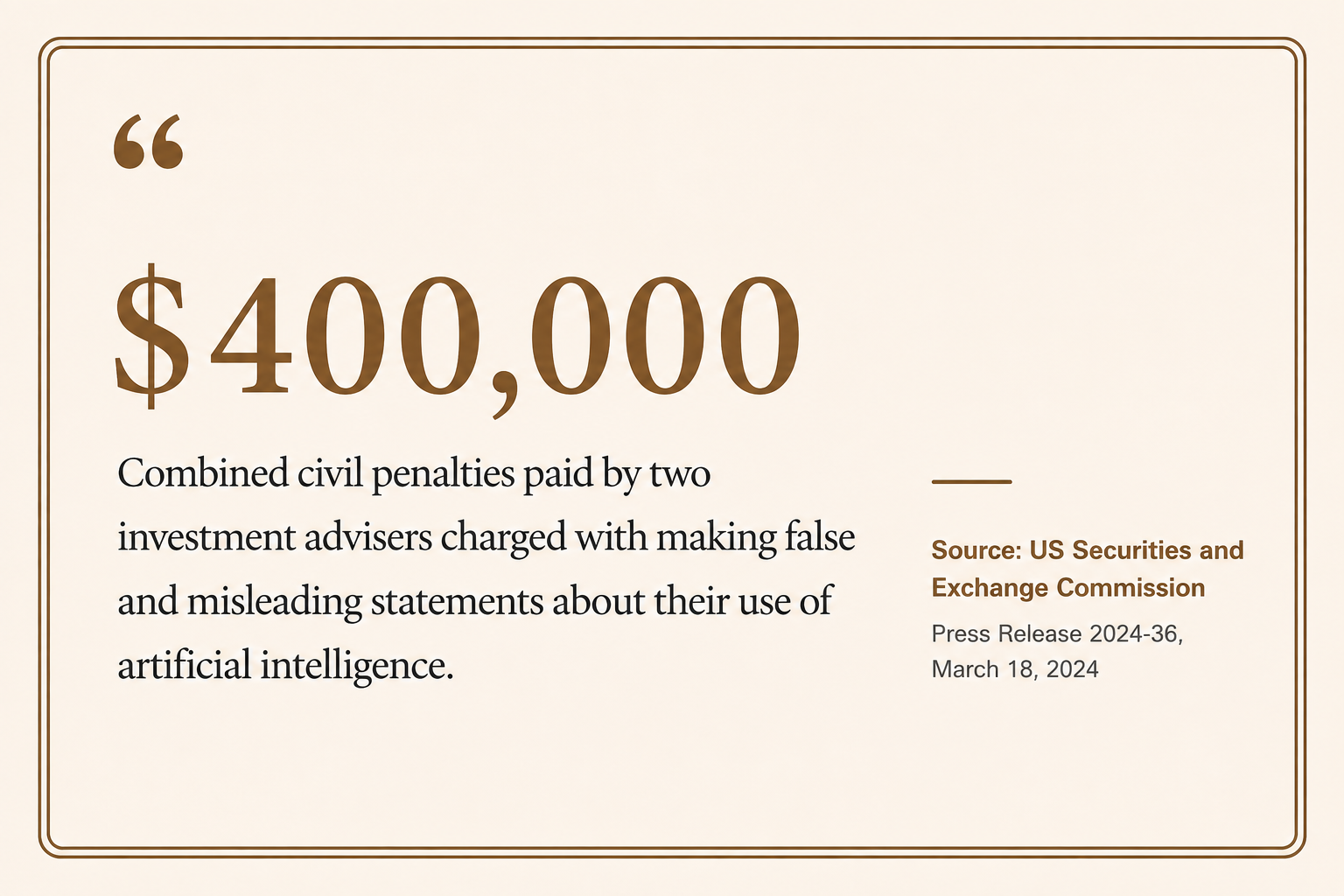
In an enforcement action announced on 03/18/2024, the SEC charged two investment advisers with making false and misleading statements about their use of artificial intelligence. Delphia (USA) Inc. had claimed it “put[s] collective data to work to make our artificial intelligence smarter so it can predict which companies and trends are about to make it big and invest in them before everyone else.” Global Predictions, Inc. had described itself as the “first regulated AI financial advisor” offering “expert AI-driven forecasts.” The SEC found neither firm had the capabilities it claimed. Delphia paid a civil penalty of $225,000 and Global Predictions $175,000, both settling without admitting or denying the findings.
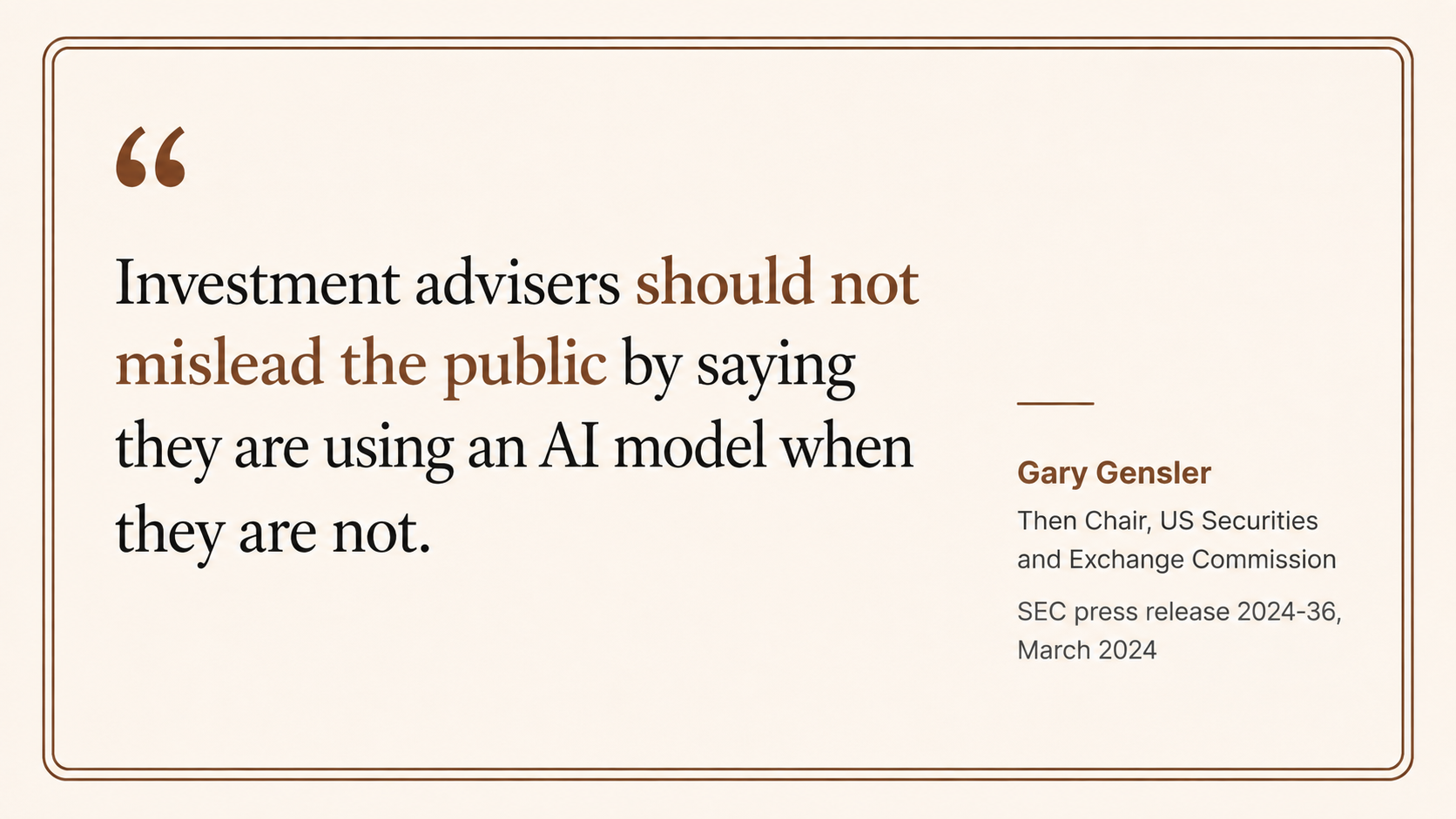
“Investment advisers should not mislead the public by saying they are using an AI model when they are not. Such AI washing hurts investors,” said SEC Chair Gary Gensler.
Two settled enforcement actions don’t indict a category, and the paper examined here is a different matter altogether: a real model with a real error, produced by researchers who published their working. But the two share a lesson. The standard of proof applied to that paper, publication and replication and scrutiny and a response from the original authors, and still no durable answer, is one that almost nothing sold under an “AI-powered” label has faced.
The Question AI Still Hasn’t Answered
A recent claim that machine learning could support active mutual fund selection has now been challented in a subsequent analysis and remains subject to ongoign debate.
None of this means machine learning is worthless in finance, or that the DeMiguel team is wrong. It means the evidence examined here does not establish a durable, investable advantage for ordinary investors. The original long-only result failed once the look-ahead error was corrected. The revised result may fare better. It still needs independent testing.
Which brings us back to that single character. The model looked brilliant because it had been handed a glimpse of the future. Take the glimpse away and the brilliance goes with it.
There’s a quieter alternative that needs no glimpse at all. A low-cost, globally diversified portfolio, as advocated by many evidence-based investors, makes no forecast about which manager will shine next year, so it can’t be wrong about one. It won’t spare you falling markets. But it doesn’t ask you to be right about a manager.
So, can AI pick winning mutual funds? Nothing examined here shows durably that it can. That’s a question worth following. It isn’t one you need to answer.
Resources
DeMiguel, V., Gil-Bazo, J., Nogales, F. J., & Santos, A. A. P. (2023). Machine learning and fund characteristics help to select mutual funds with positive alpha. Journal of Financial Economics, 150(3), 103737.
DeMiguel, V., Gil-Bazo, J., Nogales, F. J., & Santos, A. A. P. (2021). Can machine learning help to select portfolios of mutual funds? (Universitat Pompeu Fabra Economics Working Paper No. 1772).
Fausch, J., Frigg, M., Johann, T., Mussbach, E., Westheide, C., & Drobetz, W. (2025). Does machine learning really help to select mutual funds with positive alpha? (SSRN Working Paper No. 5937794).
DeMiguel, V., Gil-Bazo, J., Nogales, F. J., & Alves Portela Santos, A. (2026). Corrigendum: Machine learning and fund characteristics help to select mutual funds with positive alpha (SSRN Working Paper No. 6860698).
Kaniel, R., Lin, Z., Pelger, M., & Van Nieuwerburgh, S. (2023). Machine-learning the skill of mutual fund managers. Journal of Financial Economics, 150(1), 94–138.
DISCLOSURES:
This article is for informational purposes only and does not constitute investment advice, an offer, or a solicitation to buy or sell any security. This material includes general educational information and should not be interpreted as individualized investment advice or a recommendation to take any specific action. Past performance is not indicative of future results. All examples and data cited are based on historical analysis and may not reflect future market conditions. Investing involves risks, including the possiblity of loss and principal. The mathematical principles and academic research discussed illustrate theoretical and historical concepts and should not be interpreted as guarantees of investment outcomes. Diversivication does not ensure profit or protect against loss.
References to academic studies represent the findings and conclusions of the cited authors and do not constitute endorsements of any investment strategy or prediction model.
Any discussion of regulatory actions is based on publicly available information and should not be interpreted as representative of industry-wide practices. There is no guarantee that reducing turnover or fees will result in improved investment outcomes.
The information discussed is general in nature and may not be suitable for all investors. Examples and studies cited reflect specific time periods and may not be representative of all market conditions or investor experiences. Individual circumstances vary, and readers should consult a qualified professional regarding their personal situation. Index Fund Advisors, Inc. (IFA) believes the information to be accurate but does not guarantee its completeness or accuracy. This article was sourced and prepared with the assistance of artificial intelligence (AI) technology.For more information about Index Fund Advisors, Inc, please review our brochure at https://www.adviserinfo.sec.gov/ or visit www.ifa.com.