
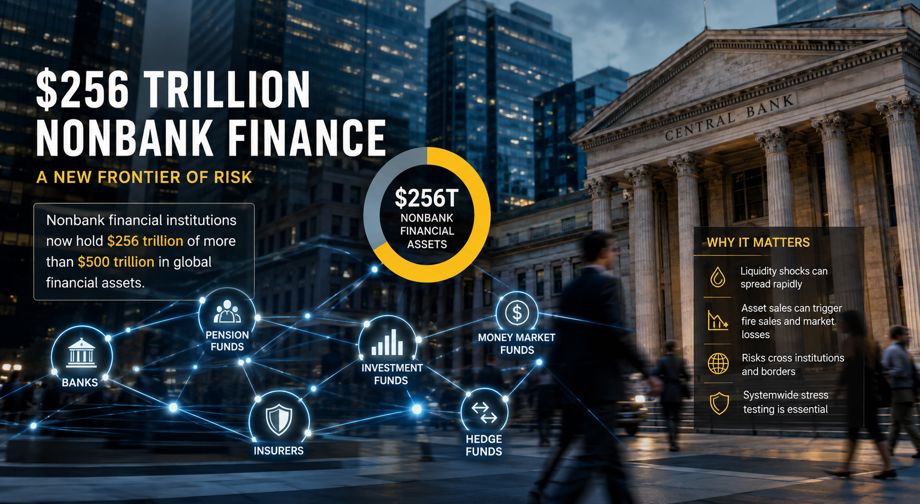
The global financial system is becoming harder to protect as investment funds, insurers, pension funds and other nonbank financial institutions take a bigger role in moving money across markets. An International Monetary Fund analysis warns that traditional stress tests focused mainly on banks may no longer be enough to detect risks that can spread quickly across institutions, markets and countries.
Nonbank financial institutions, or NBFIs, hold around $256 trillion of more than $500 trillion in global financial assets. The sector includes investment funds, money-market funds, hedge funds, insurers, pension funds and finance companies. Their growing involvement in government bonds, corporate debt, derivatives and repo markets means financial trouble in one corner of the system can rapidly affect another.
The IMF’s central message is straightforward: regulators should not focus solely on whether individual banks or funds can survive a crisis. They also need to understand what those institutions will do when they come under pressure, and whether their attempts to protect themselves could create problems elsewhere.
When a Search for Cash Becomes a Systemwide Crisis
Liquidity is at the heart of the problem. When markets fall sharply, investment funds can face investor withdrawals, while hedge funds, insurers and pension funds may need additional cash to meet margin or collateral calls. To raise money, they can withdraw bank deposits, borrow in the repo market, or sell government and corporate bonds.
These actions can start a damaging chain reaction. Heavy bond sales push prices lower, causing losses for other investors. Falling prices can generate additional margin calls, forcing further sales. Banks may simultaneously lose deposits or face demands on credit lines.
Recent crises show how quickly this can happen. The March 2020 “dash for cash” disrupted major financial markets, while the 2022 UK liability-driven investment crisis demonstrated how leveraged pension-related strategies could intensify turmoil in government bonds. The collapse of Archegos produced more than $10 billion in losses for banks, despite the problem originating outside conventional banking.
The implication for governments is significant: an institution can meet regulatory requirements and still contribute to a wider liquidity crisis.
Emerging Economies Face an Added Foreign-Exchange Risk
For developing and emerging economies, financial stress can quickly become a currency and foreign-exchange problem. International funds selling local bonds can push bond prices down while putting pressure on exchange rates. Domestic investors moving money into foreign assets can deepen the pressure.
Central banks can create domestic currency during emergencies, but they cannot create foreign currency. Their ability to provide dollars or euros therefore depends on available international reserves.
Country assessments show why this matters. In Türkiye, banks’ foreign-exchange assets held at the central bank were about twice the central bank’s readily available gross FX reserves and gold holdings during the period studied. Nearly three-quarters of central-bank FX liabilities were owed to domestic banks through deposits or swaps.
In Iceland, severe capital outflows could create foreign-currency liquidity shortages in banks, although central-bank reserves provided a backstop. However, more than 40% of gross international reserves were financed through external borrowing, demonstrating why policymakers need to examine the quality as well as the headline size of reserves.
India presents a different challenge. Its relatively closed capital account reduces some foreign-exchange risks, but non-banking financial companies remain exposed to infrastructure lending, wholesale funding and limited liquidity buffers. Mexico, meanwhile, faces risks from foreign participation in government bonds, where capital outflows can affect banks, insurers, pension funds and investment funds simultaneously.
Better Data Could Become the First Line of Defence
The findings have major implications for governments and international development partners. Many countries still lack detailed information on investment funds, pension funds, insurers, derivatives, repos and cross-border financial exposures. Without such data, authorities may discover dangerous connections only after a crisis has begun.
The IMF is developing systemwide tools to address this gap. One framework uses sector-level balance-sheet information to track financial claims across an economy. This can be particularly useful for developing countries where sophisticated transaction-level datasets are unavailable.
Another framework, known as Market Impact from Investment Funds Liquidity Distress, or MILD, examines what happens when investment funds face redemptions and are forced to sell securities. It estimates how those sales could lower market prices and create losses for other investors.
The 2025 Euro Area assessment went further by analysing banks, insurers, money-market funds, hedge funds and other investment funds together. It examined liquidity pressures over the first two days of a crisis and the following two weeks, recognising that margin payments may become due before institutions receive cash from securities they have sold.
For development partners, this creates a clear agenda: help countries improve financial statistics, supervisory technology, transaction databases, staff capacity and information sharing between central banks and financial regulators.
New Risks, and New Opportunities, for the Private Sector
Private financial institutions also have reason to respond. Banks need better information about their exposures to investment funds through deposits, derivatives, repos and credit lines. Asset managers need stronger liquidity planning, while pension funds and insurers should understand how leveraged investment strategies could generate sudden cash requirements.
The transition also creates opportunities for fintech companies, data providers, financial-market infrastructure operators and risk-management firms. Demand is likely to increase for technologies that track collateral, predict liquidity requirements and analyse transaction-level financial connections.
But regulators need to avoid simply shifting risk from one institution to another. Requiring investment funds to keep more money in bank deposits, for example, could strengthen links between funds and banks. Encouraging funds to hold more government bonds could increase simultaneous selling during a crisis. Bank credit lines could protect investment funds while transferring their liquidity problems to banks.
Between 2020 and 2025, 19 IMF Financial Sector Assessment Programs incorporated some form of systemwide risk analysis, showing that regulators are increasingly looking beyond individual institutions.
For policymakers, the priority is to map connections between banks, NBFIs, markets and foreign-exchange reserves before a shock occurs. Development partners can support countries with data, technical expertise and stronger supervisory systems, while private-sector institutions can invest in liquidity management, stress testing and risk analytics.
With around $256 trillion held by nonbank financial institutions, the next financial crisis may not begin with a failing bank. It could start with an investment fund facing redemptions, a pension fund selling government bonds or foreign investors suddenly leaving an emerging market. The key question is therefore no longer only whether individual institutions can survive a shock, but whether the actions they take to survive could destabilise the wider economy.