

Supply Chain Disruption: Big Losses, Little Clarity
Credit:
Pixabay
As discussed in NIST AMS 100-71, there are a number of knowledge gaps regarding supply chain disruption (see detailed discussion below). First, there is a limited understanding of aggregate economy wide losses that result from goods failing to arrive on time at the next point in the supply chain. There are numerous studies on supply chain disruption; however, this particular aspect is underexplored. There is also a limited understanding of the frequency and magnitude of supply chain disruptions, which makes it difficult to estimate annualized losses that are useful for guiding investment in mitigation. Finally, there is a knowledge gap in understanding supply chains from a network-level perspective, which limits our ability to model systemic vulnerabilities and cascading impacts.
Natural Hazard Impacts in the Downstream Supply Chain May Exceed the Direct Effects
Thomas and Helgeson (2021) investigated the short-term downstream effects of natural hazards. For instance, the failure of supplies to arrive on time at the factory floor due to a hazard experienced by a supplier. This is an area with limited research, as many studies examine upstream impacts (e.g., the effect of hazards experienced by customers) or long-term downstream impacts (e.g., the effect years after a hazard is experienced by suppliers). Thomas and Helgeson examine the short-term downstream impact, which includes the more immediate effects. They find that during the 2005 to 2016 time period payroll, GDP, and employment in the manufacturing/goods industry supply chain were decreased or suppressed by 2.9 %, 3.9 %, and 8.6 %, respectively due to hazards upstream – that is, due to hazards experienced by suppliers. This can create an incentive misalignment, as the establishment that invests in mitigation efforts and experiences the hazard locally does not directly experience a large portion of the net benefit. The result may be an underinvestment in hazard resilience.
Thomas and Helgeson (2022) further examined the effect of data resolution (for instance, local level data vs. state level data) on examining the effects of hazards. They find that data resolution can obscure the impacts of hazards in some types of studies. Thus, caution should be taken as some studies may underestimate the impacts. An analysis in the same paper showed that an investment of USD 100 billion or less in hazard resilience is economical if it results in a reduction in losses of 10% or more. Moreover, the results of these papers suggests that current estimates of hazard impacts may be underestimates and that there may also be underinvestment in hazard resilience.
Supply Chain Losses Due to Power Disturbances Exhibit Higher Losses Downstream
Research on the downstream supply chain effects of power disturbances by Thomas and Fung (2022) shows that:
- Power disturbance literature has limited coverage on the downstream economic impact;
- No single method of analysis estimates all power disturbance losses;
- Power disturbances have a statistically significant effect on downstream value added;
- The downstream effect of power disturbances is 0.8% of private value added and 2.3% of manufacturing value added;
A $50 billion investment in energy resilience is economical if it reduces direct/indirect losses by 5%.
Power outages in the U.S. affect many firms’ economic activity and are likely to result in downstream supply chain disruptions. Our research suggests that power disturbances have a statistically significant effect on gross domestic product (i.e., value added), particularly in manufacturing where power disturbances in the supply chain had a statistically significant effect. While this industry represents 12.8 % of private industry value added, it experiences 36.8 % of the supply chain losses due to power disturbances. Power disturbances in the supply chain affected all four industries examined (i.e., manufacturing, durable goods manufacturing, nondurable goods manufacturing, and total private industry) with nondurable goods being affected the most. This creates a significant disconnect between the stakeholder that invests in reliability in the power grid and the stakeholders that experience the bulk of losses.
Credit:
NIST AMS 100-71
Limited Literature and Knowledge
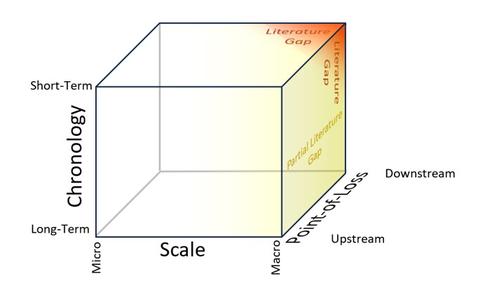
Supply chain disruption losses themselves can be classified by scale (micro vs macro), chronology (short-term vs long-term), and point-of-loss (upstream vs downstream). As discussed in NIST AMS 100-71, there is a literature gap relating to macro short-term downstream losses; that is, there is limited understanding of the aggregated losses that occur when goods fail to arrive at the next point in the supply chain, as illustrated by the red shading in Figure 3.1 from NIST AMS 100-71. There is also a limited understanding of the frequency and magnitude of supply chain disruptions that makes it difficult to estimate annualized losses, which are useful for guiding investment in mitigation. Further, there is a literature gap in understanding supply chains from a network-level perspective, which is illustrated by the yellow shading in Figure 3.1 from NIST AMS 100-71.
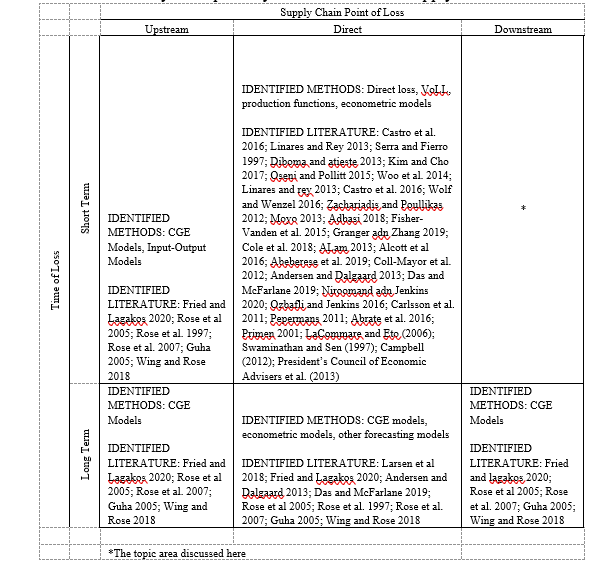
Table 2 from Thomas and Fung (2022) categorizes literature on power disturbances by the point in the supply chain where the measured losses occurred and the relative time period in which the measured losses occurred. The literature has significant coverage of the losses that occur at the establishments that experience a power disturbance and at the time of the disturbance. There are also a number of papers discussing upstream losses and long-term losses; however, we did not identify literature examining the downstream short-term losses. That is, the immediate shortages or delays that result from having suppliers that experience a power disturbance. Additional literature searches in Thomas and Helgeson (2021) and Thomas and Helgeson (2022) found similar results regarding natural hazards disrupting supply chains.
Table 2 from Thomas and Fung (2022): Literature on Economic Impacts of
Electricity Disruption by Time of Loss and Supply Chain Point
Insight through Modeling
As discussed in NIST AMS 100-71, to better understand supply chain disruption losses, NIST’s Applied Economics Office is conducting research on supply chain disruption using agent-based models, an approach that is used by some manufacturers for supply chain management that might help shed light on some economy wide issues. An agent-based model is a computational method used to simulate interactions among independent agents such as establishments. Each agent follows behavioral rules and may adapt in response to changes in the environment or other agents. To illustrate, one might think about birds that flock in the sky creating shifting patterns. In this example the birds are agents and they follow behavioral rules (e.g., stay close to the other birds) that result in emergent patterns. In an agent-based model there are many independent entities making decisions based on programmed rules. When the simulation is run, we can make observations about the emergent behavior of the system as a whole. This work is at its initial stages; thus, results are still forthcoming.
For more information please see the NIST research below:
Thomas, Douglas; Jennifer Helgeson; and Ireland Crowther. (2025). “Supply Chain Disruption and Agent-Based Modeling: A Literature Review and Model.” NIST AMS 100-71. https://doi.org/10.6028/NIST.AMS.100-71
Thomas, Douglas and Juan Fung (2023) “Power Disturbances: An Examination of Short-Term Losses in the Downstream Supply Chain.” ASSA 2023 Annual Meeting. New Orleans, LA. January 6–8, 2023. https://www.aeaweb.org/conference/2023/program/paper/BzdNZsQN
Thomas, Douglas and Jennifer Helgeson (2022). “The Effect of Natural Hazard Damage on Manufacturing Value Added and the Impact of Spatiotemporal Data Variations on the Results.” Int J Disaster Risk Sci 13. https://doi.org/10.1007/s13753-022-00438-x
Thomas, Douglas and Juan Fung. (2022). “Measuring downstream supply chain losses due to power disturbances.” Energy Economics, Volume 114, https://doi.org/10.1016/j.eneco.2022.106314
Thomas, Douglas and Jennifer Helgeson. (2021). “The effect of natural/human-made hazards on business establishments and their supply chains.” International Journal of Disaster Risk Reduction. Volume 59. https://doi.org/10.1016/j.ijdrr.2021.102257