

Table of Contents
What Just Happened: Dollar Stablecoins Find a Home in Asia
The landscape for stablecoin payments shifted on August 22, 2026, when economy.ac reported that Singapore, Hong Kong, and Japan are each carving distinct paths for dollar stablecoin adoption across Asia’s financial infrastructure. Major Asian centers are now integrating stablecoins into payment rails, remittance corridors, and institutional liquidity structures. For global businesses, the question is no longer “if,” but “how fast.”
Singapore and Hong Kong: Natural Pegs, Natural Hubs
Both jurisdictions operate currency boards pegged to the US dollar, structurally aligning them with dollar stablecoins like USDC. This reduces FX friction and makes stablecoin settlement functionally identical to domestic dollar transfers. Singapore’s Monetary Authority has signaled comfort with regulated stablecoin frameworks, while Hong Kong’s digital asset licensing creates an environment where regulated stablecoin corridors can operate alongside traditional banking. Businesses banking in either hub can now treat USDC payments as an extension of existing dollar operations, avoiding a separate crypto ecosystem.
Japan’s Cautious but Strategic Play
Japan restricts stablecoin issuance, but the institutional liquidity story is where the action sits. The economy.ac report notes that Japan absorbs liquidity institutionally: large financial players accumulate stablecoins as balance-sheet assets for settlement within controlled environments. For treasury teams, Japan is a wholesale stablecoin market for large-value cross-border settlement, not retail payment flows.
Southeast Asia’s Remittance Revolution
Meanwhile, Southeast Asia’s adoption is happening from the ground up. Stablecoins are increasingly used for remittances, bypassing high fees and multi-day delays of correspondent banking. This is a parallel track: hub-level policy in the north, practical adoption in the south.
Why This Matters Now for Global Businesses
Cheaper, Faster Cross-Border Payments Are No Longer a Promise
Cross-border payments using stablecoins settle in seconds, not days. A USDC transfer between Singapore and Vietnam costs fractions of a cent in network fees, compared to typical 3-5% remittance corridor costs and $25-50 wire fees plus FX markups. The August 2026 developments signal that regulated infrastructure is catching up to the technology—businesses can now adopt stablecoin settlement within a compliant framework. Treasury managers gain access to clear cost savings without compliance gray zones.
The Shrinking Role of Traditional Correspondent Banking
Traditional cross-border payments rely on chains of correspondent banks, each adding delay and fees. Stripe’s research on cross-border payment types details this opaque system. The Asia stablecoin hubs offer a direct on-chain rail, convertible to local fiat through regulated providers. The structural shift: regulated hubs now make stablecoins viable for treasury-grade transactions.
The Background: Stablecoin Payments in Three Minutes
What Are Stablecoin Payments and How Do They Work?
A stablecoin payment transfers value via a blockchain-based token pegged 1:1 to a fiat currency, most commonly the US dollar. USDC, issued by Circle, is the dominant B2B stablecoin. Each token is backed by cash and short-duration US government securities. A business sends USDC to a counterparty’s wallet; the transaction settles on-chain in seconds. The recipient converts to local fiat through a licensed exchange or platform like OneSafe without correspondent banks or SWIFT delays. As McKinsey’s analysis of stablecoin payments infrastructure puts it, this is “tokenized cash” on programmable, always-on rails.
Why Are Singapore and Hong Kong Becoming Stablecoin Payment Hubs?
The answer goes beyond regulatory friendliness. Their currency boards mechanically peg local dollars to the US dollar. A USDC balance faces no currency mismatch—a structural advantage no other major financial center shares. Regulators thus view dollar stablecoins as a technological upgrade to existing dollar clearing. Singapore’s single-currency stablecoin licensing framework and Hong Kong’s virtual asset trading platform regime provide clear compliance pathways, transforming stablecoin adoption into a treasury decision.
How Do Stablecoin Payments Reduce Cross-Border Payment Costs?
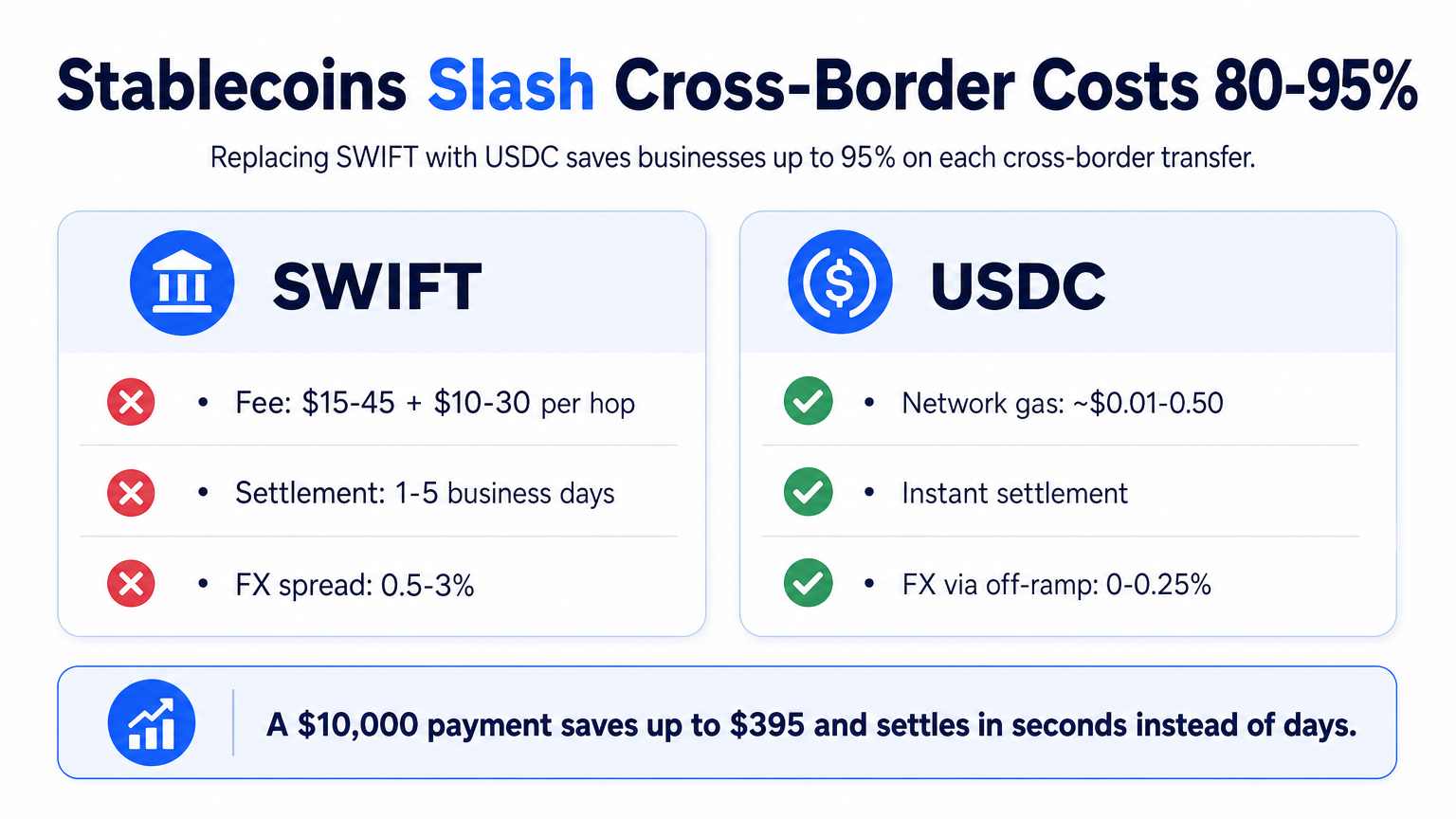
Three cost layers collapse when switching from SWIFT to a stablecoin rail:
| Cost Layer | Traditional SWIFT Wire | USDC Stablecoin Transfer |
|---|---|---|
| Wire transfer fee (sending bank) | $15-45 | ~$0.01-0.50 (network gas) |
| Correspondent bank intermediary fees | $10-30 per hop | $0 |
| FX conversion spread | 0.5-3% on major corridors | 0-0.25% via on/off-ramp provider |
| Settlement time | 1-5 business days | Seconds to minutes |
| Cut-off hours restriction | Yes (business hours only) | No (24/7) |
| Receiving bank fee | $10-20 | Varies by off-ramp provider |
A $10,000 payment from Singapore to Indonesia via SWIFT might cost $160-420 all-in with a 3-day wait. The same via USDC on a layer-2: under $0.10 network fee, with a 0.25% off-ramp FX cost—totaling around $25.10 and settlement in seconds. J.P. Morgan’s work on cross-border payment modernization confirms banks are building infrastructure in response.
What Does Japan’s Stance on Stablecoin Issuance Mean for Businesses?
Japan restricts issuance but allows institutional accumulation, creating a wholesale stablecoin liquidity pool. A US-based treasury can use Japan’s institutional liquidity for large-dollar settlements with Japanese banking partners holding USDC, but not for retail payments to small suppliers. Treat Japan as a source of deep institutional liquidity for large-ticket stablecoin settlement, not a general payments corridor. Build workflows accordingly: segregated accounts, high minimum transfer thresholds, direct banking relationships.
How Can Global Businesses Integrate Stablecoin Payments Alongside Fiat?
A unified platform that handles both fiat and stablecoin transactions eliminates reconciliation chaos and duplicated overhead. OneSafe, for example, provides multi-currency fiat accounts and USDC wallets, enabling payments to vendors and seamless conversion. For a DAO paying contributors, the workflow becomes: hold treasury in USDC, pay core team in fiat via automated off-ramps, and settle contractors in stablecoins—all from one dashboard with unified reporting.
This solves the last-mile problem: a stablecoin payment isn’t complete until the recipient can use the funds locally. Native on/off-ramp capability (ACH, local wire support) turns a blockchain transfer into a usable payment.
What This Means for DAOs and Web3 Startups
DAOs gain a path to treasury diversification without banking fragmentation. They can hold USDC, route payments through a unified platform, and avoid lengthy traditional bank account openings. DAO treasury management benefits from near-zero recurring payment costs, programmable schedules via smart contracts, and transparent on-chain records. With Singapore and Hong Kong providing regulatory cover, this option becomes practical in compliant environments.
Compliance in a Multi-Jurisdiction World
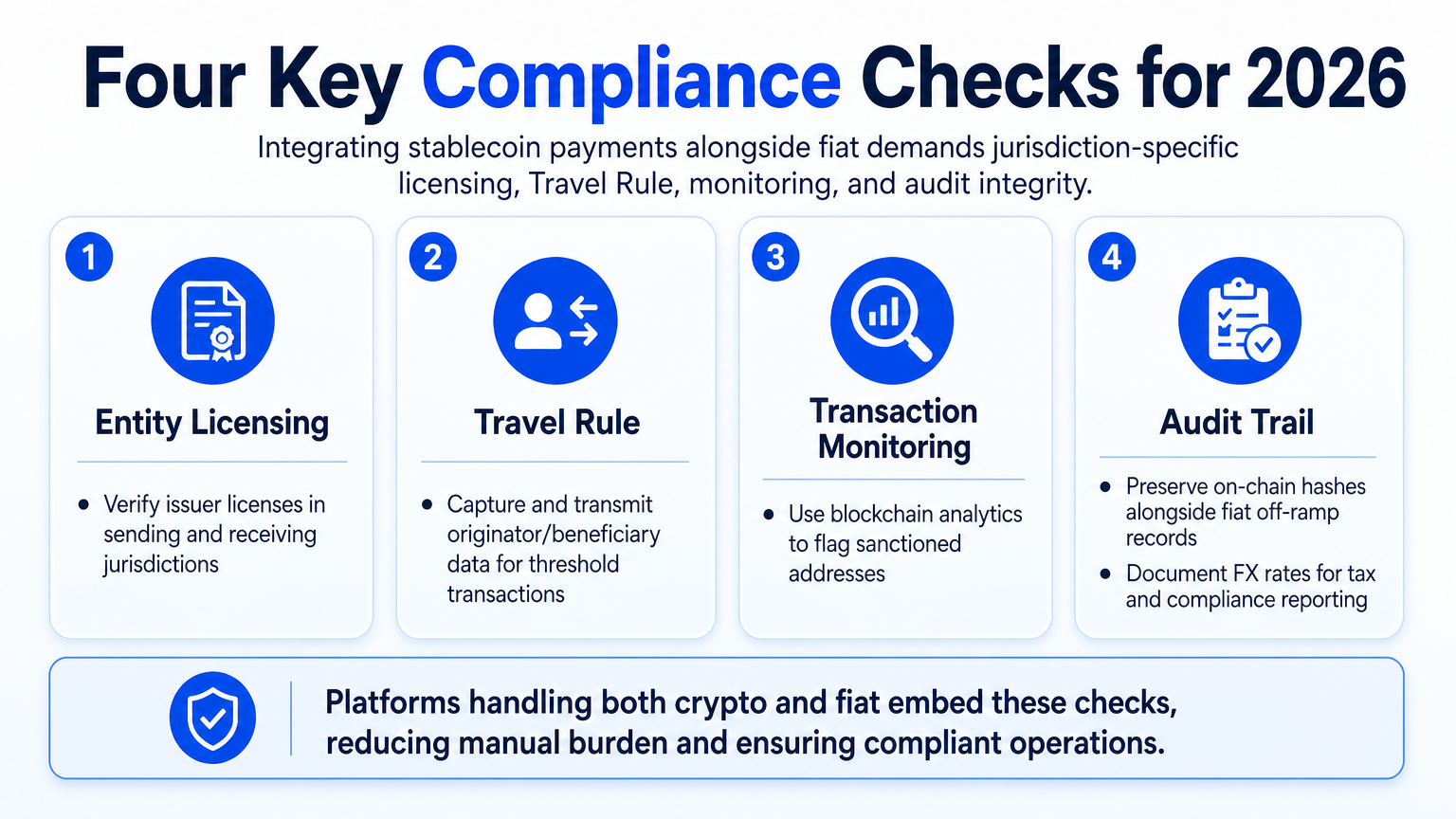
Integrating stablecoin payments alongside fiat introduces compliance complexity. A payment from a Singapore-licensed entity to a Hong Kong counterparty sits under two regimes; crossing into a third compounds the oversight. The operational checklist for 2026 includes:
- Entity-level licensing checks: Confirm the stablecoin issuer holds relevant licenses in both sending and receiving jurisdictions.
- Travel Rule compliance: Capture and transmit originator/beneficiary information for threshold transactions.
- Transaction monitoring: Maintain blockchain analytics to flag sanctioned addresses.
- Audit trail integrity: Preserve on-chain transaction hashes alongside fiat off-ramp records.
- Currency conversion disclosure: Document FX rates applied for tax and compliance reporting.
Platforms handling both crypto-fiat payments can embed these checks, reducing manual burden. Integration—not after-the-fact reconciliation—separates compliant operations from hidden risk.
Concrete Implications for Treasury and Operations in 2026
Why a Single Platform for Fiat and Stablecoins Is Becoming a Necessity
Maintaining separate banking and crypto infrastructure creates cost, risk, and audit complexity. A unified platform supporting USDC payments alongside multi-currency fiat accounts, with automated FX and on/off-ramps, transforms stablecoin adoption into an operational upgrade. For businesses exploring what global finance means in practice, that integration eliminates the friction between rails.
What to Watch Next: Regulatory Gaps and Open Questions
Will Frameworks Like the GENIUS Act Become a Global Standard?
The GENIUS Act defines payment stablecoin requirements in the US. If its principles (1:1 backing, monthly attestation, issuer licensing) align with Singapore and Hong Kong’s frameworks, a de facto global standard could emerge. Divergence would force businesses into compliance arbitrage. Track the GENIUS Act as a signal of global norms.
The Risk of Fragmentation: US vs. Asia Approaches
As of August 2026, fragmentation is the reality: Japan restricts issuance, Singapore licenses, Hong Kong licenses differently, the US debates. Businesses operating across all four face four compliance playbooks, increasing the value of platforms that abstract that complexity. The open question: will a 2027 cross‑border USDC payment between compliant entities be seamless? Regulatory coordination hasn’t yet answered that.
What Are the Risks and Regulatory Considerations for Stablecoin Payments in 2026?
Risks fall into four categories:
Regulatory divergence. Different Asian paths mean a transfer compliant in Singapore may not meet Japan’s institutional rules. Jurisdiction-specific legal review is essential.
Counterparty risk on off-ramps. Converting USDC to fiat requires a partner. Solvency issues can freeze funds. Use platforms that custody with institutional-grade providers and segregate client assets.
Smart contract and network risk. Blockchain networks face congestion, forks, and vulnerabilities. USDC core contracts are audited, but layer-2 bridges carry higher technical risk.
Shifting compliance burden. Regulators expect originators to verify recipients and screen for sanctions. Platforms integrating Travel Rule data capture and blockchain analytics reduce that burden; manual processes won’t scale.
For a broader assessment, review risk factors specific to cross-border banking—many of which stablecoin rails reduce but don’t eliminate.
Key Takeaways
- Singapore and Hong Kong’s dollar pegs make them structurally ideal Asia stablecoin hubs, and their August 2026 moves provide a compliance pathway.
- Stablecoin payments collapse wire fees, intermediary charges, and FX spreads, reducing all-in costs by 80-95% on typical B2B corridors.
- Japan’s institutional liquidity absorption model means it functions as a wholesale stablecoin market; build workflows for large-ticket treasury settlement, not retail.
- A unified fiat-and-crypto platform is the operational prerequisite for managing stablecoin payments alongside traditional banking without reconciliation chaos.
- The biggest risk in 2026 is regulatory fragmentation across Asia and the US, forcing businesses to maintain multiple compliance playbooks.
Get started with a platform built for both sides of your balance sheet—fiat and crypto, in one place—at OneSafe.