
With Dr. Krassen Stanchev (Founder and Board Chairman of the Institute for Market Economics in Bulgaria).
There is a curious paradox in today’s debates over capitalism: The only economic system that has expanded ordinary people’s opportunities is routinely accused of being immoral.
Capitalism is said to run on greed and exploitation, producing inequality. Socialism, by contrast, presents itself as institutionalized compassion. Replacing competition with “cooperation” and private property with “collective ownership,” it supposedly distributes wealth according to needs.
But consider what a market economy asks of us. It does not require us to love each other. Some people consider it their Christian duty, but a global economy runs on impersonal exchanges.
Thus, it needs a different mechanism — one that incentivizes us to find ways to cooperate.
The Benevolence of the Baker?
A baker need not be loving or benevolent to sell us bread. The customer need not care about the baker’s family to buy it. Both sides pursue their own purposes, and therefore, the two can make each other better off through voluntary exchange. Competition gives each side alternatives and incentives to excel.
Producers strive to please customers. Buyers seek the best products. Employers bid for the most productive workers. Employees compete for the most attractive jobs. Anyone who fails to satisfy the other side suffers losses and gets an opportunity to try again with something better.
The role of prices
Market prices communicate knowledge when all resources are privately owned and used for profit. They tell entrepreneurs where resources are more or less urgently needed and when consumer preferences are changing. Remove those signals, and the planner is completely blind.
Socialism, which seeks to remove those signals, is therefore both wasteful and tyrannical. The state assumes responsibility for allocating productive resources. Economic decisions become political. Officials decide what is produced and who receives what. This requires complete transfer of power from the people to the state.
The officials might have good intentions. They might be competent in certain areas. They are also human beings, so they have no way to acquire the information contained in trillions of individual choices, in billions of individual brains.
The Eastern Europe Test
During the last 25 years under socialism, life expectancy stagnated or deteriorated in Eastern Europe while it rose steadily in the capitalist West. After 1989, life expectancy began rising even through the painful transition away from central planning.
What produced this amazing improvement in the standard of living for the region? Through private property and free enterprise, people regained control over their own lives. They could once again make choices that had previously been made for them by socialist central planners.
Between 1950 and 1973, Western Europe grew at an average annual rate of roughly 4.8 percent, compared with about 3.8 percent in Eastern Europe. Over time, this produced a huge divergence. After the end of the socialist experiment, the freed people experienced decades of rapid growth.
Since the early 1990s, real GDP per capita has multiplied several times in many of these nations, while wealth per adult has risen even more dramatically. Former socialist countries that once lagged far behind the developed world are now classified as high-income economies.
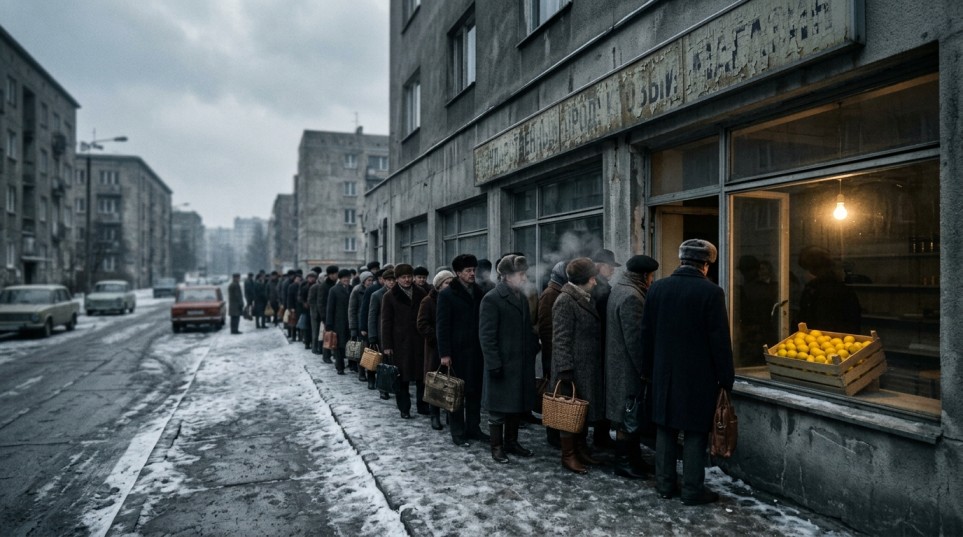
There’s a Bulgarian TV show from the 1980s about truckers. In one of the episodes, a woman goes to the government grocery store and encounters a long line. “Why are you waiting?” she asks her neighbors. “They [meaning the socialist planners] released lemons today.”
Released? Were the lemons imprisoned for spreading Western influence? Try to explain that conversation to an American! Waiting for goods to be “released” was symbolic of our total dependence on political authority.
For 40 years under socialism, we waited in lines for almost all basic necessities. We often used newspapers to wipe ourselves in the loo. Deodorants were luxury birthday presents. Electricity disruptions and water shortages were the norm. Under socialism, you can enjoy all of that!
Socialists delude themselves when they say that personal freedom and happiness can be achieved by letting elected officials take care of your economic needs. When the state planners control access to the things you need to live and thrive, saying “no” to the government is dangerous.
Learn more about the delusions of socialists:
Socialism does not just breed poverty due to its inherent inefficiencies. It tramples all rights. It eradicates all freedoms. Worst of all, socialism feeds on the moral degradation of the enslaved citizens. And it makes no difference if that system comes from the barrel of a gun or elections.
Capitalism is the only humane economic arrangement. Freedom is not merely an efficient way of utilizing scarce resources to satisfy our needs, it is a moral principle because it respects our dignity, treating us as responsible agents capable of choosing how to pursue our happiness.
Are you a student interested in getting involved in pro-liberty activism? By applying to join Students For Liberty’s Local Coordinator Program, you can be supported in promoting the ideas of liberty while also developing your skills and meeting many like-minded students from across the world. Click on the button below to find out more and get involved!
This piece solely expresses the opinion of the author and not necessarily the organization as a whole. Students For Liberty is committed to facilitating a broad dialogue for liberty, representing a variety of opinions.

