

Private credit fills the post-2008 regulatory gap left by Dodd-Frank
Europe's bank-dependent market shifts as Basel rules bite
Direct euro-area bank exposure stays small but concentrated

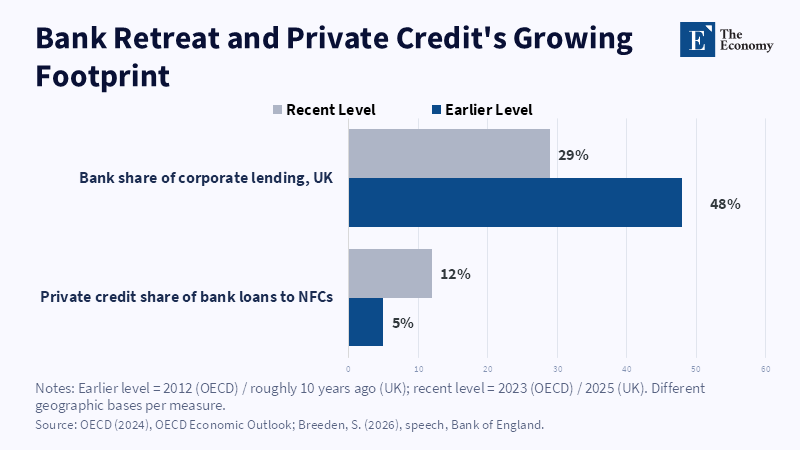
Banks’ share of business lending in the UK fell from 48% to 29% within a decade, according to data released by the Bank of England. At the same time, private credit as a percentage of bank loans to non-financial corporations in advanced economies more than doubled, from 5% in 2012 to 12% in 2023, based on OECD data. The regulatory framework that emerged after the 2008 crisis focused almost exclusively on large, systemically important institutions, leaving private capital markets outside the main supervisory radius. Within two decades, private credit has become one of the most critical hubs in the financial system, with Europe emerging as one of the fastest-growing and most complex fields outside the United States. The question is no longer whether banks and private credit servicers are linked but how well supervisory authorities and institutions themselves understand the nature of this link.
The Regulatory Gap After 2008
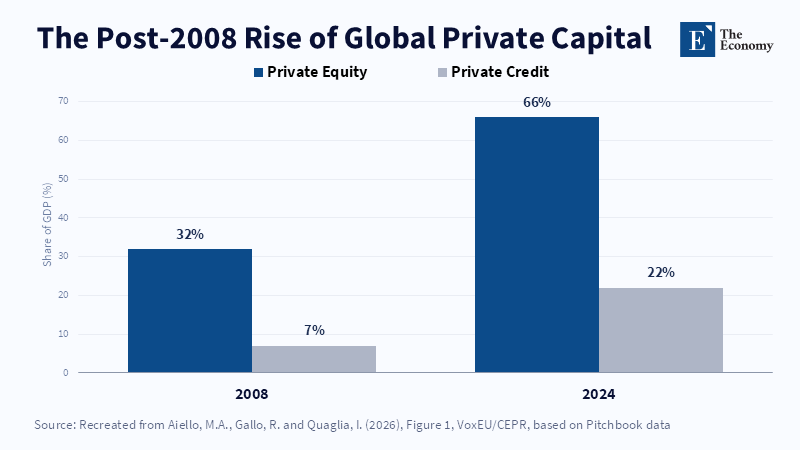
The legislative response to the 2008 crisis in the United States, centered on the Dodd-Frank Act, was designed around the control of large banks and institutions that were classified as systemically important. The logic was understandable: the actors that had caused or transmitted most of the crisis had to be placed under stricter capital and supervisory discipline. But what remained outside this framework, such as private equity and private credit funds, continued to operate with much less transparency and almost no direct supervision.
In this gap, an entire non-bank finance industry gradually developed over one to two decades. The global private credit market reached around $2 trillion in 2023, with industry projections placing it above $4 trillion to $5 trillion by 2030. Institutional investors, such as pension funds and insurance companies, turned to these funds in search of portfolio diversification and higher returns, while medium-sized companies found the financing that traditional banks were no longer willing or able to offer with the same ease.
The European Specificity Of Private Credit
The European funding market has historically remained much more dependent on banks than the American one. This is gradually changing as regulatory pressure, particularly through the Basel rules, pushes banks to be more frugal with their capital and more selective about where they channel it. European banks are now regularly approaching private credit managers to allocate loan portfolios, negotiate forward flow agreements or share risk on non-performing loans, a dynamic also described by executives of large alternative fund managers operating in the region.
But complexity remains a structural feature of the European market. Twenty-seven Member States with different regulatory and legal regimes, together with the United Kingdom, Norway and Switzerland outside the European Union, make up a landscape that cannot be treated as a single market. A recently adopted legal guide to private credit in Europe covers fourteen different jurisdictions, which in itself captures the extent of the legal fragmentation that lenders have to manage. Scale and local specialisation have become a prerequisite for anyone seeking to operate effectively in this market.
Mapping The Interconnection Between Banks And Private Capital Markets
A survey by the Bank of Italy identifies four distinct levels of interconnectedness between banks and private capital markets, each with a different capital treatment. At the enterprise level, a bank may directly lend to the same company that borrows from private equity as well, with the weighted capital requirement reaching 100% under the standardized approach. At the capital level, the bank finances the investment vehicle itself, usually with more favourable treatment due to portfolio diversification. At the facility level, where the bank lends to a special purpose vehicle or buys part of a mortgage liability, overcollateralisation and the upper ranking can reduce the risk weight by up to 20%.
The sum of these exposures remains based on available supervisory surveys, relatively limited at the euro area level, at around €60 billion to €70 billion or around 0.2% of banks’ total assets. This exposure is concentrated in a few large institutions and is mainly generated at facility level. However, this figure reflects only the direct, recorded exposure. It does not capture exposure to businesses financed simultaneously by banks and by private or private equity, nor does it capture the reverse flow of risk through synthetic risk transfers, whereby banks transfer credit risk to non-bank entities while keeping loans on their balance sheets.
| Interconnection Level | Mechanism | Capital Treatment | Key Risk | Conclusion |
|---|---|---|---|---|
| Enterprise | Joint borrower of bank and capital | About 100% risk weighting | Direct correlation with borrower’s credit quality | Equivalent to a direct corporate loan |
| Fund | Financing of NAV or Capital Drawdown Lines | More favorable due to diversification | Quality of investors or underlying portfolio | Lower immediate risk for the bank |
| Facility | Special Purpose Vehicle Loan or CLO | Up to approx. 20% with overcollateralized | Quality of the underlying loan portfolio | Largest share of concentrated exposure |
| Asset Manager | Ownership or affiliation with a manager | It does not generate an immediate credit report | Operational and reputational risk | Indirect but existing interconnection |
Two Decades, Two Different Sources Of Risk
The 2008 crisis stemmed from specific and relatively visible sources. Investment banks in the United States had accumulated enormous exposure to low-rated mortgages, while in southern Europe and Ireland the problem was expressed through unsustainable sovereign debt. In both cases, the risk was concentrated in entities that were already under some degree of supervision, which ultimately allowed for coordinated government intervention.
The potential source of volatility in the 2020s is of a different nature. It is not so much a specific product as an entire class of investment, private credit, which has expanded to less diversified and often riskier borrowers, with limited public information. A European supervisory review found that banks face difficulty in systematically identifying transactions in which they lend to the same company alongside private credit funds, meaning that the true degree of risk concentration may be greater than the individual data suggests. The Financial Stability Board and the European Central Bank have both pointed to hidden leverage along the intermediation chain as the main point of weakness, more than the size of the reports themselves.
The Need For Early Oversight
The return to the original element, the decline in the bank’s share of corporate lending, is not just a description of a shift in financing. It reflects a risk rearrangement that remains largely uncharted, especially in Europe where legal fragmentation makes it more difficult to gather consistent supervisory data. The harmonisation of the definition of private credit at the European level, the systematic recording of funds and companies financed by them and closer cooperation between jurisdictions and supervisors, are no longer optional improvements but prerequisites for early risk identification. The 2008 story showed what happens when interconnections become visible only after pressure has set in. The challenge today is to identify them before that.
This article reflects the analytical judgment of The Economy Markets Editorial Board and does not constitute business advice or the official position of any affiliated institution.
References
Aiello, M.A., Gallo, R. and Quaglia, I. (2026) ‘European banks and private markets: Mapping the linkages’, VoxEU/CEPR, 2 September.
Baker McKenzie (2026) Guide to Private Credit in Europe, 4th edn, 16 June.
Bank of England (2026) speech by S. Breeden, reported in Fi-Desk.
Capital – Private Credit Desk (2026) ‘Top 30 Private Credit Market Leaders 2026’, The Ranking News, 1 May, updated 31 August.
European Central Bank (2026) ‘Private credit and euro area financial stability’, Financial Stability Review, May.
Financial Stability Board (2026) Report on Vulnerabilities in Private Credit, May.
Leach, T. (2026) ‘Europe’s Structural Opportunity in Private Credit’, Apollo Global Management, 11 May.
OECD (2024) OECD Economic Outlook, December.