
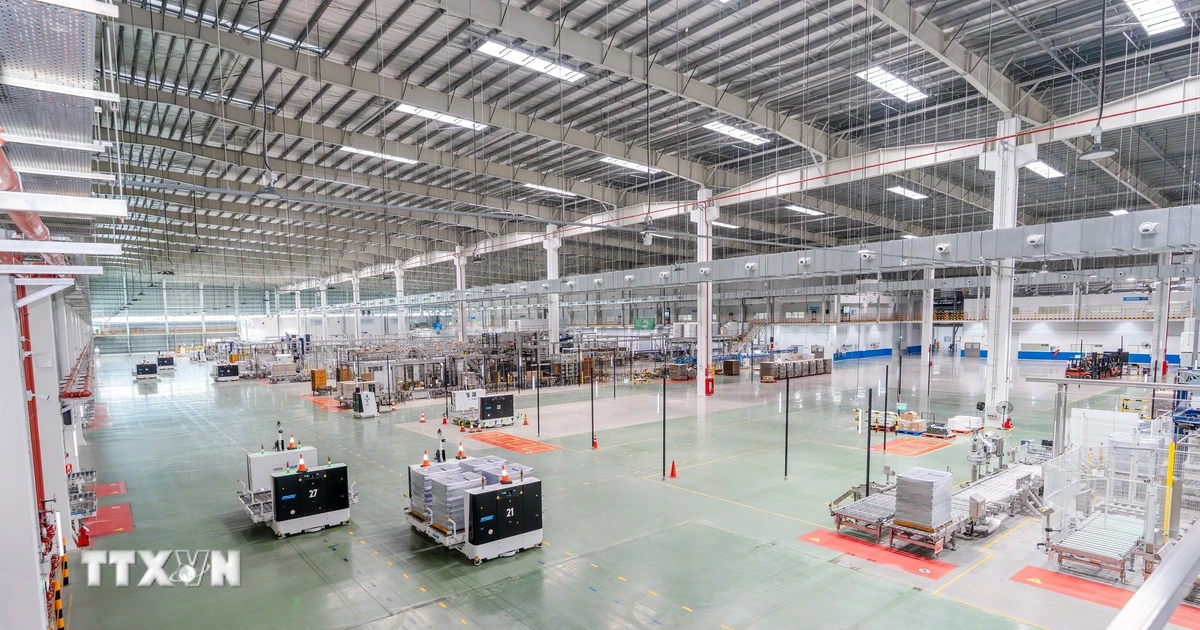
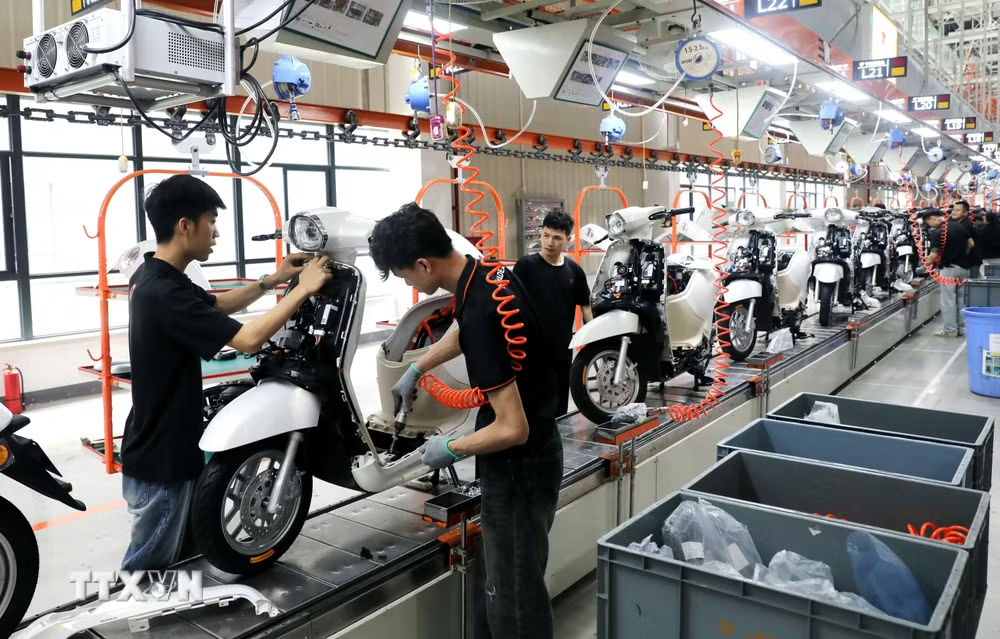
The steady growth of foreign direct investment (FDI) is strongly impacting the development of Vietnam’s industrial real estate, while simultaneously strengthening the country’s position in the global supply chain. As FDI enterprises in the electronics, optical products, computer, and high-tech sectors continuously expand their production and supply chains in Vietnam, the demand for industrial land, factories, and warehouses is also being boosted.
Policies to strengthen investor confidence
According to the General Statistics Office, realized FDI capital in the first eight months of 2026 is estimated at US$17.25 billion, an increase of 12% compared to the same period last year, the highest eight-month level in the past five years. The processing and manufacturing industry played a leading role with US$14.24 billion, accounting for 82.6% of the total capital. The North alone attracted approximately US$8.63 billion in FDI for manufacturing, accounting for 80.5% of the total new FDI for manufacturing nationwide; within this, the computer, electronics, and optical products group led with over US$7.03 billion, nearly 66% of the total capital.
While Vietnam’s advantages were previously primarily seen in labor costs, land availability, and geographical location, its attractiveness is now being created by an industrial ecosystem that meets the stringent requirements of multinational corporations; this includes an open policy environment, continuously improving inter-regional transportation connectivity, and an increasing supply of high-quality industrial real estate.
Mr. Nguyen Phuoc Thuan, Director of Industrial and Office Leasing at Cushman & Wakefield Vietnam, said: “From regular exchanges with Cushman & Wakefield’s international clients and partners, we have noticed that investors today are not only looking for attractive investment opportunities or competitive commercial conditions.
Increasingly important factors include the transparency of the investment environment, policy stability, and the coordination and support of relevant authorities throughout the project implementation process. These factors directly influence investment progress, operational efficiency, and long-term capital allocation decisions for businesses.
Currently, the Government is continuously implementing policies to create a favorable investment and business environment for FDI enterprises. Resolution No. 10-NQ/TW dated June 8, 2026, of the Politburo on the development of the foreign-invested economy is considered a positive signal, strengthening the confidence of international investors and demonstrating the Government’s commitment to supporting foreign investors.
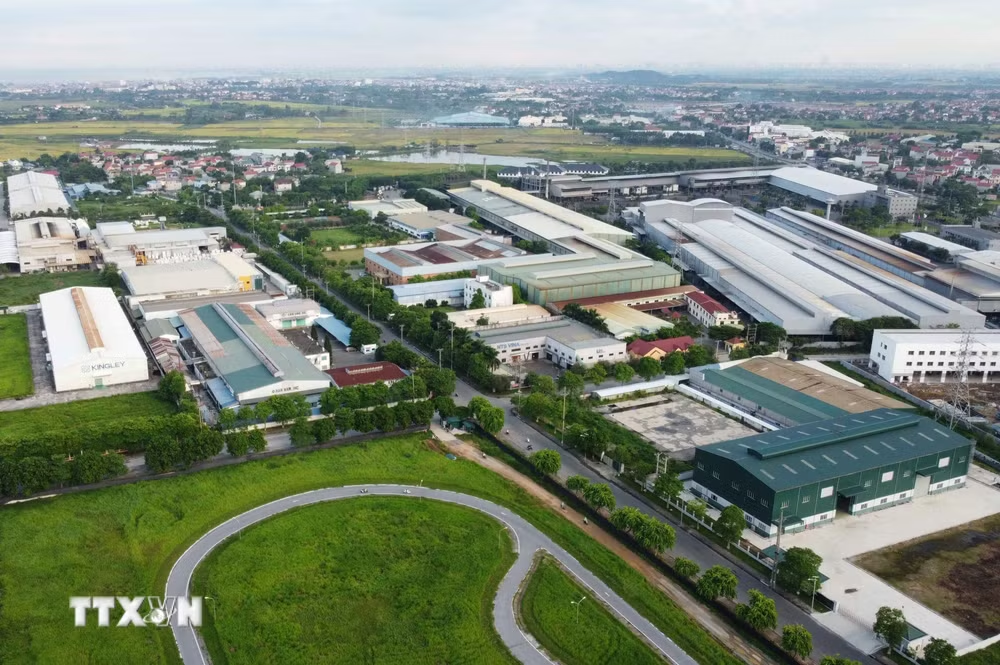
The resolution outlines a strategic direction for attracting a new generation of FDI, focusing on high technology, innovation, and sustainable development; it also advocates for the comprehensive development of an investment ecosystem linked to capital markets, international financial centers, free trade zones, economic zones, industrial parks, and logistics infrastructure, along with piloting superior institutional models to attract high-quality capital flows while controlling risks.
Simultaneously, the amended Investment Law and Decree 96/2026/ND-CP continue to improve the investment environment towards greater transparency, convenience, and competitiveness. The “special investment procedure” mechanism allows projects in industrial parks, economic zones, and high-tech zones to be licensed faster based on a commitment to comply with regulations, contributing to shortening implementation time.
Simultaneously, preferential policies are being expanded to strategic technology sectors such as semiconductors, AI, data centers, and 5G, as well as free trade zones and international financial centers. The draft Investment Law continues to ease market access conditions, reduce barriers and compliance costs for foreign investors, while ensuring the principles of openness, transparency, and consistency.
From an investment perspective, according to Savills Vietnam, the impact of FDI on the real estate market is not limited to the industrial segment. The new investment capital creates demand for jobs, offices, housing, retail, hotels, and serviced apartments, thereby generating a ripple effect across many real estate segments.
“We are witnessing a shift of businesses in the supply chain, with major manufacturers moving to Vietnam. This helps strengthen the manufacturing base and increases Vietnam’s attractiveness to international investors in the long term,” said Neil MacGregor, Managing Director of Savills Vietnam.
Beyond manufacturing, Savills also noted significant investments in education , healthcare, and energy infrastructure, contributing to the diversification of the economy’s growth base. Within this picture, industrial real estate is the segment that most clearly reflects the synergistic impact of FDI and connectivity infrastructure. Industrial park occupancy rates nationwide have reached approximately 90%, while average industrial land prices have approached VND 5 million/m² and are projected to continue rising in localities with advantageous connectivity.
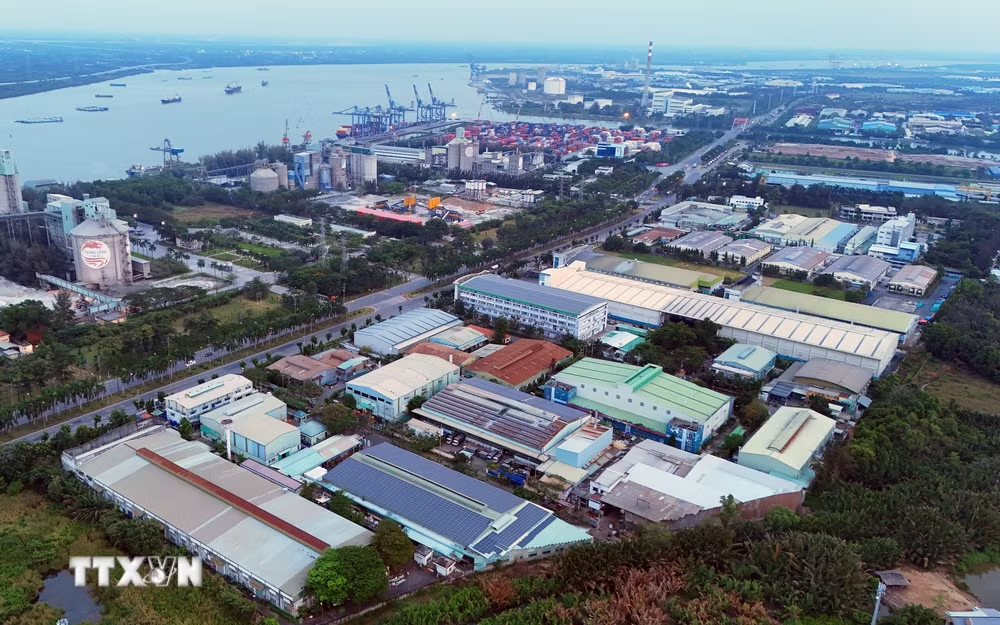
Interregional connectivity has been comprehensively upgraded.
Infrastructure and transportation are being planned and upgraded significantly across the country, helping to increase regional connectivity and logistics capacity – a key factor that directly supports industrial real estate.
In the South, the People’s Committee of Ho Chi Minh City is seeking feedback on the Ho Chi Minh City Master Plan for the period 2025-2050, with a 100-year vision. In this plan, transportation infrastructure is a key axis connecting the expanding urban space and promoting regional linkages through a multimodal model: expressways, strategic ring roads (Ring Road 3, Ring Road 4, Ben Luc-Long Thanh, Ho Chi Minh City-Moc Bai…), national high-speed railways connecting industrial zones, seaports, airports, along with an integrated system of seaports, inland ports, and logistics centers. This creates a more favorable operational foundation for industrial projects.
In the North, the Dong Anh, Me Linh, and Soc Son areas are being developed into dynamic hubs for international integration, centers for services, trade, logistics, and high-tech industries, linked to Noi Bai International Airport. Key metro lines (lines 2, 10, and 14) are underway, along with the completion of Ring Road 4 and the expansion and upgrading of Noi Bai Airport, connecting it with international logistics and free trade centers, strengthening the North’s position on the national production and logistics map.
According to Avison Young Vietnam, the shift of global supply chains to Vietnam has led to increasingly high demands for infrastructure quality and operational readiness. Businesses are not only seeking land but also requiring complete technical systems, from electricity and water to logistics and supply chain connectivity. This forces industrial park developers to upgrade development standards, ensuring the ability to meet the needs of specialized manufacturing sectors such as electronics, semiconductors, or high technology, instead of the mass development model of the past.
“Competition among industrial parks no longer depends on rental prices. Operational efficiency and the ability to meet the more detailed requirements of the new generation of investors are the differentiating factors,” said Mr. Vu Minh Chi, Director of Industrial Park Services, Avison Young Vietnam.
As Vietnam strives to transition to high-tech and high-value manufacturing industries, the well-managed development roadmap of new industrial parks will be strategically positioned to attract the next wave of foreign investment.
According to leading real estate market research firms in Vietnam, next-generation technology parks are shifting from a model of simply providing land to developing integrated industrial ecosystems, including energy infrastructure, technology, logistics, and worker amenities. This integration not only enhances operational efficiency but also improves the quality of the working environment, thereby attracting high-quality labor. This is also a crucial factor in helping Vietnamese industrial parks improve their position in the global value chain and attract large-scale, high-tech FDI projects.
With land resources shrinking in some key markets, the trend of developing modern, multi-story factories and warehouses is becoming a natural direction to maximize land use efficiency. According to Mr. Nguyen Phuoc Thuan, this trend aligns with the direction of Resolution 10-NQ/TW, as Vietnam gradually shifts from simply attracting capital to projects with higher technological content, added value, and operational quality. Multi-story factories are suitable for high-tech industries such as electronics, semiconductors, medical equipment, and R&D; multi-story warehouses are a solution for logistics, e-commerce, and cold storage in areas near consumer centers or major transportation hubs.
“In the long term, the development of multi-story warehouses and factories will not only solve the land shortage problem but also contribute to upgrading the quality of Vietnam’s industrial supply,” Mr. Thuan assessed.
On the other hand, instead of large-scale upgrades to existing industrial parks – most of which have only been operating for 20-30 years – the prominent trend is to expand supply to new locations to capitalize on new infrastructure and capital flows, reflecting the early stage of development of Vietnam’s industrial market compared to the region.
It is clear that Vietnam’s growth story is no longer solely about growth rate, but increasingly about where that growth is taking place and the connectivity between growth poles. As ring roads, metro lines, and airport connectivity infrastructure are gradually completed in the coming years, demand for housing, industrial, retail, and hospitality is projected to continue expanding beyond the traditional central areas.
Locations with convenient connectivity will have an advantage in attracting residents, businesses, and investment capital; at the same time, the formation of new economic corridors can promote the development of new urban and commercial hubs, contributing to changing the real estate value map in key localities as well as the entire region.
Source: https://www.vietnamplus.vn/dong-von-fdi-thuc-day-tang-truong-cua-bat-dong-san-cong-nghiep-post1137144.vnp