
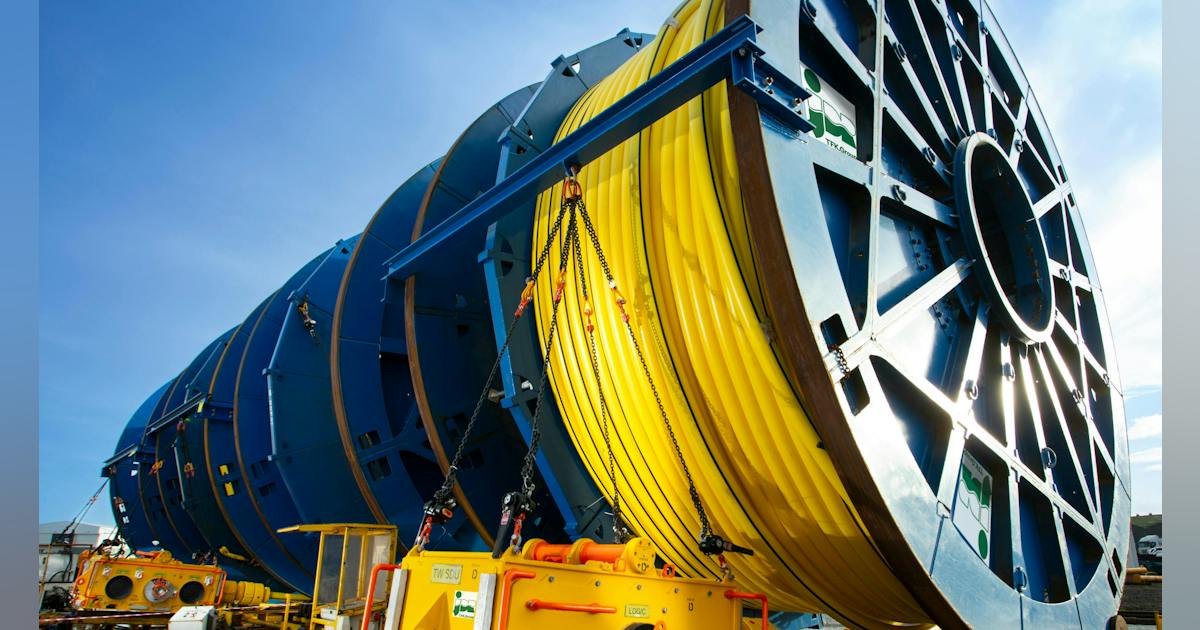
Biggest drivers of subsea cable demand
Knott said demand for subsea infrastructure is being driven by three converging trends:
- Larger offshore wind projects;
- Continued deepwater oil and gas investment; and
- Growing offshore electrification efforts.
Together, these trends are increasing demand for higher-capacity cable systems and more advanced subsea infrastructure.
“Offshore wind remains a major one as turbines become larger and projects require higher-capacity cable systems to transmit increasing amounts of power,” he added. “Electrification is another driver.”
While much of the industry’s attention is focused on offshore wind, Knott noted that deepwater oil and gas developments remain a significant source of demand for subsea infrastructure.
Electrification and offshore cable requirements
Electrification is becoming a practical pathway for operators seeking to reduce offshore emissions. As more facilities rely on power supplied from shore, cable systems must deliver higher transmission capacity while maintaining long-term reliability for critical offshore operations.
“This is one of the most practical aspects of the energy transition,” he said. “Electrification gives operators a tangible way to address operational emissions while continuing to meet current energy needs.”
Brazilian deepwater developments
The success of Brazil’s next generation of deepwater projects will depend heavily on early collaboration between operators and suppliers, Knott said. He also emphasized the importance of local expertise, project planning and technical support capabilities to deliver increasingly complex subsea developments.
“For the next wave of Brazilian deepwater development, project execution will be critical,” he said. “Brazil already has considerable offshore expertise, and that becomes increasingly valuable as deepwater developments move forward.”
Scaling floating offshore wind
According to Knott, floating wind has already proven its technical viability. The industry’s next challenge is industrialization: reducing costs, improving supply-chain coordination and applying lessons learned from decades of offshore oil and gas operations to commercial-scale floating wind projects.
“We know floating wind can work. The next stage is making projects more efficient and cost-effective to deliver as the industry moves from a handful of turbines to full-scale developments,” he added. “Scaling floating wind is ultimately a question of industrialization.”