
Azerbaijan has improved its position by four spots to rank 60th among 146 nations in the 11th edition of the Global Attractiveness Index (GAI 2026), joining the world leaders in terms of sustainability dynamics and macroeconomic indicators, Report informs.
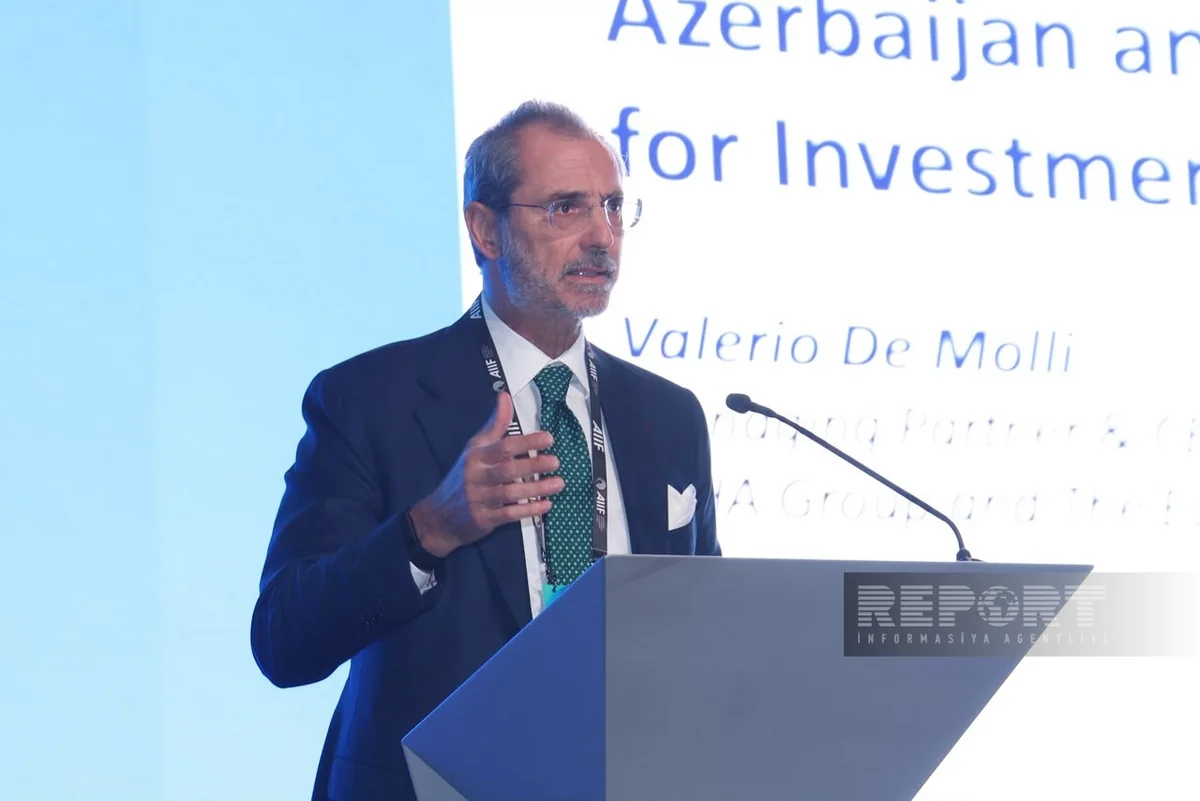
Valerio De Molli, Managing Partner and CEO of TEHA Group (The European House – Ambrosetti), made the remark during the Second Azerbaijan International Investment Forum (AIIF 2026) in Baku.
The GAI rating evaluates 146 countries representing 95% of the world’s population and 99% of global GDP. The index methodology is audited by the Joint Research Center (JRC) of the European Commission.
“Azerbaijan’s key indicators in GAI 2026 include: 60th worldwide in overall attractiveness, 15th worldwide in the Dynamism Index, a public debt-to-GDP ratio of 20.1% (the eighth lowest on the planet), and a 513% increase in scientific publications (fourth worldwide in terms of growth rate),” De Molli noted.
The head of TEHA Group noted that Azerbaijan’s most significant progress was achieved in the Dynamism Index, climbing from 145th to 15th place over the past eight years. This outcome represents the second-largest improvement in ranking among all countries globally over that period.
“Notable progress was also recorded across other GAI sub-indices – the Positioning Index: 64th worldwide (+6 spots over eight years); the Sustainability Index: 62nd worldwide (+30 spots over eight years); and the Future Orientation Index: 65th worldwide (+13 spots over seven years),” he emphasized.
In the macro-region of the South Caucasus and Central Asia, Azerbaijan ranked third in overall attractiveness (60th place), behind Kazakhstan (56th) and Georgia (59th), but ahead of Uzbekistan (63rd), Armenia (68th), Kyrgyzstan (80th), and Tajikistan (96th). At the same time, Azerbaijan recorded the highest annual rise in the region (+4 positions year-over-year).
According to De Molli, Azerbaijan secured the top position in the South Caucasus and Central Asia macro-region across seven key performance indicators:
“Dynamics of scientific publication volume (1st worldwide and in the macro-region), energy balance (4th worldwide, 1st in the macro-region), dynamics of foreign direct investment inflows (6th worldwide, 1st in the macro-region), dynamics of profit tax burden reduction (6th worldwide, 1st in the macro-region), public debt-to-GDP ratio (8th worldwide, 1st in the macro-region), total factor productivity (TFP) dynamics (8th worldwide, 1st in the macro-region), and 20-year forecast of working-age population share (29th worldwide, 1st in the macro-region),” De Molli stated.