
Live updates: US and Iran agree to conditional ceasefire
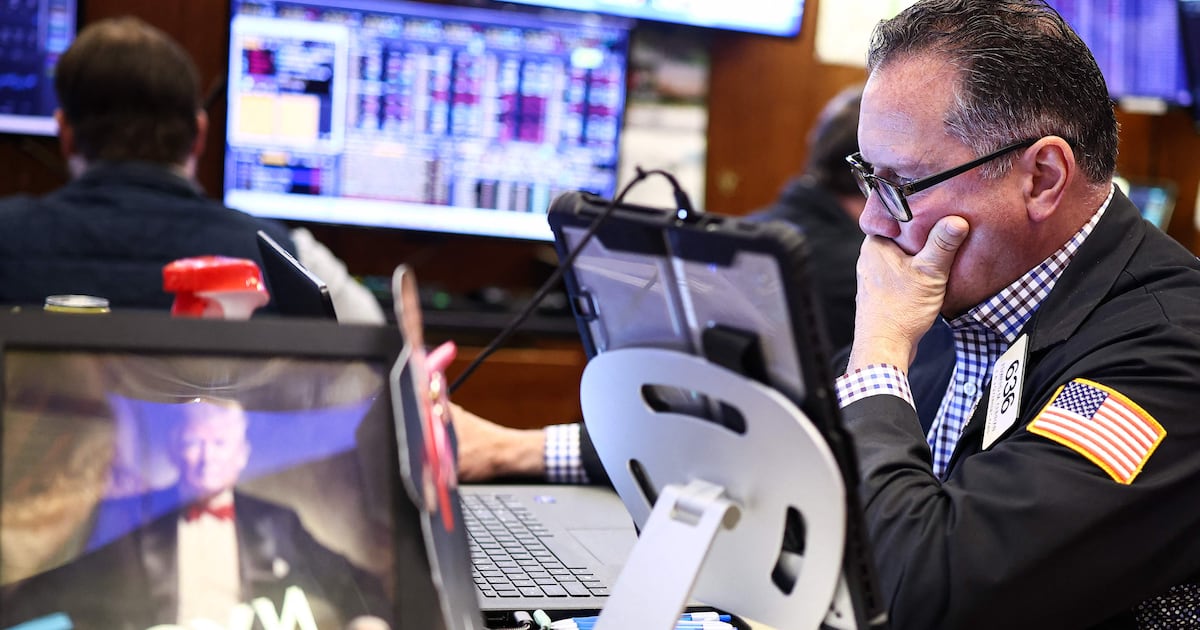
The world’s eyes are on the conflict in Iran. As it drags on, the threat of an energy crisis intensifies by the day. Investors can’t tear their eyes away, with global stock markets plunged into volatility.
But it’s not the only threat out there. Before US President Donald Trump launched his war, investors were already grappling with two other bubbles, and they haven’t gone away.
The first is in artificial intelligence, with hyperscalers pouring vast sums into infrastructure while struggling to generate sufficient returns.
The second is in the $2 trillion private equity sector, where unregulated non-bank lenders, or shadow banks, are financing the AI boom with high levels of debt. If AI firms cannot service those loans, losses could cascade through the system and threaten broader financial stability.
There is also the risk that AI disruption itself undermines existing business models, triggering widespread debt impairments elsewhere.
As the Iran conflict pushes up energy prices, fuels inflation and keeps interest rates higher for longer, these pressures risk colliding. How worried should we be?
Vijay Valecha, chief investment officer at Century Financial, says AI spending has hit dizzying levels. S&P Global estimates Microsoft, Amazon, Alphabet and Meta plan about $635 billion of AI-related capital expenditure in 2026, up from $383 billion in 2025 and just $80 billion in 2019. “That makes the AI trade sensitive to higher interest rates and any slowdown in investor monetisation.”
Madhur Kakkar, founder and chief executive of Elevate Financial Services, warns that markets are not just pricing AI for growth, but perfection. “Leadership is narrow, capital expenditure runs into the trillions, and earnings are still catching up. That gap does not always close smoothly.”
At the same time, private markets remain under strain, with roughly 32,000 unsold companies worth $3.8 trillion, amid delayed exits and mounting liquidity pressure.
Mr Kakkar says private equity and private credit present a risk of delayed reality. “Higher rates have slowed exits, increased funding costs, and compressed valuations. Private markets adjust slower than public ones. That creates a potential lagged shock.”
The shadow banking sector has expanded to $257 trillion, equivalent to just over half of all global financial assets, Mr Valecha says.
“Individually, these risks are manageable. But if they materialise together, they could reinforce each other and lead to a deeper and more prolonged market correction.”
Hamza Dweik, head of trading for Mena at Saxo Bank, says the probability of all three risks materialising at once in a triple whammy is still relatively low, but cannot be ruled out.
“The result could see much greater volatility than many investors are currently pricing in.”
A sustained rise in oil prices could keep inflation stubbornly high, delay interest rate cuts, and increase refinancing pressure. “If sentiment turns, the impact could be amplified because AI exposure is now embedded across indices, thematic funds, and retail portfolios.”
Today, many portfolios remain positioned for a benign outcome, having been drawn up before the war.
The good news, he adds, is that household balance sheets are stronger and banks are better capitalised, reducing the risk of systemic collapse but not prolonged volatility.
Yves Bonzon, group chief investment officer at Julius Baer, is less alarmed about private debt. “In truth, private debt is less leveraged and, thanks to its illiquid nature, carries less systemic risk than the traditional banking sector.”
He argues risks are more concentrated in private equity, lower down the capital structure.
“But the main risk remains the vulnerability of business models disrupted by AI. As we move forward, dispersion between AI losers and winners will only widen.”
After 15 years of US exceptionalism driven by its technology giants, investors are still heavily exposed, he adds.
Mr Bonzon describes the war outlook as “binary”, with either a recession driven by prolonged disruption or a relatively swift de-escalation. “Given the fluid situation in the Middle East, patience is warranted, as this is not the time to add meaningfully to risk.”
Other risks on the horizon
As well as war, AI and private credit, the world is vulnerable in other ways, says James J Angel, faculty affiliate at Georgetown McDonough’s Psaros Centre for Financial Markets and Policy. “The near doubling of oil prices will increase production costs for almost everything. This will be passed on to consumers, raising the cost of living.”
Fuel and food prices will rise, potentially triggering serious civil unrest. “Multiple things can break at the same time, leading to more extreme financial events. Policymaker errors could make the situation worse.”
Russ Mould, investment director at AJ Bell, says the conflict has checked the momentum of the previously dominant S&P 500. “It comes on top of nagging doubts about US tariffs and political pressure on the Federal Reserve, further aggravating private credit and AI bubble fears.”
Adding to the danger, US equities look expensive based on almost any metric. “They represent more than 60 per cent of global stock market capitalisation. Just as they did at the peak of the dot-com bubble.”
So how should private investors respond? Even if we escape a full-blown polycrisis, the investment landscape is shifting.
Betting against US entrepreneurial culture is rarely smart, but investors may want to diversify into underperforming areas such as emerging markets, the UK and commodity stocks. “Vital raw materials are key elements of national security, and offer protection against inflation,” Mr Mould says.
Tony Hallside, chief executive of STP Partners in Dubai, says most portfolios look diversified on paper but are more concentrated than investors realise. “A typical allocation today is heavily exposed to a small group of large-cap tech names.”
It’s a challenge for investors to keep calm and carry on
Susannah Streeter,
chief investment strategist at Wealth Club
It’s a challenge for investors to keep calm and carry on.
Investors should not panic and shift funds out of riskier areas, but should reduce concentration, Mr Hallside says. “The key is to avoid being exposed to the same macro risk through multiple channels, whether that is AI-driven equity concentration or leveraged credit exposure.”
Markets can stabilise quickly if inflation eases, but if rates stay higher for longer, portfolios built on narrow leadership and leverage will be the most exposed, he adds.
Susannah Streeter, chief investment strategist at Wealth Club, says investors are in a period of rolling risks, which have already collided to some extent. “It’s a challenge for investors to keep calm and carry on.”
Yet she says it is important to remember that asset valuations have recovered quickly after previous conflicts.
Markets also rebounded quickly after the 2020 pandemic, 2022 energy shock, and Donald Trump’s ‘liberation day’ tariffs. Investors who’d already exited the market lost out.
These are uncertain times, but in one respect, the old rules still apply, Ms Streeter says. “During periods of volatility, time in the market and diversification have consistently been the foundations of successful investing.”