
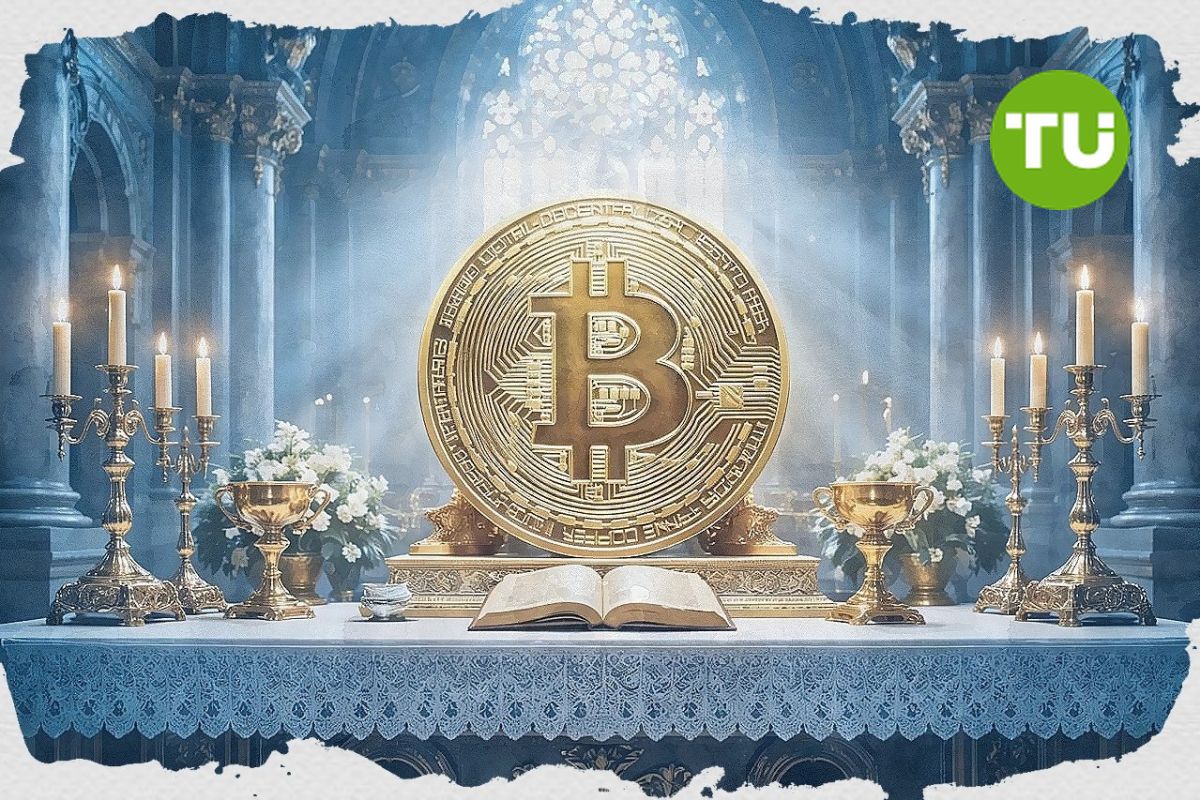
Can the position of the Pope change attitudes toward cryptocurrency? At first glance, the church seems to have nothing to do with the crypto market. But institutions like this often define what society considers a risk, speculation, or an accepted norm. And therefore, they shape the environment in which cryptocurrency either gains ground or faces resistance.
Why churches did not accept cryptocurrency
At the early stage of Bitcoin’s existence, churches did not see cryptocurrency as either a new ethical challenge or a полноценный financial instrument. In the first half of the 2010s, it entered the religious sphere mainly through isolated practical experiments, most often in the form of donations. A notable early example is the London Anglican parish St Martin-in-the-Fields, which began accepting BTC donations in February 2014.
However, the first массовое impression of cryptocurrency within church circles was shaped not by donations, but by the 2017 boom — along with volatility, fraud, and a sense that the market operated on a logic of rapid enrichment. It was then that the first strong positions from major religious institutions emerged. On December 4, 2017, Turkey’s Diyanet stated that cryptocurrency transactions associated with high uncertainty, the risk of deception, and unjustified enrichment could not be considered permissible. On December 28, 2017, Egypt’s Dar al-Ifta declared Bitcoin transactions prohibited, citing harm to the economy, market instability, lack of legal protection, and excessive uncertainty.
In the Catholic world, the reaction was initially more restrained, but still cautious. The Vatican was in no hurry to grant cryptocurrency institutional trust and, when the Holy See publicly engaged with the topic, it immediately emphasized risks. In October 2021, a Vatican representative at a UN platform spoke about uncontrolled digital payments, lack of proper identification, and the risks of using unregulated cryptocurrencies in migrant smuggling and other criminal schemes. Such statements effectively served as warnings to the faithful against using cryptocurrency.
In other words, the church’s initial response was largely defensive. Early positive interactions with cryptocurrency did exist, but they were local and practical. Major religious centers initially read this new reality as a space of speculation, deception, legal uncertainty, and social risk. It is from this starting point that the entire subsequent church discourse on cryptocurrency developed.
How the church gradually began to change its attitude
The shift did not begin when churches suddenly believed in cryptocurrency, but when they learned to separate the technology itself from the speculative noise surrounding it. If early reactions were almost entirely negative, over time a different approach emerged within church circles: not to reject the instrument entirely, but to seek a form in which cryptocurrency could function under control, transparently, and without a cult of quick money.
This is most visible in the Catholic example. While in 2021 the Vatican spoke of blockchain only as a threat, by 2024 the Vatican Apostolic Library, together with NTT DATA, launched a Web3 project in which users, by promoting the initiative or making a donation, received a non-transferable NFT as a key to access a digitized collection of manuscripts. This is a highly illustrative shift: from the language of threat to the controlled use of technology for culture, community, and institutional support.
Even more importantly, the change in attitude manifested not only in symbolic projects, but also in financial practice. The Roman Catholic Archdiocese of Washington no longer merely allows cryptocurrency donations but clearly outlines how to handle them. All contributions are immediately converted into US dollars, donors undergo KYC and anti-money laundering procedures, and anonymous donations are not accepted. In other words, cryptocurrency has become acceptable not as an ideology of freedom from rules, but as just another payment instrument within a strictly defined framework.
A similar shift is visible across the broader Catholic environment. The international humanitarian organization Catholic Relief Services in the United States now actively promotes cryptocurrency donations as an effective way to support charity, explaining that for donors this may mean full market valuation of the gifted asset and avoidance of capital gains tax. In other words, the Church is no longer arguing with the very existence of cryptocurrency, but integrating it into the familiar logic of charity, accountability, and fiscal benefit.
In the Protestant environment, the turn toward practical acceptance came even earlier. As early as December 2020, The Salvation Army in the western United States launched the first “crypto kettle,” allowing direct donations in Bitcoin and Ethereum. But here too, the shift was driven not by the romance of digital money, but by very practical considerations: the need for a new donor base, the convenience of fundraising during a time of crisis, and the use of intermediaries that accept cryptocurrency, sell it, and transfer conventional money to the organization. This again highlights the core principle of the new church logic: not to retain risk internally, but to domesticate the tool through infrastructure and control.
Even where church institutions have not become open supporters of cryptocurrency, the tone of the conversation itself has changed. Initially, it sounded like a warning about a vague and dangerous zone. Now, it increasingly sounds like a set of conditions: can this instrument be made transparent, can anonymity be reduced, can donations be separated from speculation, and technology from criminal use. This is the essence of the shift. The Church has not so much embraced cryptocurrency as acknowledged that it will have to deal with it — but only on its own terms.
How the church influences the crypto market
So does it matter how exactly the church views cryptocurrency? At first glance — not really. It does not trade on exchanges or move charts. But in practice, its position can influence both market sentiment and real money flows.
First, through trust. When major church institutions recognize cryptocurrency as acceptable, it automatically becomes less risky for a broad audience. This does not change prices instantly, but it changes people’s willingness to enter the market.
Second, through money. The church is not only a moral authority but also a large financial system with постоянные donation flows. If even part of major denominations begins to systematically accept cryptocurrency or designates specific assets as “acceptable,” this could create stable inflows. Believers will donate in these assets, and that is no longer symbolic but a tangible source of demand.
Third, through institutional behavior. The Vatican already operates within financial markets, and it is not hard to imagine a scenario where some institutions begin experimenting with crypto assets — not necessarily as speculation, but as a new asset class or even as infrastructure. Mining or participation in blockchain projects, in the long term, already look less exotic today than they did a few years ago.
But another point is more important. Even if the church moves toward more open acceptance, it will almost certainly support not the entire crypto space, but only its “safe” segment. Transparent assets, clear infrastructure, control, and the absence of anonymity — in other words, the part of the market that is already moving toward regulation.
For a trader, this means something simple. Full recognition from the Vatican or other major denominations will not necessarily trigger a sharp rally, but it could redistribute trust and capital within the market. Some assets will gain additional legitimacy and stable inflows, while others may come under greater pressure.
Ultimately, the question today is no longer whether the Church will “accept cryptocurrency.” The question is which cryptocurrency it will consider acceptable. And when that choice is eventually made publicly, the market will receive not a short-term impulse, but a new hierarchy of trust.
This material may contain third-party opinions, none of the data and information on this webpage constitutes investment advice according to our Disclaimer. While we adhere to strict Editorial Integrity, this post may contain references to products from our partners.