
Key Takeaways
-
Standard Bitcoin wallets will destroy your Ordinals. A regular BTC wallet has zero awareness that an inscribed satoshi exists. It will spend it as transaction change — permanently destroying your NFT without warning. You need an Ordinals-native wallet.
-
The Bitcoin Ordinals ecosystem has crossed 90 million inscriptions as of April 2026, with March 2026 generating $46.8 million in secondary sales across nearly 60,000 transactions and 14,909 unique buyers.
-
ORDI surged 184% in a single 24-hour window this week, with the broader BRC-20 sector hitting a $237 million market cap and $1.6 billion in daily trading volume — signaling explosive renewed interest in Bitcoin-native digital assets.
-
Runes now dominate fungible token activity on Bitcoin, capturing 35% of all Bitcoin metadata transactions. Built directly on Bitcoin’s UTXO model, Runes are more efficient, cheaper, and cleaner than BRC-20 — your 2026 wallet must support them.
-
Magic Eden exited the Bitcoin NFT space in March 2026, sending users scrambling to purpose-built wallet and marketplace alternatives — a watershed moment that elevated dedicated Ordinals wallets to critical infrastructure.
-
Top 3 quick picks: Xverse (best all-rounder for beginners and mobile), UniSat (best for BRC-20 power users and traders), Leather (best for Bitcoin DeFi and Stacks ecosystem).
However, the technical nature of Ordinals makes security a critical hurdle for the average user. Traditional Bitcoin wallets often fail to distinguish between inscribed and “clean” satoshis, leading many to accidentally spend their valuable assets as mere transaction fees. To navigate this landscape safely, specialized Ordinals wallets are no longer optional but essential.
This guide simplifies that complexity by ranking the top 10 wallets of 2026, breaking down non-negotiable security rules, and providing a comparison framework to help you protect your digital inscriptions from costly, irreversible mistakes.
What Is an Ordinals Wallet?
An Ordinals wallet isn’t just a Bitcoin wallet; it’s a specialized tool designed to recognize, isolate, and protect inscribed satoshis.
Standard wallets use a UTXO (Unspent Transaction Output) model that treats all satoshis as identical. This creates a massive risk: a standard wallet might accidentally spend a rare Ordinal worth thousands of dollars to cover a tiny transaction fee. To prevent this, an Ordinals wallet utilizes UTXO-level awareness (or “UTXO locking”). This feature automatically labels and freezes inscribed satoshis, ensuring they are never spent as “change.”
In 2026, a fully capable Ordinals wallet must also support:
Bitcoin Ordinals (Inscriptions): The original standard. Each inscription is unique and non-fungible — the Bitcoin equivalent of an NFT. Data can include images, text, audio, video, or applications, all stored 100% on-chain. Once inscribed, the content is immutable and permanent — it cannot be deleted, modified, or lost if a hosting provider shuts down.
BRC-20 Tokens: A fungible token standard built on top of Ordinals using JSON text inscriptions. The entire BRC-20 category holds a $71 million market cap with millions in daily volume across leading tokens, proving the standard maintains real utility and liquidity three years after its debut. Key tokens include ORDI, SATS, RATS, and MUBI.
Rare Sats: Certain satoshis carry historical significance based on when they were mined — the first sat of a halving block, a palindrome number, a specific mining epoch. Dedicated “Rare Sat” detection and protection is now a standard feature in top-tier wallets.
Why You Need a Specialized Ordinals Wallet
If you’ve been managing Bitcoin in a standard wallet and are now exploring Ordinals, this section explains exactly why you cannot simply use what you already have — and what the real-world consequences of ignoring this are.
1. The Risk of Permanent Loss
The “accidental spend” problem is irreversible. Unlike Ethereum, where tokens and gas are separate, Ordinals reside inside Bitcoin UTXOs. A standard wallet cannot distinguish an inscription from a regular satoshi; if it spends an inscribed sat as change or a fee, that asset is gone forever with no possibility of recovery.
2. A Billion-Dollar Ecosystem
The market has matured into a $1.2 billion industry with over 24 million inscriptions. As demand for Bitcoin NFTs and BRC-20 tokens surges, high-grade security is no longer optional. With user bases growing by 60% in early 2026, infrastructure-grade protection is now a baseline requirement for collectors.
3. Shifting Marketplace Dynamics
The landscape changed significantly in early 2026:
-
The Magic Eden Exit: After Magic Eden discontinued Bitcoin support in March 2026, users migrated to platforms with native Ordinals tooling.
-
The Rise of Horizon: Horizon Market now leads the space, offering unified access to all major Bitcoin NFT protocols. To navigate this new environment, you need a wallet that integrates directly with these specialized marketplaces.
4. Mandatory Hardware Security
Cold storage is now the standard for serious holdings. By 2026, over 35% of crypto users utilize hardware wallets (like Ledger or Trezor) as their primary security layer. Utilizing features like biometric ID and physical “UTXO locking” is essential to protecting high-value digital artifacts from theft and human error.
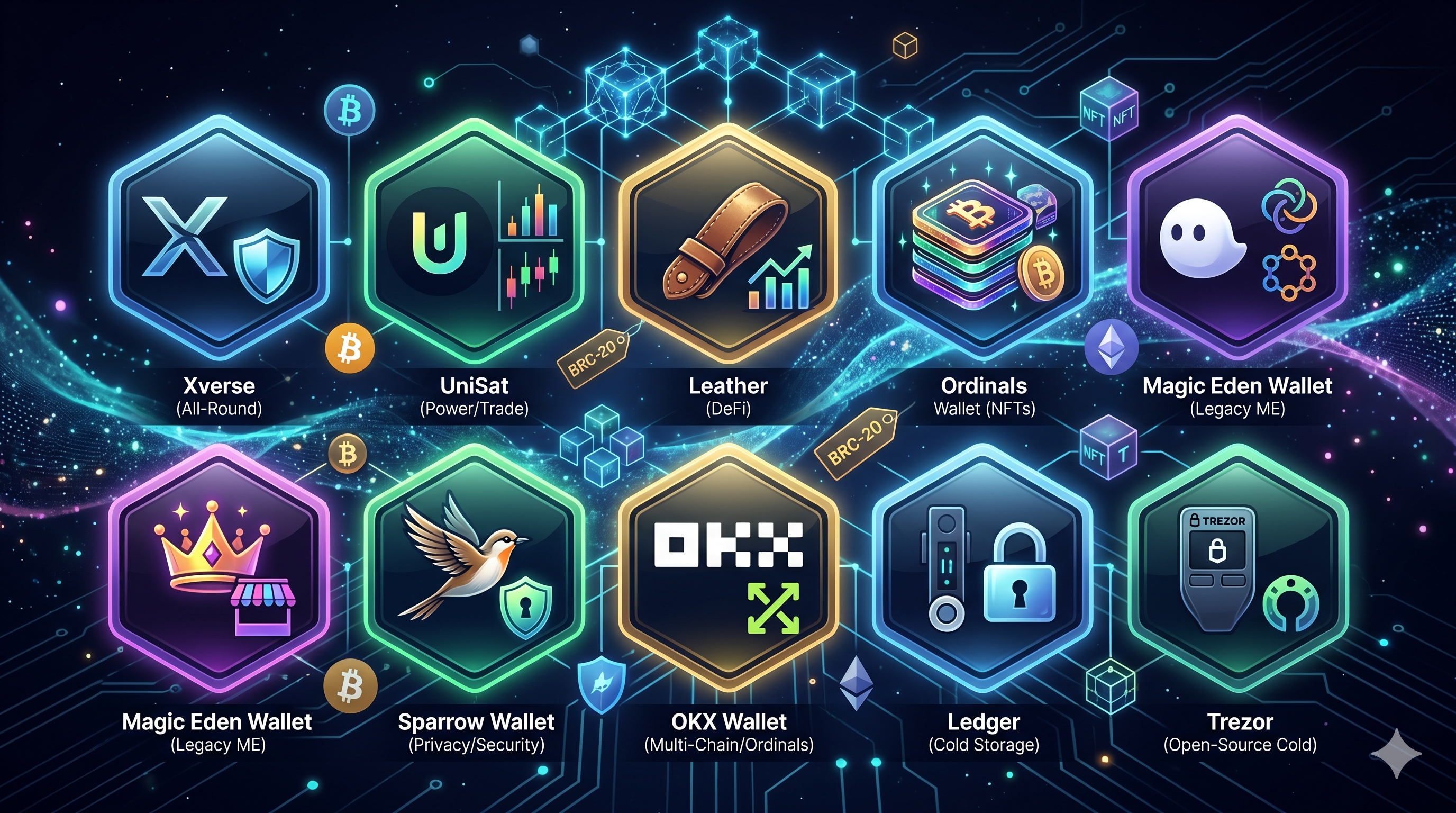
Top 10 Ordinals Wallets Ranked by Use Case (2026)
1. Xverse — Best All-Round Ordinals Wallet for 2026
Best for: Beginners, mobile users, and anyone who wants one wallet for all Bitcoin-native assets.
Xverse is the most complete Bitcoin Web3 wallet available in 2026. Available on iOS, Android, and Chrome extension, it supports Ordinals, Runes, BRC-20, Rare Sats, Stacks, and multiple Bitcoin Layer 2s from a single interface. Standout features include a fiat-to-Bitcoin on-ramp, rare satoshi detection, support for BRC-20 tokens, biometric authentication, and Ledger hardware wallet integration — making it one of the most crypto-friendly options in the Web3 space.
Xverse’s wallet has built-in ledger support, biometric authentication and multi-sig support, giving you plenty of security options. Xverse also has a mobile app, allowing you to access your wallet on the go. Xverse is audited and open source — regularly audited by Least Authority. It integrates with major marketplaces like Gamma, Liquidium, and the new Horizon Market, and supports in-wallet token swaps via the Satsdaq platform.
Pros: Mobile-first, beginner-friendly, full asset support, biometric auth, Ledger integration, automatic UTXO separation
Cons: Main codebase is not fully open source; some users report occasional Chrome extension sync issues
2. UniSat — Best for BRC-20 Power Users and Marketplace Traders
Best for: Active BRC-20 traders, power users, and deep inscription tooling.
UniSat was the first wallet purpose-built for Bitcoin Ordinals and BRC-20 tokens. That head start gave it something no competitor has easily replicated: a massive built-in user base and a native marketplace. Today it supports Ordinals, Runes, Alkanes, BRC-20, and rare sats. It also added Fractal Bitcoin support, which is a Bitcoin scaling layer that uses Bitcoin Core code to run a secondary chain.
In early 2026, UniSat doubled down on its Bitcoin-only commitment. The team implemented a 90-day zero-fee policy on the UniSat Marketplace starting March 1, 2026, while expanding access to UniHexa — a unified on-chain exchange service for BRC-20 and Runes — and planning to upgrade the UniSat API to a commercial-grade MCP architecture for on-chain data. UniSat’s “Unconfirmed NFTs” feature lets you view inscriptions before they are confirmed on-chain — unique functionality no other wallet offers. The UniSat wallet is 100% open source — making it a good choice for investors who value transparency. UniSat’s wallet connects to the UniSat marketplace — which makes it easy to buy, sell, and trade ordinals.
Pros: Open source, native marketplace, zero-fee policy, Fractal Bitcoin support, unconfirmed NFT visibility, no KYC
Cons: Uses a single Taproot address for both BTC and Ordinals, increasing accidental spend risk; interface less polished than Xverse
3. Leather (formerly Hiro Wallet) — Best for Bitcoin DeFi
Best for: Users combining Ordinals with Bitcoin-native DeFi on Stacks.
Leather was the first wallet to launch Ordinals testnet support in February 2023, and it remains the go-to choice for the Bitcoin DeFi ecosystem. Leather’s real focus is on Bitcoin DeFi. The wallet gives you direct access to Stacks DeFi protocols like ALEX, Bitflow, Velar, and Zest, and it’s building native sBTC support for bridging BTC into the Stacks ecosystem. It processes over 300,000 transactions monthly and has 100,000+ active monthly users.
Leather boasts over 375,000 total downloads to date and maintains a strong user base with more than 100,000 active monthly users. Leather supports Bitcoin Assets like Ordinals, BRC-20 tokens, Stamps and Runes. It provides access to NFT Marketplaces like Gamma and Magic Eden, and decentralized exchanges such as ALEX and Velar. The wallet is also compatible with Ledger hardware devices.
Pros: Open source, audited by Least Authority, deep DeFi integrations, Ledger compatible, 100K+ active users
Cons: No mobile app yet (coming soon); primarily Bitcoin-and-Stacks focused — less suited for multi-chain users
4. Ordinals Wallet — Best Dedicated Bitcoin NFT Collector’s Wallet
Best for: Focused collectors who want a clean, inscription-first experience without multi-chain noise.
Ordinals Wallet is the leading Bitcoin-native marketplace for Ordinals, Runes, Tap, and BRC-20 tokens, allowing users to buy, sell, and securely store their Bitcoin NFTs in a non-custodial wallet built for collectors and traders. Ordinals Wallet has a simple interface for managing and storing Bitcoin and Ordinals NFTs. It is available on both desktop and mobile. You can create your own Ordinals through its built-in inscription tool.
Ordinals Wallet now supports all four major Bitcoin-native asset standards: Ordinals, Runes, BRC-20, and Tap tokens — making it arguably the most protocol-comprehensive collector’s wallet available in 2026.
Pros: Clean collector-focused UX, built-in inscription tool, all four Bitcoin asset standards, cross-platform
Cons: Bitcoin-only (no cross-chain); lacks advanced power trading features
5. Phantom — Best Multi-Chain Wallet with Ordinals Support
Best for: Users managing Solana, Ethereum, and Bitcoin assets from a single interface.
Phantom Wallet is designed to simplify the management of various assets, including Bitcoin, Ordinals, and BRC-20 tokens. It integrates features from Solana, Ethereum, and Bitcoin, allowing users to manage their portfolios seamlessly across different chains. With Phantom, users can buy, sell, trade, and transfer BTC, Ordinals, and BRC-20 tokens with ease. The wallet offers an immersive Ordinals gallery and automatic spam detection for enhanced security.
Phantom supports Native SegWit and Taproot addresses, and it works with Ordinals. It no longer supports BRC-20s in-app. For cross-chain collectors who hold Solana NFTs or Ethereum assets alongside Bitcoin inscriptions, Phantom is the most elegant single-wallet solution available.
Pros: Excellent multi-chain UX, automatic spam detection, Ordinals gallery, Ledger support, beginner-friendly
Cons: Bitcoin is secondary to Solana; no longer supports BRC-20 in-app; not optimized for deep Ordinals trading
6. Magic Eden Wallet — Best for Legacy ME Collectors
Best for: Collectors who built their collection through Magic Eden and want wallet continuity.
The Magic Eden Wallet is a great choice for those who want a simple, seamless integration between their Ordinal marketplace and wallet. Magic Eden’s multi-chain wallet also partners with projects in the Ordinals space to give exclusive perks to ME Wallet users. Audited — ME Wallet’s code has passed security checks by 3rd party security auditor Halborn.
Xverse, Magic Eden Wallet, and Hiro (Leather) wallets can be connected to Magic Eden, offering seamless integration and added protection. Magic Eden champions secure transactions in the Bitcoin ecosystem through its adept use of Partially Signed Bitcoin Transactions (PSBTs). Despite the marketplace closure in March 2026, the wallet itself remains functional and secure, with full Ordinals and Runes support.
Pros: Halborn-audited, PSBT-based secure trading, automatic address separation, multi-chain
Cons: Primary Bitcoin NFT marketplace has closed; ecosystem relevance has narrowed in 2026
7. Sparrow Wallet — Best for Privacy-First and Advanced Security Users
Best for: Privacy-conscious power users, advanced Bitcoin security practitioners, multisig setups.
Sparrow Wallet is a Bitcoin and Ordinals wallet that’s considered best in class when it comes to security and privacy. Privacy Focused: Excellent choice for investors focused on privacy. Sparrow Wallet is built on Tor — an open-source network built for anonymous communication. Multisig and Hardware Wallet Support: Sparrow offers features to help you maximize your security — including support for hardware and multisig wallets. Customizable: Includes a full transaction editor for advanced users.
Sparrow gives you the deepest UTXO management control of any wallet on this list — ideal for collectors who want surgical precision in how their inscriptions and BTC are handled. Pair with Ledger or Trezor for the maximum security stack.
Pros: Best-in-class UTXO control, Tor privacy, hardware wallet integration, multisig, fully open source
Cons: Steep learning curve; desktop-only (no mobile); requires manual configuration to protect Ordinals
8. OKX Wallet — Best Multi-Chain Alternative with Full Ordinals Support
Best for: Users already in the OKX ecosystem wanting one wallet across all blockchains including Bitcoin.
OKX Wallet is a decentralized multi-chain wallet designed to provide users with access to the world of Web3. It offers access to over 1,000 DApp protocols, including features like multi-chain and cross-chain decentralized exchanges (DEX), yield farming, NFT marketplaces, and DApp discovery. OKX Wallet emphasizes security, having passed a security key audit by Slowmist, and it assures users that it never saves seed phrases, private keys, or passwords.
OKX Wallet supports over 50 blockchains with full Ordinals, BRC-20, and Runes support — making it the broadest multi-chain option for users who want a single wallet across their entire crypto portfolio.
Pros: 1,000+ DApp integrations, 50+ chains, SlowMist-audited, multi-chain DeFi access
Cons: Bitcoin Ordinals are one of many chains, not primary focus; can feel overwhelming for Ordinals-only users
9. Ledger (Hardware Wallet) — Best Cold Storage for High-Value Collections
Best for: Long-term holders with significant inscription or BRC-20 portfolios requiring maximum security.
Trezor and Ledger, two of the most popular Bitcoin wallets on the market, now offer full support for Ordinals inscriptions, thanks to the Taproot upgrade. These wallets store your private keys offline, separate from internet access, reducing the risk of hacks. Ledger is compatible with over 50 third-party wallets, such as MetaMask, Phantom, MyEtherWallet, Rainbow, and Neon wallet. Ledger’s Secure Element chip (CC EAL5+ certified) stores cryptographic secrets in complete hardware isolation. Pair with Xverse for the best Ordinals workflow combining hardware security with software management.
Pros: Maximum private key security, CC EAL5+ certified chip, 5,500+ asset support, 50+ wallet integrations, native NFT filtering in Ledger Live
Cons: Not a standalone Ordinals wallet; requires pairing with software; Ledger Live Ordinals UI is limited compared to dedicated software wallets
10. Trezor (Hardware Wallet) — Best Open-Source Cold Storage Alternative
Best for: Security-first users who demand a fully open-source hardware solution.
Trezor operates fully open-source, so anyone can review its code for added trust. Trezor Safe 5, Safe 3, and Model T support 37 third-party wallets, such as MetaMask, Exodus, Sparrow, OKX, and Rabby. For Ordinals use, pair Trezor with Sparrow Wallet for complete UTXO control and inscription protection. Trezor functions as the signing layer — your private keys never leave the device — while Sparrow manages your inscription portfolio on the software side.
Pros: Fully open-source firmware, 37+ wallet integrations, excellent value, Sparrow pairing for Ordinals
Cons: No native Ordinals UI; Trezor Suite has no native NFT management; requires software wallet pairing
Ordinals Wallet Feature Comparison: Key Metrics That Matter
Use this comparison table to evaluate the features that matter most for your specific use case. A ✅ indicates full native support; ⚠️ indicates partial or limited support; ❌ indicates no support.
td {white-space:nowrap;border:0.5pt solid #dee0e3;font-size:10pt;font-style:normal;font-weight:normal;vertical-align:middle;word-break:normal;word-wrap:normal;}
| Wallet | Ordinals | BRC-20 | Runes | UTXO Protection | Open Source | Mobile App | Hardware Wallet | Marketplace Links | Ease of Use |
| Xverse | ✅ | ✅ | ✅ | ✅ Auto | ⚠️ Partial | ✅ iOS+Android | ✅ Ledger | ✅ Gamma, Liquidium | ⭐⭐⭐⭐⭐ |
| UniSat | ✅ | ✅ | ✅ | ⚠️ Manual | ✅ Full | ✅ iOS+Android | ❌ | ✅ UniSat native | ⭐⭐⭐ |
| Leather | ✅ | ✅ | ✅ | ✅ Auto | ✅ Full | ❌ Coming | ✅ Ledger | ✅ Gamma, ALEX | ⭐⭐⭐⭐ |
| Ordinals Wallet | ✅ | ✅ | ✅ | ✅ Auto | ❌ | ✅ iOS+Android | ⚠️ Via connect | ✅ Native | ⭐⭐⭐⭐ |
| Phantom | ✅ | ⚠️ Removed | ✅ | ✅ Auto | ❌ | ✅ iOS+Android | ✅ Ledger | ⚠️ Limited BTC | ⭐⭐⭐⭐⭐ |
| Magic Eden Wallet | ✅ | ✅ | ✅ | ✅ Auto | ❌ | ✅ iOS+Android | ❌ | ⚠️ ME BTC closed | ⭐⭐⭐⭐ |
| Sparrow | ✅ | ❌ | ❌ | ✅ Manual/Full | ✅ Full | ❌ Desktop only | ✅ All major | ❌ | ⭐⭐ |
| OKX Wallet | ✅ | ✅ | ✅ | ✅ Auto | ❌ | ✅ iOS+Android | ⚠️ Via connect | ✅ 1,000+ DApps | ⭐⭐⭐⭐ |
| Ledger | ✅ Via pair | ✅ Via pair | ✅ Via pair | ✅ Hardware | ⚠️ App open | ✅ Ledger Live | ✅ Native device | ✅ Via 50+ wallets | ⭐⭐⭐ |
| Trezor | ✅ Via pair | ⚠️ Limited | ⚠️ Limited | ✅ Hardware | ✅ Fully open | ✅ Via app | ✅ Native device | ✅ Via 37+ wallets | ⭐⭐⭐ |
Table reflects features as of April 20, 2026. Always verify current support with each wallet’s official documentation before transacting.
Security First: 3 Critical Rules to Protect Your Inscriptions
Choosing the right wallet is step one. Keeping your inscriptions safe over time requires three non-negotiable operational rules that every Ordinals holder — beginner or veteran — must follow.
Rule 1: Segregate Your Assets
Never use your Ordinals address for regular BTC transactions. High-tier wallets like Xverse or Leather provide two distinct addresses: one for payments and a Taproot address (bc1p) for inscriptions. Always keep them separate. If you use a wallet with a unified address, like UniSat, maintain a completely different wallet for daily spending to ensure your valuable inscribed UTXOs aren’t accidentally used to pay for transaction fees.
Rule 2: Physical Seed Phrase Storage
Your seed phrase is your master key; never store it digitally. Avoid photos, cloud storage, or emails. Write it on paper and keep it in a fireproof safe. For high-value collections, a metal backup is recommended. For maximum security, use a hardware wallet like Ledger (purchased only from the official site) to keep your private keys offline and protected from malware.
Rule 3: Verify Before Signing
Always use Partially Signed Bitcoin Transactions (PSBTs) to review exactly what you are signing in a human-readable format. This prevents “blind-signing” malicious transactions. Additionally, leverage the built-in spam filters in wallets like Phantom or OKX. Never interact with, transfer, or attempt to sell “airdropped” inscriptions you didn’t buy, as they may be designed to trigger harmful scripts.
Beyond Storage: How KuCoin Supercharges Your Ordinals Strategy
Here’s a question that most wallet guides never ask: once you’ve minted, bought, or accumulated Ordinals and BRC-20 tokens — what’s the smartest way to actively trade and profit from them?
Your self-custody wallet is essential for secure, on-chain ownership. But when it comes to converting BRC-20 tokens like ORDI, SATS, or MUBI into real liquidity — or capitalizing on the kind of explosive price action that defined this past week — a centralized exchange with professional trading infrastructure is where the action happens.
Consider the numbers: ORDI’s trading volume spiked to $1.24 billion over a 24-hour period, indicating massive investor interest and liquidity flowing into the asset — the kind of volume that requires an exchange with serious order book depth to execute without destructive slippage. KuCoin’s ORDI/USDT and SATS/USDT trading pairs consistently provide that infrastructure.
But KuCoin’s utility for Ordinals participants goes well beyond spot trading:
Futures and Leveraged Exposure: KuCoin’s perpetual contracts allow directional positions on ORDI and other BRC-20 tokens with customizable leverage — ideal for traders who want to capture momentum events like recent surges without managing on-chain wallets.
Copy Trading (2026 Elite Trader Premier Program): Running through May 4, 2026, KuCoin’s copy trading ecosystem lets users automatically follow verified lead traders, with a minimum entry of just 100 USDT and daily profit-sharing settlement. It’s an accessible entry point to BRC-20 exposure for users who want market participation without active management.
Portfolio Hedging for Miners and Long-Term Holders: Many serious Ordinals collectors use KuCoin to hedge their on-chain holdings. When ORDI shows signs of a price reversal after a spike, a short position on KuCoin can offset portfolio drawdown without requiring you to sell or move your actual inscriptions.
A Practical Workflow: Think of self-custody wallets (Xverse, UniSat, Leather) as your vault — where your inscriptions and BRC-20 tokens live, immutably, on-chain. Think of KuCoin as your trading desk — where you convert realized gains into liquidity, speculate on BRC-20 price action, and manage portfolio risk. The two are complementary, not competitive. If you’re accumulating BRC-20 tokens through the Ordinals ecosystem and haven’t set up a KuCoin account yet, you may be leaving meaningful trading upside — and downside protection — on the table.
Conclusion
The Bitcoin Ordinals ecosystem in 2026 has matured into a multi-hundred-million-dollar market, driven by 90 million on-chain inscriptions and the rise of high-efficiency standards like Runes. However, this growth has raised the stakes for wallet security. Using a wallet that lacks UTXO-level protection or proper address separation is a significant financial risk; once an inscription is accidentally spent as a transaction fee, it is gone forever. To navigate this landscape safely, users must choose specialized tools like Xverse, UniSat, or hardware wallets that are purpose-built to recognize and isolate these high-value assets.
Success in the 2026 landscape requires matching your wallet to your specific strategy—whether that involves the developer-friendly features of Leather, the institutional-grade security of Sparrow, or the multi-chain flexibility of OKX. Beyond storage, active traders can leverage platforms like KuCoin to manage BRC-20 liquidity and hedge portfolios against market volatility. Ultimately, protecting your digital legacy comes down to three essentials: choosing a wallet based on technical capability, securing your seed phrase offline, and never signing a transaction without full verification.
FAQs
What is the difference between an Ordinals wallet and a regular Bitcoin wallet?
A regular Bitcoin wallet treats all satoshis identically and will accidentally spend inscribed satoshis as transaction change, permanently destroying your NFT. An Ordinals wallet has UTXO-level awareness — it identifies inscribed satoshis, separates them from spendable BTC, and prevents accidental destruction.
Which Ordinals wallet is best for beginners in 2026?
Xverse is the top recommendation for beginners. It’s available on iOS, Android, and Chrome, automatically separates your Ordinals and payment addresses, supports all major Bitcoin-native asset standards (Ordinals, BRC-20, Runes, Rare Sats), and connects directly to major marketplaces like Gamma and Liquidium.
Can I use MetaMask for Bitcoin Ordinals?
Not natively. MetaMask can be connected to GenerativeXYZ to manage Ordinals via a Bitcoin Taproot key, but this is a workaround rather than native support. For serious Ordinals activity, use a purpose-built wallet like Xverse, UniSat, or Leather.
What happened to the Magic Eden Bitcoin NFT marketplace?
Magic Eden announced in late February 2026 that it was shutting down its Bitcoin Ordinals, Runes, and EVM NFT support, with trading ending March 9, 2026. Many users migrated to Xverse, UniSat, and Horizon Market — which launched on March 30, 2026, as a unified replacement for all major Bitcoin NFT protocols.
What is the Runes protocol and why must my wallet support it?
Runes is the next-generation fungible token standard on Bitcoin, also created by Casey Rodarmor. Unlike BRC-20 (which uses text inscriptions and depends on off-chain indexers), Runes operate natively on Bitcoin’s UTXO model — faster, cheaper, and with less network bloat. Runes now capture 35% of all Bitcoin metadata transactions in 2026. Wallets without Runes support are becoming obsolete.
Is cold storage (Ledger/Trezor) necessary for Ordinals?
Not mandatory, but strongly recommended for significant collections. By 2026, hardware wallets are considered the gold standard for protecting digital assets. Pair a Ledger with Xverse for ease of use, or with Sparrow for maximum UTXO control. Always purchase hardware wallets only from official manufacturer websites to avoid tampered devices.
What is UTXO protection and why does it matter?
UTXOs are the discrete “chunks” of Bitcoin in your wallet. An inscription lives inside a specific UTXO. UTXO protection means the wallet identifies and locks inscribed UTXOs so they cannot be accidentally spent as transaction inputs or change. Without this, every BTC transaction you make is a potential inscription loss event.
Disclaimer: This article is for informational purposes only and does not constitute financial or investment advice. Cryptocurrency wallets and digital assets involve significant risk, including the risk of permanent loss. Always conduct your own research and verify wallet security practices before storing digital assets.