
The artificial intelligence (AI) boom has triggered a seismic reshuffling of global equity markets, with Taiwan and South Korea muscling past European nations one by one.
With its stock market now valued at nearly US$4.3 trillion, Taiwan surpassed the UK, Europe’s biggest market, earlier this month, data compiled by Bloomberg showed. South Korea is about US$140 billion away from doing the same. The tech-heavy Asian markets have shot past Germany and France in the past seven months.
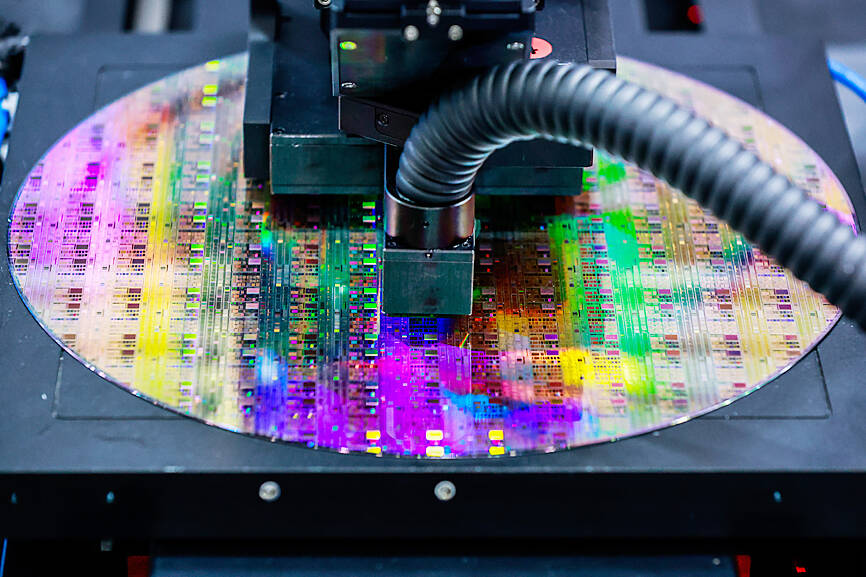
The shift is largely down to massive gains in shares of three companies that provide essential hardware for AI: Taiwan Semiconductor Manufacturing Co (TSMC, 台積電), the world’s largest chip foundry, and South Korea’s leading memory makers Samsung Electronics Co and SK Hynix Inc. Meanwhile, European stock markets are more heavily weighted toward financial firms.
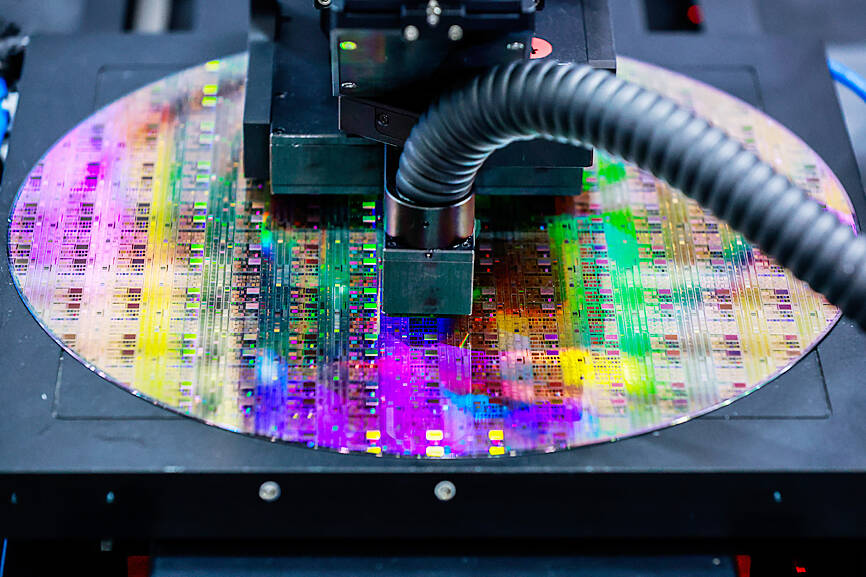
Photo: Ritchie B. Tongo, EPA
“The rapid rise of [South] Korea and Taiwan has been due to the long-term megatrend of semiconductors as ‘the new oil’ — the key input to economic activity — combined with the latest price-insensitive boom in AI investment,” Fidelity International portfolio manager Ian Samson said, adding that it demonstrates “the oligopolistic nature of leading-edge semiconductor manufacturing.”
Asia has cemented its central place in the world’s economy as AI develops and spreads, even amid concerns over the impact of tariffs and the Iran war. Taiwan’s export orders last month surged at the fastest pace in 16 years, while South Korea’s exports rose more than 40 percent for a second-straight month, both fueled by robust chip shipments.
Investors have become more cognizant of this role, with TSMC, Samsung and SK Hynix known as key suppliers to AI kingpin Nvidia Corp. TSMC shares have climbed more than 40 percent this year while the South Korean duo have surged more than 80 percent each.
TSMC now ranks among the largest companies in the world, with its market capitalization of US$1.8 trillion, and the South Korean pair combined at US$1.5 trillion. Europe’s largest company, chip equipment maker ASML Holding NV, is smaller than all of them. In fact, the combined market cap of all technology stocks in the Stoxx Europe 600 Index stands at about US$1.4 trillion.
“This trend can broadly be viewed as a divergence between technology and non-technology sectors,” UBS Global Wealth Management Greater China equities head Eva Lee (李智穎) said. “While individual AI-related stocks in Europe have also delivered strong gains year-to-date, the impact is more pronounced in [South] Korea and Taiwan due to the higher concentration of technology stocks.”
To be sure, some investors have sounded caution about the outsized influence of tech stocks in Asia’s markets, given their high weightings in local indexes. Samsung and SK Hynix account for a combined 42 percent of South Korea’s KOSPI equity benchmark while TSMC makes up a similar proportion of Taiwan’s TAIEX.
However, AI investment is broadening as the technology’s increasing integration into people’s everyday lives expands demand for all sorts of hardware and applications. TSMC’s index weighting has come down from recent highs as stocks such as MediaTek Inc (聯發科) and Delta Electronics Inc (台達電) gained share.
“The AI story in Asia may seem narrow at the index level, but is broader across the supply chain,” JPMorgan Asset Management emerging markets and Asia Pacific investment specialist Francesco Chan (陳智灝) said. “While the largest companies are getting bigger, the opportunity set is also expanding as AI capex continues to trickle down.”
Having passed the UK, Taiwan’s market value is now closing in on that of Canada, which has been expanding on gains in gold and other resource-related stocks. A little further up the rankings is India, whose equities have been slumping on higher energy prices as well as weakness in its banking and information technology sectors.
“[South] Korea and Taiwan — and broader North Asia — have built durable advantages in innovation, talent and manufacturing scale, particularly in key growth sectors, continuing to attract global capital,” Franklin Templeton portfolio manager Yi Ping Liao (廖亦平) said.
Beyond institutional funds, the hard-charging Asian stock markets are also enjoying greater support from retail investors lured by the AI stock boom. South Korea is seeing a resurgence of loyal mom-and-pop traders known as “ants” for their tendency to act in unison, while there has also been an upswing in retail participation in Taiwan.
“We are seeing domestic investors playing an increasingly important role” across Asia, M&G Investments Asia equities portfolio manager Vikas Pershad said, adding that he sees the market cap gains in Taiwan and South Korea as “justified” on a long-term view.