
(HedgeCo.Net) Artificial intelligence investing is entering a new phase. The market’s first wave was dominated by a relatively simple trade: own the obvious winners. Nvidia became the centerpiece of that narrative, with investors piling into the company as demand for high-performance chips exploded and Wall Street rushed to price in a once-in-a-generation compute boom. For a time, the AI story looked almost singular. If investors wanted exposure to artificial intelligence, they bought the leading chip supplier, a handful of hyperscale cloud platforms, and perhaps a short list of software names promising to monetize generative AI. That era is now evolving into something far more complex—and far more interesting for hedge funds.
AI infrastructure has moved beyond a venture-capital theme and beyond a narrow large-cap technology trade. It is becoming one of the most important stock-picking battlegrounds in the hedge fund world. Managers are increasingly looking past Nvidia and the Magnificent Seven toward the broader ecosystem that makes the AI boom possible: data-center operators, electrical contractors, utilities, power-generation providers, cooling companies, semiconductor equipment makers, PCB manufacturers, fiber and networking specialists, and Asia-based supply-chain beneficiaries. In other words, the AI trade is no longer just about the brains of the system. It is about the entire physical architecture required to power it.
That shift matters because it changes the nature of the investment opportunity. In the early phase of a technological transformation, capital often concentrates in the most visible leaders. In the later stages, as real deployment begins, the market broadens. The winners are no longer only the companies designing the core technology; they also include the firms that build the roads, the pipes, the wires, the storage capacity, the cooling systems, the server racks, the substations and the fabrication ecosystem behind it. AI has now entered that stage.
For hedge funds, this creates precisely the kind of environment where active management thrives. The investment universe becomes larger, more fragmented and more interconnected. Valuations diverge. Narrative momentum collides with operational constraints. Capital cycles create second- and third-order winners. And perhaps most importantly, the market begins to separate companies that are merely associated with AI from those that will actually generate durable earnings power from the buildout.
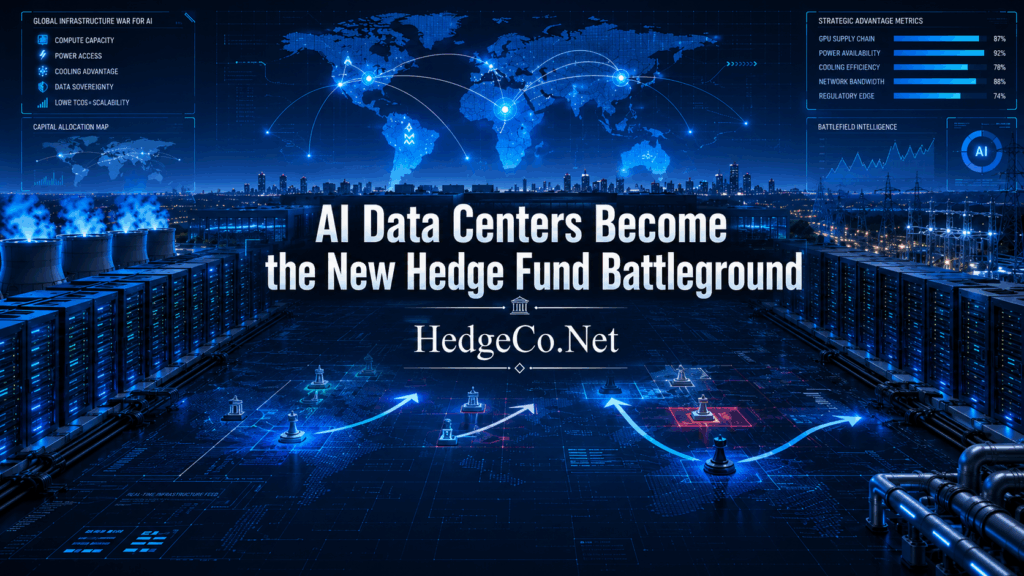
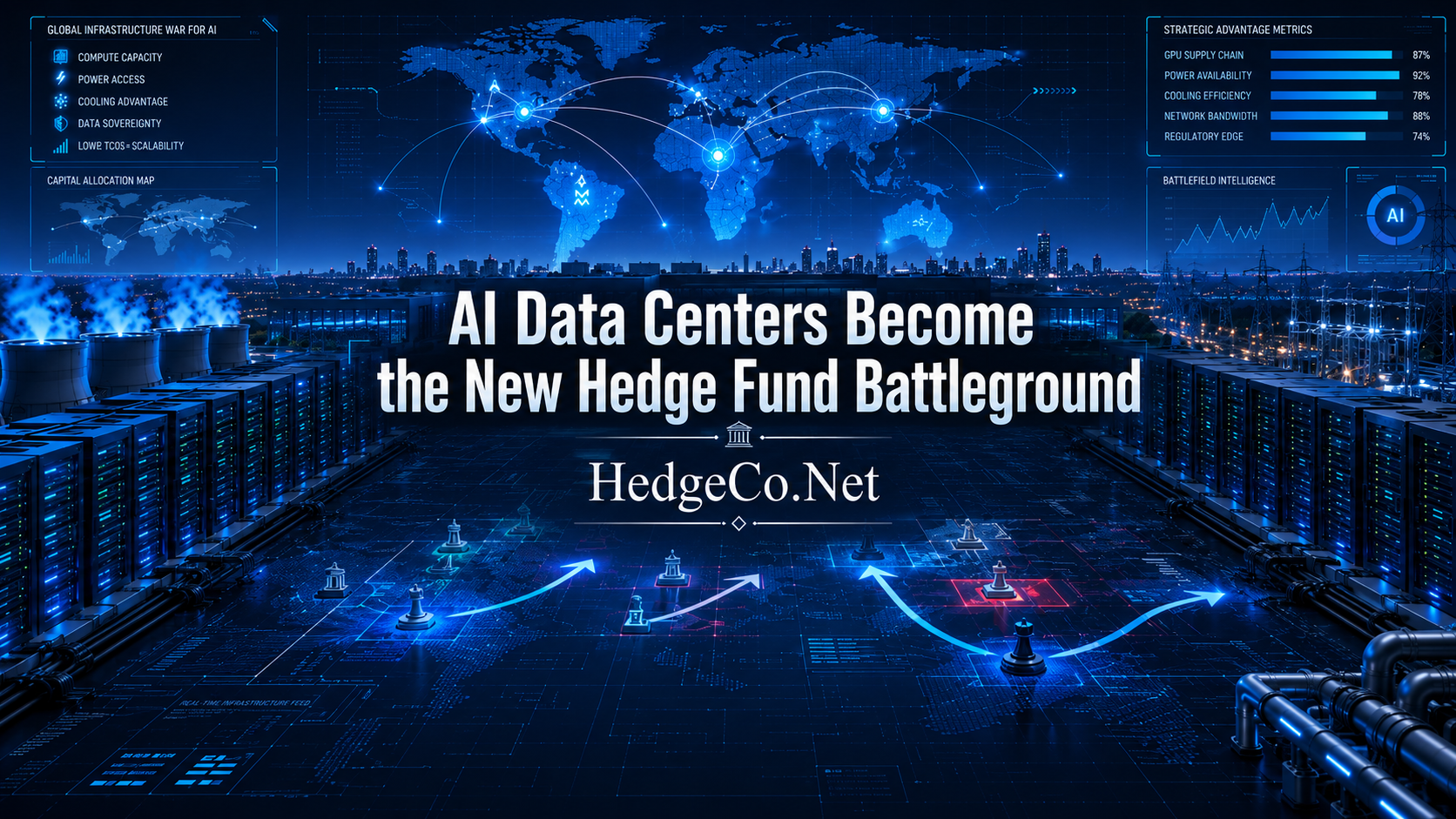
This is why AI data centers have become such a critical battleground. They sit at the center of the entire infrastructure thesis. Every large-language model, every enterprise AI workflow, every inference engine and every next-generation cloud service ultimately requires vast amounts of compute and storage capacity. Those capabilities do not exist in the abstract. They are housed in physical facilities that demand land, power, cooling, semiconductors, networking equipment and enormous amounts of capital. The AI boom, in other words, is not only a software revolution. It is a massive industrial buildout disguised as a technology story.
That insight is driving hedge fund attention. For years, many managers focused on software because software historically offered the ideal combination of growth, margins and scalability. AI is forcing a reconsideration of that framework. Training and running advanced models is expensive. Inference workloads are energy-intensive. Hyperscalers and model developers must commit tens of billions of dollars to expand compute capacity. This changes who captures value. The leading beneficiaries may include not just software platforms, but the companies that supply the inputs without which AI cannot function.
Data centers are the clearest example. Traditional data centers were already essential to cloud computing, streaming, e-commerce and enterprise digital operations. But AI workloads dramatically intensify the economics. They require far greater compute density, more advanced thermal management, more robust networking and significantly higher energy consumption. A standard enterprise data center is not the same as an AI-optimized facility designed to handle clusters of GPUs and the electrical intensity associated with them. That difference is creating a wave of capex across the sector.
Hedge funds see opportunity in that transition. Some are looking at the obvious names—listed data-center operators, colocation providers, and infrastructure REITs. Others are digging deeper into the supply chain. Electrical contractors are suddenly relevant because these facilities need upgraded power systems and complex installations. Cooling companies are drawing increased attention because thermal management is becoming a defining constraint in AI deployment. Power and utility providers are moving to the center of the investment debate because AI data centers consume extraordinary amounts of electricity, and local grids are not always ready for that level of demand.
This is where the trade becomes particularly attractive to long-short managers. Whenever a new capital cycle emerges, markets tend to overreward the most visible themes and underappreciate the enabling layers beneath them. Hedge funds can exploit that mispricing. They can build portfolios around companies with tangible order books, pricing power and capacity constraints, while shorting firms whose AI exposure is more promotional than economic. They can differentiate between businesses that benefit from sustained multi-year infrastructure demand and those that only enjoy a temporary sentiment tailwind.
Power is perhaps the most underappreciated component of the AI boom. The market is increasingly recognizing that AI models are not limited by imagination but by electricity. A world of hyperscale training clusters and real-time inference engines requires a grid capable of handling enormous and growing loads. This has pushed utilities, independent power producers, transmission-equipment suppliers and energy infrastructure firms closer to the center of AI investing than many would have imagined just a few years ago.
For hedge funds, this is fertile ground. The power angle introduces a new kind of cross-sector investing. Managers who traditionally focused on technology must now understand utility regulation, generation mix, transmission bottlenecks and energy pricing. They must evaluate which power markets are best positioned to host new data-center capacity, which utility territories have spare load capacity, and which companies can deliver electricity fast enough to meet hyperscaler demand. The result is a rare convergence of tech, industrials, energy and infrastructure investing.
Cooling is another fast-rising segment. Advanced AI servers generate intense heat, and traditional air-cooling methods are often insufficient for the densest workloads. That is creating demand for liquid-cooling technologies, thermal-management systems and specialized equipment providers. What used to be a relatively niche engineering consideration is becoming a core investment theme. Companies that can solve the cooling challenge may enjoy a surge in pricing power and strategic relevance as AI data centers expand. Hedge funds are paying attention because these are often the kinds of underfollowed, mid-cap or industrial-adjacent names that can outperform when a structural demand wave hits.
Then there is networking. The AI boom depends not just on compute but on moving vast amounts of data quickly and efficiently. High-speed interconnects, fiber infrastructure, switching equipment and optical components are all becoming more critical as AI clusters grow in size and complexity. Investors increasingly understand that a data center is not simply a building full of chips; it is a tightly integrated system where compute, storage, power and networking must all scale together. A bottleneck in one layer can delay monetization across the entire stack.
This systems-level thinking is one reason hedge funds are broadening their scope. Rather than treating AI as a single trade, they are breaking the theme into component exposures. Which parts of the stack have the best supply-demand dynamics? Which companies have sustainable margins? Which names are already fully priced for perfection? Which overlooked suppliers are seeing real order acceleration? And where does the market underestimate the duration of the build cycle? These are classic hedge fund questions, and AI infrastructure offers an unusually rich field in which to ask them.
The semiconductor angle also remains central, but even here the focus is widening. Nvidia may still dominate the headlines, but sophisticated investors are digging into the rest of the semiconductor ecosystem: memory, packaging, substrate suppliers, power-management chips, analog components, test and measurement tools, and the equipment required to manufacture advanced semiconductors at scale. The AI boom is not supported by one chip company alone. It depends on an entire manufacturing chain, much of it global and much of it highly specialized.
That brings Asia into the picture. Hedge funds looking for AI infrastructure opportunities increasingly have to think globally. Taiwan, South Korea, Japan and other parts of Asia are deeply embedded in the AI hardware and electronics supply chain. PCB manufacturers, advanced packaging specialists, semiconductor foundries, component assemblers and materials suppliers may all benefit from the continued expansion of AI infrastructure. In some cases, these companies may offer cleaner valuation entry points than the most crowded U.S. AI leaders. In others, they provide differentiated exposure to demand trends that the U.S. market has not fully priced.
For hedge funds, however, the global supply-chain angle cuts both ways. It offers opportunity, but it also introduces geopolitical and execution risk. Tensions around Taiwan, U.S.-China export controls, supply-chain concentration and industrial policy all matter. Managers must assess not just earnings power, but vulnerability. Which companies are most exposed to policy shifts? Which regions benefit from reshoring or friend-shoring trends? Which suppliers can maintain relevance as customers diversify? AI infrastructure investing is no longer purely about technology adoption; it is also about industrial strategy and geopolitical resilience.
The rise of AI data centers as a hedge fund battleground also reflects a broader shift in how investors understand the AI profit pool. In the beginning, the assumption was that value would accrue primarily to the companies creating the software and models. Now the market is recognizing that infrastructure may claim an outsized share of the economics—at least in this stage of the cycle. Before companies can monetize AI applications at scale, they must first build the underlying capacity. That means capex. And capex creates winners among the suppliers.
This is a familiar pattern in technological revolutions. During the railroad boom, investors made fortunes not only in rail lines but in the steel, machinery and land surrounding them. During the internet buildout, telecommunications networks and semiconductor firms became critical beneficiaries. In the cloud era, data-center REITs and network providers gained importance. AI is following a similar path, only at even greater scale and with far greater energy intensity.
That does not mean every AI infrastructure stock is a buy. In fact, the growing popularity of the theme is precisely why hedge funds are so engaged. Once a trade becomes obvious, selectivity matters more. Some names may be overextended, trading at valuations that already discount years of perfect execution. Some suppliers may see a temporary demand spike that fades as customers normalize inventory or diversify vendors. Some companies may be labeled AI beneficiaries even though only a modest share of revenue is truly tied to the theme. This is where hedge funds can distinguish themselves from passive capital. They can separate signal from noise.
The long-short opportunity is especially compelling. On the long side, funds can identify companies with hard-to-replicate positions in power equipment, cooling, networking or specialized manufacturing. On the short side, they can target businesses that are overcrowded, technically overowned or operationally less critical than the market believes. They can pair obvious beneficiaries with second-derivative winners, or hedge thematic exposure by shorting companies vulnerable to AI-driven disruption elsewhere in the economy.
The other attraction is duration. Unlike some technology themes that can be monetized quickly and fade just as fast, AI infrastructure appears to be a multi-year story. Data centers cannot be built overnight. Utility upgrades take time. Permitting, land acquisition, interconnection and construction are long-cycle processes. Chip fabs and equipment expansion require sustained investment. This gives hedge funds a rare chance to participate in a structural capex cycle rather than a fleeting momentum burst.
The institutional nature of the spend also matters. Much of the demand is being driven by hyperscalers, major enterprises and capital-rich technology companies with the balance sheets to commit to long-term infrastructure buildouts. That creates a degree of visibility that some speculative themes lack. If Microsoft, Amazon, Google, Meta, Oracle and others continue spending aggressively on AI infrastructure, a broad ecosystem of suppliers stands to benefit. Hedge funds are increasingly positioning around that assumption.
At the same time, the risks are real. The biggest is that AI demand ultimately fails to justify the current scale of infrastructure investment. If enterprise monetization disappoints, if inference economics remain too expensive, or if model efficiency improves faster than expected, the industry could face a mismatch between capacity and demand. In such a scenario, the market could reprice many AI infrastructure names sharply. Hedge funds are keenly aware of this possibility. It is one reason why many are approaching the theme through diversified baskets, relative-value trades and selective position sizing rather than one-way momentum chasing.
There is also execution risk. Building data centers is hard. Securing power is hard. Managing supply-chain constraints is hard. Delays in equipment delivery, utility interconnection or local permitting can affect project timelines and earnings recognition. The companies best positioned to benefit are not merely those exposed to the theme, but those capable of delivering reliably in a capital-intensive, operationally demanding environment.
Still, the broader direction is clear. AI is no longer just a software narrative or a chip narrative. It is an infrastructure narrative. And in the public markets, infrastructure narratives tend to spread value across a much larger universe of companies than initial enthusiasm suggests. That is why hedge funds are widening their lens. The AI boom’s next winners may include businesses that, until recently, sat far outside the mainstream technology conversation.
This widening lens is transforming portfolio construction. A hedge fund that once played AI through a concentrated long in Nvidia and a handful of hyperscalers might now express the theme through a much broader mosaic: long a utility with favorable data-center exposure, long an electrical-equipment supplier, long a cooling specialist, long a semiconductor equipment name, long an Asia-based PCB or packaging supplier, and short companies whose valuations imply unrealistic AI monetization. That is a very different portfolio from the one the market saw a year ago.
And it may be a more durable one.
Ultimately, the rise of AI data centers as a hedge fund battleground reflects the maturation of the entire AI investment cycle. The market is moving from excitement about potential to analysis of implementation. From software demos to physical deployment. From concept to infrastructure. That shift rewards investors who can think across sectors, understand supply chains, model capex cycles and identify the real bottlenecks in the system.
For alternative investment managers, that is an ideal setup. AI remains one of the most powerful secular themes in the market, but it is no longer a simple story. It has become a complex industrial ecosystem with winners and losers across technology, energy, industrials and global manufacturing. The best hedge funds are not just asking who builds the smartest models. They are asking who sells the power, who cools the servers, who lays the fiber, who assembles the hardware, who manages the real estate, and who captures the economics when the world races to build the machines that will run the next era of computing.
That is why AI data centers have become the new hedge fund battleground. They are where the abstract promise of artificial intelligence meets the hard realities of power, capital and execution. And in markets, it is often at that intersection—where story becomes structure—that the most compelling investment opportunities emerge.