
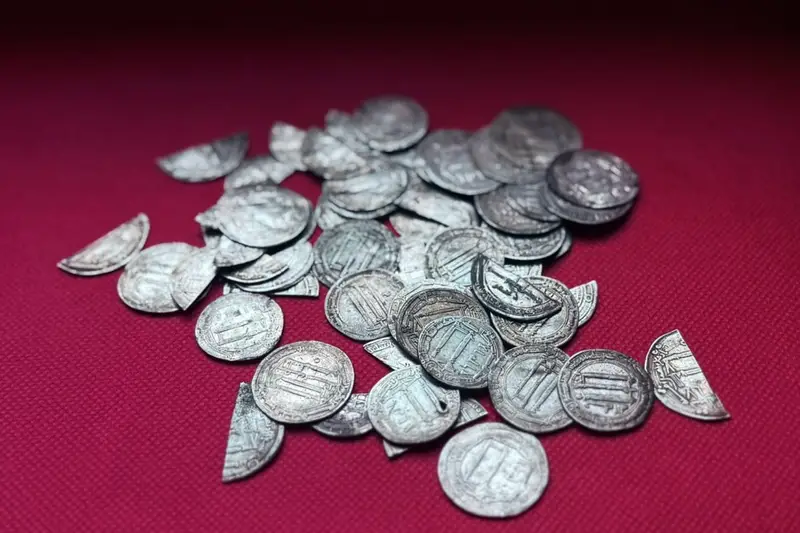
Archaeologists have uncovered a hoard of 59 Islamic silver coins near the Kaliningrad Lagoon, offering new evidence of trade between the Abbasid Caliphate and the Baltic region during the early Middle Ages. The coins date from CE 746 to 815, placing them among the earliest known Islamic silver finds in Eastern Europe.

The hoard was found during excavations by the Institute of Archaeology of the Russian Academy of Sciences. The team worked at an ancient settlement about 1.2 kilometers from the Kaliningrad Lagoon. People first settled there in the 8th century, and the site stayed occupied until the 12th century.
Researchers identified one coin from the reign of Marwan II, the last Umayyad caliph. The other 58 coins were issued under the Abbasid Caliphate after CE 750. Most were minted during the rule of Harun al-Rashid, who led the Abbasid state from CE 786 to 809.
The hoard includes 29 complete dirhams and 30 coin fragments. Many fragments are cut halves, a common form of silver used in trade. Several coins have small holes, showing they were worn as jewelry. Others carry small cuts along the edges, marks made to test whether the silver was genuine.

Researchers found clear differences between the complete coins and the fragments. They vary in age, condition, and place of origin. This pattern suggests the silver reached the Baltic through more than one trade route before people buried the collection.
Most complete coins came from Madinat al-Salam, today’s Baghdad, where 25 dirhams were struck. Other coins came from al-Kufa, Nishapur, and al-Muhammadiyah, showing the wide reach of the Abbasid minting system.
The fragments came from an even larger area. Some were produced in al-Basra and al-Kufa. The easternmost coin came from Madinat Zarang in present-day Afghanistan. The oldest coin in the hoard was minted in Wasit, in modern Iraq, during the final years of the Umayyad Caliphate.
Islamic silver coins began reaching Northern and Eastern Europe in the late 8th century. During the 9th and 10th centuries, merchants carried large amounts of silver across routes linking the Islamic world with the Baltic. Viking traders and other merchant groups took part in these networks.

People across northern Europe used dirhams as money. They also cut many of them into pieces and melted them for making jewelry and other silver objects. The coins became part of daily trade far from the places where they were minted.
Only about twenty coin hoards buried between the 780s and 830s are known from Sweden, northern Poland, Estonia, Russia, and the Kaliningrad region. Many were found years ago and survive only in part, leaving gaps in the record.
The Kaliningrad region has produced single Islamic coins before, though most date from the 10th century. Two earlier hoards were known, yet one was incomplete and the other lacked enough archaeological records to determine when people buried the coins.
This newly recovered hoard stands apart because archaeologists recorded the find carefully during excavation. The well-preserved archaeological setting gives a clearer picture of how silver moved through the Sambia region during the 9th century. The find adds fresh evidence for long-distance trade linking the Islamic world with communities along the Baltic coast.
More information: Institute of Archeology RAS