
The Weight has pacing issues, but it’s still a successful film.
“People get funny around gold,” a character says at one point during The Weight, and that’s an understatement. The film’s simultaneously a historic epic, a caper film and a tense drama set during the Great Depression. It’s enjoyable, with several strong performances, though it drags in the middle. It ends, however, with a bizarre tonal choice that’s just odd enough to work.
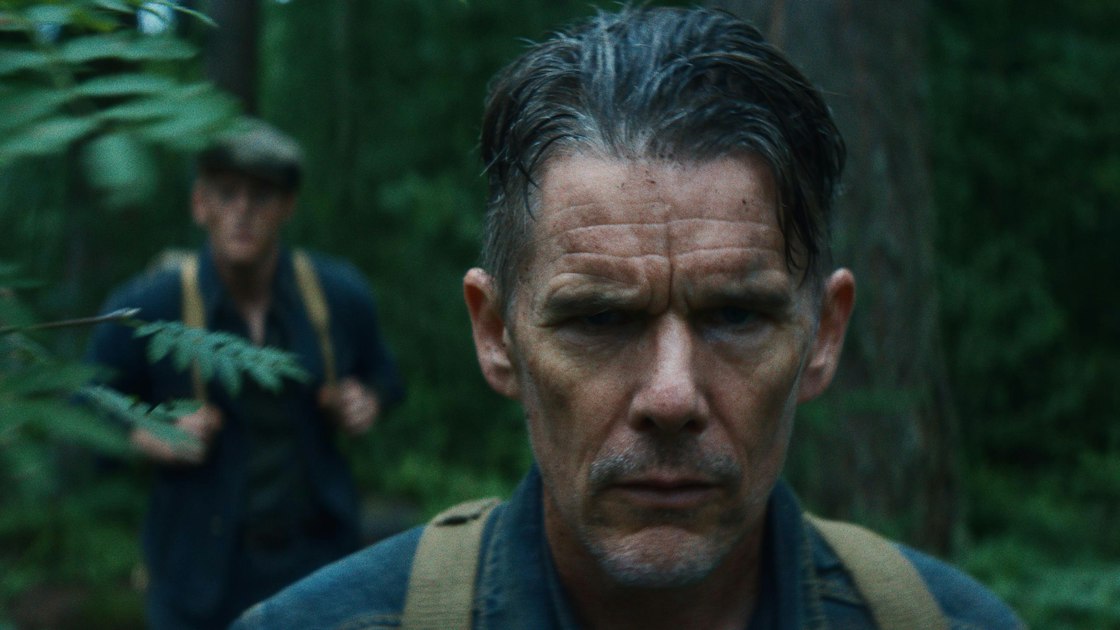
The Weight stars Ethan Hawke as Murphy, a widowed single father of a cute young daughter and a Depression-era jack of all trades. After he gets into a scuffle with a couple of guys who turn out to be off-duty police, Murphy’s sentenced to a work camp, where he’s set to serve a term so long that he’ll miss the deadline for his beloved girl to become a ward of the state.
This kicks off a plot with a bunch of moving parts: the camp’s warden (Russell Crowe) offers Murphy and a few other men a deal. Since the government is about to seize gold, they’re to take a haul of it and smuggle it across a long distance. If they can do it successfully, their sentences will be commuted, and Murphy can get back to his daughter. But if they lose any of the gold, the deal’s off. Naturally, things don’t go as planned.
Gold is heavy, and it’s especially difficult to carry across the bridge or over other long distances. This came up a few years ago in the Ben Affleck movie Triple Frontier, where the heist itself was the easy part but carrying the loot was much harder.
There’s also the matter of the gold itself, which functions like the ring from Lord of the Rings—it activates people’s greed and jealousy. They have a lot of bitter disagreements as it is; one of the men (Avi Nash) is a socialist, while another (Austin Amelio, from Hit Man and Weapons) is a racist.
The Weight is the feature debut of director Padraic McKinley, who worked with Hawke previously on The Good Lord Bird, the acclaimed miniseries in which he played John Brown. The film was shot in Germany, which convincingly stands in for 1930s Oregon. Russell Crowe, inconsistent lately, is outstanding, although his role is sort of small. Hawke is fine as a strong, silent type, and Anna Jones has some good scenes as an Indigenous woman who cuts herself into the scheme. Despite some serious drag in the middle section, The Weight is a mostly successful effort.