
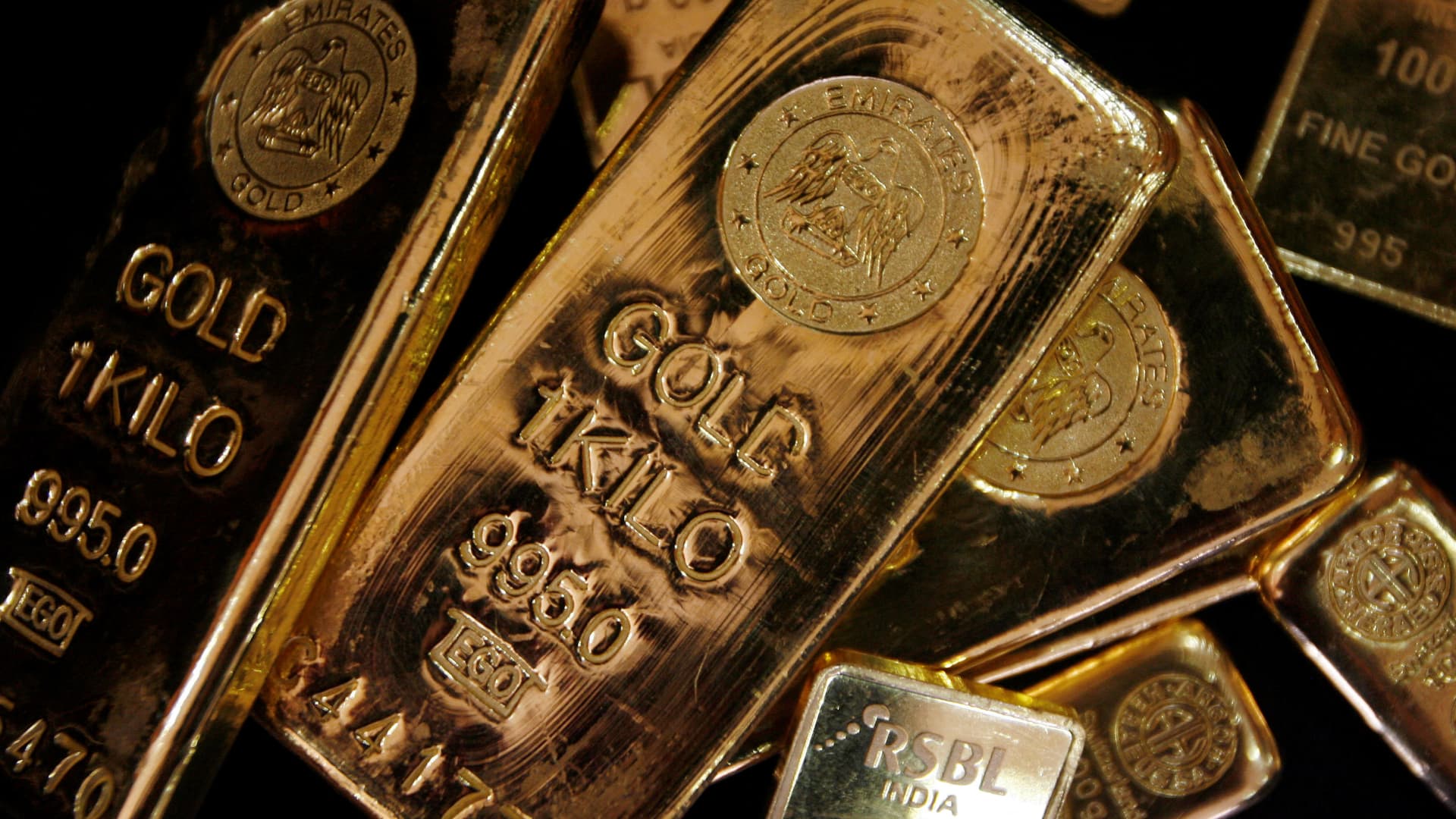
Gold prices edged lower on Wednesday as Middle East uncertainty and stronger-than-expected U.S. inflation data dimmed hopes for Federal Reserve rate cuts.
Arko Datta | Reuters
Gold prices edged lower on Wednesday as uncertainty in the Middle East and stronger-than-expected U.S. inflation data dimmed hopes for Federal Reserve rate cuts.
Spot gold fell 0.4% to $4,695.99 per ounce, as of 0231 GMT. U.S. gold futures for June delivery gained 0.4% to $4,705.30.
“Inflation data out of the U.S. has really watered down hopes, if not extinguished them, that there will be rate cuts from the Fed, and now the markets are kind of pricing in that the next move could be a hike as soon as the end of the year. So it kind of puts some downward pressure on gold,” said Kyle Rodda, a senior financial market analyst at Capital.com.
Data showed that U.S. consumer inflation increased further in April, with the annual rate posting its largest gain in three years, further reducing hopes that the Fed will cut interest rates this year.
Traders have largely priced out a Fed rate cut this year, with markets now seeing a 30% chance of a hike by December, according to CME Group’s FedWatch tool.
U.S. President Donald Trump said on Tuesday he does not think he will need China’s help to end the war with Iran, even as hopes for a lasting peace deal dwindled and Tehran tightened its grip over the Strait of Hormuz.
U.S. Treasury Secretary Scott Bessent said that President Trump and his Chinese counterpart, Xi Jinping, will discuss the Iran war, and urged China to “join us in this international operation” to reopen the Strait of Hormuz to international shipping.
Meanwhile, India has raised import tariffs on gold and silver to 15% from 6% as part of efforts to curb overseas purchases of the metals and ease pressure on the country’s foreign exchange reserves.
Spot silver rose 0.2% to $86.71 per ounce, after hitting its highest level since March 11 earlier in the session. Platinum slid 0.8% to $2,109.53, and palladium was down 0.2% at $1,487.47.