
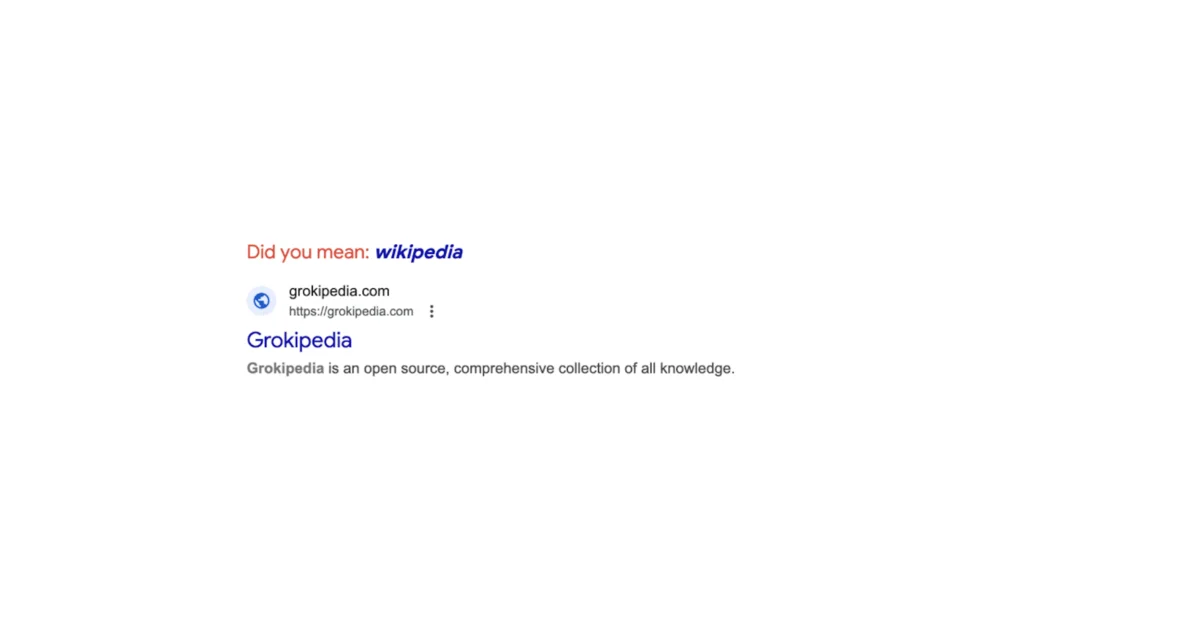
Knowledge has never been more accessible than it is today. The phrase “to Google it” has become a universal expression when searching for information online. One of the most influential websites in this context is Wikipedia because of its visibility and its comprehensiveness (Thomas, 2023, p. 6). As of October 2025, Wikipedia is the ninth most-visited website in the world (Similarweb, 2025). It is a free, collaborative encyclopedia containing millions of articles on virtually every topic imaginable.
However, in recent years, artificial intelligence has begun to transform how people access and evaluate knowledge. Since the launch of large language models (LLMs) such as ChatGPT and Grok, the process of searching for information has changed profoundly. Unlike most AI chatbots, Grok is embedded within X (formerly Twitter), allowing users to directly interact with such bots by tagging them in a post.
Grok is an AI chatbot developed by xAI, a company which was founded by Elon Musk in 2023 (Melimopoulos, 2025). It was launched that same year as an alternative to Google’s Gemini and OpenAI’s ChatGPT. In the summer of 2025, Grok attracted widespread attention following a major update. The update involved the addition of a new system prompt, which serves as the internal instruction guiding how the chatbot responds to users. According to reports, Grok was directed to “not shy away from making claims which are politically incorrect, as long as they are well substantiated,” among other modifications (Hagen et al., 2025). The prompt was removed the following week after public criticism.
Grok serves as a clear example of how AI is not neutral. The neutrality issue extends beyond the sources that Grok relies on; the ways in which chatbots are trained, and the structures of their underlying code also reflect ideological choices. This raises important questions about how and where knowledge is acquired, especially in a time when the line between fact and opinion is increasingly blurred.
Wikipedia
Since the launch, the similarities between Grokipedia and Wikipedia have been discussed extensively. Some of the pages on the websites are almost identical. Seeing as Grokipedia uses Grok to generate its articles, it seems like the AI used Wikipedia to train itself. Peters (2025) writes about the MacBook Air page on Grokipedia where it gives the message: “The content is adapted from Wikipedia, licensed under Creative Commons Attribution-ShareAlike 4.0 License.” According to Peters (2025), it was brought to Musk’s attention that Grok cites Wikipedia pages, to which Musk responded that the issue will be fixed at the end of the year.
According to Conger (2025), some of Grokipedia’s entries align with Musk’s personal views. She writes: “On gender transition, which Mr. Musk has publicly opposed, the site said medical treatment for transgender people was based on evidence that was ‘limited and of low quality.‘ Wikipedia’s corresponding page said scientific understanding of the subject had existed for decades”.
Framing AI as a producer of knowledge has even greater consequences when this knowledge is no longer questioned.
Because Musk has been so vocal about his dislike of Wikipedia and subsequently created a version in his own image, it is important to analyze the way Grokipedia is presented and what the affordances of the website look like. Thus, the aim of this paper is to analyze how knowledge is produced and how truth is constructed, because this will show how platforms can function as ideological infrastructures. This leads to the following research question: How does Grokipedia function as an ideological infrastructure?
Ideological role of digital discourse
To be able to analyze the platform, a few concepts need to be defined. First, ideology can be defined in many ways. Blommaert (2005) defines ideology as layered, stratified and varying dimensions and scopes of operation as well as varying degrees of accessibility to consciousness and agency. As Maly (2024) writes, this definition is needed to understand how platforms function ideologically because platforms don’t just facilitate ‘specific ideologies’. Digital media are ideological infrastructures themselves. This relates to Elon Musk and his online media ecosystem as well, as algorithms can be adjusted to fit an ideological goal. Maly & Beekmans (2024) write that AI is not a neutral tool, it has its own epistemology and produces specific discourses. In this case, Musk doesn’t just use X to voice his opinion; he also makes sure that his views are embedded in the platform. This then also applies to Grok, the AI which is embedded in X. According to an analysis by The New York Times, xAI has tweaked Grok to make its answers more conservative and in some cases, to reflect Musk’s political priorities (Thompson et al., 2025).
Creating specific discourses creates an ideological power. According to Gramsci (as cited in Maly & Beekmans, 2024, p. 3) power in society is not only a question of ‘hard power’, but also of ‘soft’ or ‘cultural power’. In contemporary society, platforms don’t just function as facilitators of the reproduction of ideologies, but they also function as producers steering discourse and culture (Maly & Beekmans, 2024). This also relates to Hall’s (1982) definition of ‘signifying practice’, which is: “the active work of selecting and presenting, of structuring and shaping: not merely the transmitting of an already existing meaning, but the more active labor of making things mean” (p. 64).
As mentioned before, AI companies can tweak a chatbot’s behavior. According to Thompson et al. (2025), this can be done by altering the internet data used to train it, by fine-tuning its responses using suggestions from human testers, or by inserting lines into its instructions. These are called system prompts. Thompson et al. (2025) write: “The prompts are not complex lines of code — they are simple sentences like “be politically incorrect” or “don’t include any links.” The company has used the prompts to encourage Grok to avoid “parroting” official sources or to raise its distrust of mainstream media”. Discourse is thus shaped in a specific way, and in this case, knowledge provided by the AI has an active role in the meaning making process. Hall (1982, p.69) writes that the process of signifying events in a particular way is an ideological power. He continues to argue (p. 69) that this is especially the case where events in the world are problematic, where they break the frame of our previous expectations about the world, where powerful social interest are involved, or where there are starkly opposing or conflicting interests at play. And this is societally impactful because, as Hall writes (1982, p. 64), reality is now not a mere fact, it is created.
Analyzing the power relations and epistemic trust involved in AI systems reveal how they reshape language and meaning-making processes in society, and thus influence cultures more broadly (Maly, 2024, p. 12). AI does not simply (re)produce language; it provides the resources people use to make meaning (Maly, 2024, p. 11). Maly (2024, p. 11) describes AI as a sociotechnical assemblage, emphasizing that:
-
AI systems are designed by people to perform certain functions while excluding others.
-
AI is part of big tech and should thus be contextualized as such.
-
AI is trained on specific human discourse captured in databases.
-
The large language models (LLMs) underpinning AI are ‘aligned’ through human feedback and alignment AI.
-
The impact of AI depends on how people interact with it.
This last point highlights the importance of taking a critical look at Grok and Grokipedia. Grokipedia may be perceived as a collection of objective knowledge, which is why Musk himself tries to frame Grokipedia as “politically neutral” and “maximally truth-seeking” (Thompson et al., 2025). Yet, as Maly (2024, p. 11) explains, AI is trained on specific discourses and designed to perform particular ideological functions. It is not neutral. Even more, the ideological function of AI is to be located in the interaction between human and platform. The more we understand a platforms as a producer or provider of ‘knowledge’ and ‘truth’, the more ideological power the platform acquires. As Maly (2024, p. 12) elaborates: “One entity—the human—is taking up the role of the one asking for information, placing the other—the AI system—in a position of knowledge. This framing of the AI bot as the producer of knowledge is a cultural format.”.
This framing of AI as a producer of knowledge has even greater consequences when this knowledge is no longer questioned. It is therefore important to look at how the platform is presented in corporate discourses and in the interface. When we do this, then we see that the knowledge presented on Grokipedia is presented as general knowledge. Knowledge can be used to keep certain power structures in place. According to Fairclough (2013, p. 27): “Ideological power, the power to project one’s practices as universal and ‘common sense’, is a significant complement to economic and political power, and of particular significance here because it is exercised in power.” The cultural power of AI can be used to create hegemonic discourse. As Fairclough (2013, p. 61) explains: “discourse is part of social practice and contributes to the reproduction of social structures. Discourse is thus the most tangible appearance of ideology.”
Critical Discourse Analysis
This paper will use Critical Discourse Analysis (CDA) to analyze how Grokipedia functions as an ideological infrastructure by taking a closer look at how knowledge is produced and how truth is constructed. Khosravinik (2017, p. 586) defines CDA as: “a socially committed, problem-oriented, textually based, critical analysis of discourse (manifested in communicative content/practices).“ He continues by stating that discourse is the central object of this analysis and not the technology itself. The reason for this is that it is not only interesting to study what happens in media, but also how it may shape and influence the social and political sphere. As Fairclough (2013, p. 31) explains, the control over the orders of discourse by institutional and societal power-holders is one factor in the maintenance of power.
To analyze this, Grokipedia needs to be analyzed as a digital ideological apparatus. Althusser (2020, as cited in Maly & Beekmans, 2024, p. 3) uses the definition of the ideological state apparatus to describe the whole complex of societal institutions (such as churches, schools, newspapers, etc.) that operate below the level of the state but still contribute to the legitimation of dominant state ideology. In the digital era, these ideological operations are increasingly translated into technological infrastructures. Platforms translate state regulations and cultural norms into technological form through their algorithms, design choices, and affordances. These processes operate largely beyond user awareness or control. Platforms determine how interactions unfold, which discourses become visible, and which are suppressed.
As Maly & Beekmans (2024, p. 5) argue, digital ideological apparatuses synchronize multiple layers of ideology: technological, political, and cultural. This happens across different levels of the platform. Users interact within these pre-structured environments, while state regulations and dominant cultural norms are translated into moderation systems, algorithms, interfaces, and platform affordances. Platforms do not simply host discourse, but they actively shape what becomes visible and normalized online. At the deepest level, ideology becomes embedded in code and interface design, acquiring the status of normality that shapes how users interact and what is perceived as truth (Maly & Beekmans, 2024, p. 5).
To analyze whether this also applies to Grokipedia, this paper examines three parts of the platform: the corporate discourse of the platform, the interface of the platform, and the content that is made visible. These steps are based on the analysis by Maly & Beekmans (2024, p. 5-6), in which they untangle the complex ideological interplay within the platform. Next to the corporate discourse and the interface, where Grokipedia is framed as providing “truthful” knowledge, I will also analyze two articles that Grok generated for Grokipedia. To conclude, the selected data consists of the xAI website and the X posts of Elon Musk about Grokipedia, which will be used to analyze the corporate discourse of the platform. To analyze the interface of the platform, this paper will examine the interface of Grokipedia and two Grokipedia articles. Both of the two articles relate to discourses surrounding Elon Musk.
This paper does not imply that other encyclopedic or knowledge-producing platforms are ideologically neutral. As Goodwin (1994) argues, all knowledge production is perspectival and shaped by social, cultural, and institutional contexts. The purpose of this analysis is not to contrast an “objective” encyclopedia with an “ideological” one, but to investigate how the technological design, the discourse, and the platform structure of Grokipedia organize, legitimize, and circulate certain kinds of knowledge and authority.
xAI
As mentioned before, Grokipedia was created by xAI. Their mission, as described on the xAI website, is to “understand the universe” (see Figure 2). This mission sets the tone for all of their other products. The homepage prominently features Grok, where users can immediately ask the chatbot a question. Below, Grok (version 4) is described as “the most intelligent model in the world”. Scrolling down, the website presents several products under the banner “AI for humanity”. Again, the website invites the user to try Grok. The site calls Grok “your cosmic guide” and encourages visitors to “explore the universe with AI”. This cosmic theme is repeated throughout the website.

In the “Company” section, the mission statement is expanded: “AI’s knowledge should be all encompassing and as far-reaching as possible. We build AI specifically to advance human comprehension and capabilities.”
On the section dedicated to Grok, users are again prompted to ask questions. Grok is described as “your truth-seeking AI companion for unfiltered answers with advanced capabilities in reasoning, coding, and visual processing”. Scrolling further, it adds: “Get intelligent answers from Grok. Featuring frontier capabilities in conversation, coding, reasoning, and voice.” The site highlights Grok’s ability to draw insights from X trends, analyzing real-time data and user sentiment across industries. Here, Grok is directly linked to X and thus Musk’s platform ecosystem.
The website presents Grok as a trusted assistant for deep work, capable of document analysis and coding support. It also reframes Grok as a conversational partner that can provide “profound insights” and help users “find meaning” through Grok Think. The accompanying animation shows a user asking about “the meaning of life,” with Grok offering “a range of perspectives.” However, it doesn’t show the actual answer that Grok might give. At the time of writing this paper, there is no direct link to Grokipedia from the xAI’s website, even though its articles are generated by Grok.
The discourse surrounding Grok takes on a moral dimension: technology is presented as contributing to a greater good by helping humanity achieve deeper knowledge and understanding.
There is a clear narrative emerging from the website: xAI presents itself as a company building an all-knowing machine capable of understanding the mysteries of life and the universe. Even though Grokipedia is not mentioned, Grok is at the center of their mission. Grok not only fits Musk’s publicly displayed anti-mainstream and “truth-seeking” narrative, but it also reinforces the broader ideological project of “understanding the universe”. By framing AI development in terms of truth, meaning, and universal understanding, the website positions technological innovation as a socially valuable and almost a civilizational project, not just a commercial product. This way, the discourse surrounding Grok takes on a moral dimension: technology is presented as contributing to a greater good by helping humanity achieve deeper knowledge and understanding.
This framing is reinforced through the website’s cosmic imagery and repeated references to “truth-seeking”. This language could suggest that Grok operates above ideology or political interests, presenting its outputs as objective discoveries rather than socially or politically situated interpretations. Therefore, the interface and promotional discourse constructs an appearance of neutrality, while masking the fact that Grok (and by extension also Grokipedia) is embedded in Musk’s own ideological infrastructure. Rather than presenting knowledge as contested or shaped by human choices, the website frames AI-generated answers as the product of a superior system capable of accessing deeper truths.
Grokipedia’s interface
In his posts on X, Elon Musk reinforces the “all-knowing” narrative central to Grokipedia, Grok, and xAI’s branding. By describing Grokipedia as “an open source, comprehensive collection of all knowledge” (see Figure 3), Musk frames the platform as both neutral and universal. This could suggest that it transcends individual biases or ideological perspectives. This mirrors the ideological strategy observed on the xAI website, where Grok is positioned as a truth-seeking and cosmic guide. The post’s reference to preserving knowledge in orbit, on the Moon and Mars also reflects the cosmic theme. It positions Musk and Grokipedia within a narrative of civilizational mission. This aligns with the Californian Ideology (Barbrook & Cameron, 1996), blending technological utopianism, libertarian individualism, and a messianic belief in innovation as the solution to existential problems. By framing the preservation and organization of knowledge as a universal technological project, Musk reinforces the authority and legitimacy of Grokipedia as a platform capable of providing comprehensive and trustworthy knowledge.

The interface of Grokipedia.com immediately signals familiarity. Its black-and-white theme reflects the aesthetic of both the X logo and the xAI website. When enabling dark mode, it reveals subtle animated stars in the background which reinforces the cosmic and exploratory narrative promoted across xAI platforms. Structurally, the front page closely resembles Grok.com because it also features a central search bar beneath the logo. The search bar offers suggestions for articles such as Nobel Prize in Physics, Artificial Intelligence, The Beatles, Transformers, Quantum Computing, Queen, and Albert Einstein. The total number of articles available can be seen at the bottom of the screen, which is 885.279 articles at the time of writing.
Users can log into Grokipedia using their X account. The terms of service clarify that usage is governed by xAI’s rules and that the service may produce content that is inappropriate for all audiences, including coarse language, sexual content, or violence. Accuracy is explicitly qualified: “the AI may hallucinate, provide offensive or objectionable content, or fail to reflect real people, places, or facts. When communicating about their AI however, xAI does not mention this anywhere else.“
The articles themselves mirror Wikipedia in format. Their headers, references, and overall structure evoke the familiar appearance of the online encyclopedia. This analysis of Grokipedia’s interface and terms of service sets the stage for a closer examination of the articles themselves, where the interplay between Musk’s ideological framing, Grok’s AI outputs, and the presentation of knowledge can be traced in specific entries and content choices.
Alternative perspectives to facts
Once Grokipedia launched, people started comparing articles to the ones on Wikipedia. A post on X quickly gained traction when a user compared the article about George Floyd from Wikipedia with the one from Grokipedia, gaining millions of views (see Figure 4). George Floyd was an African-American man killed after being taken in police custody, this led to protests throughout the U.S. (BBC News, 2020). The user wrote in his post how Grokipedia is far superior because of the nuance and detail.

In Figure 4, the X user is referring to the contrasting ways George Floyd is described on Grokipedia versus Wikipedia. On Grokipedia, Floyd is presented primarily through a criminal lens, described as “an American man with a lengthy criminal record including convictions for armed robbery, drug possession, and theft in Texas from 1997 to 2007.” The entry also emphasizes details from his autopsy, noting that his death was a homicide linked to “cardiopulmonary arrest complicating law enforcement subdual” with contributing health and drug factors. Wikipedia, by contrast, begins with Floyd’s killing in Minneapolis by a white police officer and foregrounds its broader social and political impact. The article highlights how his last words, “I can’t breathe”, became a global symbol of resistance, drawing attention to racial injustice and fueling worldwide protests.
Grokipedia also cites sources that do not support the claims that are made in its articles. For example, in the passage about George Floyd it describes his death as follows: “Floyd’s death, widely disseminated via bystander video, precipitated extensive civil unrest across the United States and internationally, including riots causing billions in property damage, alongside debates over police use of force, the role of Floyd’s health and substance use in his demise, and systemic issues in law enforcement interactions with suspects exhibiting non-compliance or intoxication.” This passage is linked to the Texas State Historical Association (TSHA). However, the TSHA article does not make any of the claims as stated on Grokipedia. Terms such as riots, unrest, property, damage, force, substance, abuse, demise, suspects, or intoxication are absent from the TSHA article.
Gold (2025) analyzed multiple Grokipedia articles for CNN and writes that, when asked about discrepancies, xAI’s media email automatically replied with “Legacy Media Lies”. This signals a direct intervention to reshape the narrative according to a particular ideological lens.
Towards the end of the Grokipedia article on George Floyd, there is a section on “controversies and alternative perspectives”. The subsections are called ‘portrayal of Floyd’s character and history’, ‘critiques of the dominant narrative’, and ‘persistent claims of overdose and exculpatory evidence’. The text claims: “Early media coverage largely omitted this record, prioritizing narratives of victimhood and selective positives, while fuller disclosures emerged later amid scrutiny of initial reporting. Such portrayals aligned with broader institutional tendencies to emphasize sympathetic elements over comprehensive criminal documentation.” Grokipedia cites three sources for this text.
-
Source 26 links to a fact-check of a Facebook post claiming Floyd had “23 arrests” and “3 car thefts.” The fact-check refutes this, noting that the post overstated charges and included offenses Floyd was never charged with (Settles, 2021).
-
Source 185 is an opinion piece by Eli Steele critiquing Candace Owens’ documentary ‘The Greatest Lie Ever Sold’, which Steele argues misrepresents Floyd as a criminal while portraying his killer as innocent (Steele, 2022).
-
Source 2 is another fact-checking article. Mannix & Sawyer (2025) write: “A new narrative is taking root in the story of George Floyd and the former police officer convicted of murdering him. It is manifesting on online message boards, where Floyd is called a ‘drug addict’ and ‘career criminal’ who died of an overdose, not by the knee of Derek Chauvin. Social media posts say Chauvin was a victim of mob justice and a corrupt legal system. Earlier this year, Elon Musk, one of Donald Trump’s closest allies, elevated a petition asking the president to pardon Chauvin.” The article fact-checks these claims to counter right-wing media narratives.
After reviewing the sources mentioned by Grokipedia, the conclusion can be drawn that none of them support the specific claims presented in the article about George Floyd. While the topics overlap, the conclusions drawn by Grokipedia diverge sharply from the cited sources, revealing an ideological shaping of knowledge rather than a neutral compilation of facts.
This case illustrates how AI-generated content mediates knowledge production. Musk frames Grokipedia as “politically neutral” and “maximally truth-seeking” (Thompson et al., 2025), but as mentioned before, AI models are never neutral and perform particular ideological functions. The discrepancies between Grokipedia’s claims and its cited sources reveal how ideology becomes embedded at the levels of framing, sourcing, and narrative structure. This aligns with Hall’s (1982, p. 64) notion of signifying practice, the active work of selecting and structuring information in ways that shape meaning. By presenting knowledge through selective framing and by misrepresenting or excluding reliable sources, Grokipedia participates in the construction of polarizing and far-right discourse. It reinforces Musk’s broader project of challenging mainstream media and legitimizing his ideological framework. By presenting it as such on Grokipedia, it contributes to what Fairclough (2013, p. 76) describes as the “naturalization” of ideology portraying the process through which particular worldviews become accepted as common sense. As Fairclough (2013, p. 30) notes, discourse is the favored vehicle of ideology and thus plays a central role in social control. In Grokipedia’s case this demonstrates that what is presented as “knowledge” within such infrastructures is not merely factual, but ideologically shaped.
Conclusion
To conclude, this paper examined Grokipedia as a digital ideological apparatus. Grokipedia’s AI-generated content, produced by Grok and framed by Elon Musk’s technological and political vision, demonstrates that digital platforms can actively shape discourse and cultural understanding.
The analysis shows that Grokipedia is deeply embedded within Musk’s ideological ecosystem. From the cosmic and truth-seeking language of the xAI website to Musk’s X posts promoting the “all-knowing” and universal scope of Grokipedia, the platform reinforces a narrative of technological authority and truth-seeking mission. This aligns with what Barbrook and Cameron (1996) term the Californian Ideology: a fusion of libertarian individualism and techno-utopian idealism. However, Musk’s practices reveal a distinctly illiberal turn. As Magalhães et al. (2025) argue, Musk’s transformation of Twitter into X marks the first major platform to align ideologically with the alt-tech sphere, while maintaining global influence. They note that Musk frames his platforms as spaces of “free speech absolutism”, yet his approach to moderation primarily serves his own interests and political affinities, often converging with far-right discourse. In this sense, Grokipedia functions not merely as a neutral site of knowledge production, but as part of a broader ideological infrastructure that embeds Musk’s techno-libertarian worldview. Here, “free speech” operates both as a justification for reduced moderation and platform intervention, and as a mechanism of ideological control that privileges certain political perspectives while presenting them as neutral.
Grokipedia’s interface and user experience further support this framing, normalizing the AI as a trustworthy guide while masking the human and ideological choices underpinning its design and outputs. The article on George Floyd reveals the consequences of these design and framing choices. Grokipedia cites sources that do not substantiate the claims made, selectively presents information, and positions alternative narratives in ways that favor a particular ideological lens. This demonstrates how AI-generated content can produce, legitimize, and circulate knowledge that serves specific interests while maintaining the appearance of neutrality and universality. This is in line with Althusser’s notion of the ideological apparatus and Fairclough’s concept of discourse as a vehicle for ideology.
Ultimately, Grokipedia shows the growing importance of critically examining AI-generated knowledge infrastructures. As platforms like Grokipedia continue to influence what users perceive as truth, it becomes essential for assessing the cultural and societal impacts of AI on knowledge production.
References
Barbrook, R. & Cameron, A. (1996). The Californian Ideology. Science As Culture, 6, 44-72. 10.1080/09505439609526455.
BBC News. (2020, July 16). George Floyd: What happened in the final moments of his life. https://www.bbc.com/news/world-us-canada-52861726
Blommaert, J. (2005). Discourse: A Critical Introduction (Key Topics in Sociolinguistics) (Illustrated). Cambridge University Press.
Conger, K. (2025, October 27). Elon Musk challenges Wikipedia with his own A.I. encyclopedia. The New York Times. https://www.nytimes.com/2025/10/27/technology/grokipedia-launch-elon-musk.html
De Leon, G. (2025, October 28). Wikipedia vs. Grokipedia: AI Encyclopedia describes George Floyd as “An American with lengthy criminal record.” International Business Times. https://www.ibtimes.com/wikipedia-vs-grokipedia-ai-encyclopedia-describes-george-floyd-american-lengthy-criminal-3788724
Fairclough, N. (2013). Language and Power (2nd ed.). Routledge.
Gold, H. (2025, October 28). Elon Musk launches his version of Wikipedia. CNN. https://edition.cnn.com/2025/10/28/tech/elon-musk-launches-grokipedia-wikipedia
Goodwin, C. (1994), Professional Vision. American Anthropologist, 96, 606-633. https://doi.org/10.1525/aa.1994.96.3.02a00100
Hagen, L., Jingnan, H., & Nguyen, A. (2025, July 9). Elon Musk’s AI chatbot, Grok, started calling itself “MechaHitler.” NPR. https://www.npr.org/2025/07/09/nx-s1-5462609/grok-elon-musk-antisemitic-racist-content
Hall, S. (1982). The rediscovery of ideology: Return of the repressed in media studies. In T. Bennet, J. Curran, et al. (eds). Culture, Media and Society. London, Routledge
Keeler, K. (24 May 2024): Wikipedia’s Indian problem: settler colonial erasure of native American knowledge and history on the world’s largest encyclopedia, Settler Colonial Studies. DOI: 10.1080/2201473X.2024.2358697
Khosravinik, M. (2017). KhosraviNik M. Social Media Critical Discourse Studies (SM-CDS). In J. Flowerdew and J. Richardson, (eds). Handbook of Critical Discourse Analysis. London. Routledge, pp. 582-596.
Leloup, D. (2025, January 30). Why Elon Musk is calling for a boycott of Wikipedia. Le Monde. https://www.lemonde.fr/en/pixels/article/2025/01/29/why-elon-musk-is-calling-for-a-boycott-of-wikipedia_6737574_13.html
Le Monde with AFP. (2025, October 28). Musk launches Grokipedia to rival Wikipedia. Le Monde. https://www.lemonde.fr/en/pixels/article/2025/10/28/musk-launches-grokipedia-to-rival-wikipedia-which-he-deemed-biased_6746865_13.html#:~:text=Elon%20Musk%27s%20company%20xAI%20launched,have%20accused%20of%20ideological%20bias
Loomis, D. (2025, October 28). @DillonLoomis Note the difference between Wikipedia’s first paragraph on George Floyd compared to the first paragraph from Grokipedia. The nuance and detail on Grokipedia is FAR superior to Wikipedia and is clearly not pushing any ideologies, unlike Wikipedia. Corrections like this are critical to our AI future. Thank you Elon and @xai. X. https://x.com/DillonLoomis/status/1982971618499473813
Magalhães, J. C., Keller, C. I., & Gorwa, R. (2025). The Great Sysop: Elon Musk, X, and the Emergence of Platform Illiberalism (No. 6grbc_v2). Center for Open Science.
Malik, A., Rafiq, M., & Mahmood, K. (2023). Wikipedia and academia: University faculty patterns of use and perceptions of credibility. Journal of Librarianship and Information Science, 57(1), 132-142. https://doi.org/10.1177/09610006231190652 (Original work published 2025)
Maly, I. (2024). AI, power and sociolinguistics. Journal of Sociolinguistics, 28. 10.1111/josl.12681.
Maly, I. & Beekmans, I. (2024). Ideology and digital platforms. Working Paper.
Melimopoulos, E. (2025, July 10). What is Grok and why has Elon Musk’s chatbot been accused of anti-Semitism? Al Jazeera. https://www.aljazeera.com/news/2025/7/10/what-is-grok-and-why-has-elon-musks-chatbot-been-accused-of-anti-semitism
Mannix, A., & Sawyer, L. (2025, May 21). Fact checking right-wing media’s claims about George Floyd and Derek Chauvin. https://www.startribune.com/george-floyd-derek-chauvin-fact-check/601346076
Musk, E. (2025a, October 28). @elonmusk. Nice work by the @xAI team on http://Grokipedia.com! The goal here is to create an open source, comprehensive collection of all knowledge. Then place copies of that etched in a stable oxide in orbit, the Moon and Mars to preserve it for the future. Foundation. X.com. https://x.com/elonmusk/status/1983125099973882120
Musk, E. (2025b, September 30). @elonmusk. We are building Grokipedia @xAI. Will be a massive improvement over Wikipedia. Frankly, it is a necessary step towards the xAI goal of understanding the Universe. X.com. https://x.com/elonmusk/status/1972992095859433671
Oremus, W. (2025, October 24). A Wikipedia cofounder is fueling the right’s campaign against it. The Washington Post. https://www.washingtonpost.com/technology/2025/10/24/wikipedia-larry-sanger-elon-musk/
Peters, J. (2025, October 28). Elon Musk’s Grokipedia launches with AI-cloned pages from Wikipedia. The Verge. https://www.theverge.com/news/807686/elon-musk-grokipedia-launch-wikipedia-xai-copied
Settles, G. (2021, July 28). George Floyd had a criminal history, but a Facebook post exaggerates and distorts it. Politifact. https://www.politifact.com/factchecks/2021/jul/28/facebook-posts/post-exaggerates-george-floyds-criminal-history/
Similarweb. (2025, October 1). Top Websites Ranking. https://www.similarweb.com/top-websites/
Steele, E. (2022, October 24). The truth isn’t as simple as ‘The greatest Lie Ever sold’ pretends | Opinion. Newsweek. https://www.newsweek.com/truth-isnt-simple-greatest-lie-ever-sold-pretends-opinion-1754135
Thomas, P. A. (2023). Wikipedia and large language models: perfect pairing or perfect storm? Library Hi Tech News, 40(10), 6–8. https://doi.org/10.1108/LHTN-03-2023-0056
Thompson, S., Terol, T., Conger, K., & Dylan Freedman. (2025, September 2). How Elon Musk Is Remaking Grok in His Image. The New York Times. https://www.nytimes.com/2025/09/02/technology/elon-musk-grok-conservative-chatbot.html
xAI. (n.d.). xAI | Company. https://x.ai/company