
Welcome to Global Data Center Hub. Join investors, operators, and innovators reading to stay ahead of the latest trends in the data center sector in developed and emerging markets globally.
Six Samsung companies committed $1 billion to Helix Digital Infrastructure in late September 2026. KKR formed Helix Digital Infrastructure in June to build data centers, power plants, power lines and fiber for the biggest cloud companies. It started with more than $10 billion from KKR, the Kuwait Investment Authority, NVIDIA and Vistra.
If you read only the headline, you see a bet on growth. That reading holds as far as it goes. But four of the six Samsung companies also make things data centers need. So the money does two jobs. It funds the company, and it brings a supplier into the partnership.
Here is the one idea I want you to take away. A strategic investor can get paid in two ways, and the strongest deals plan for both from the start. I use the Ownership Ladder to show you where Samsung stood before this deal and where it stands now. It is a six-step map of how much of an AI build each participant owns.
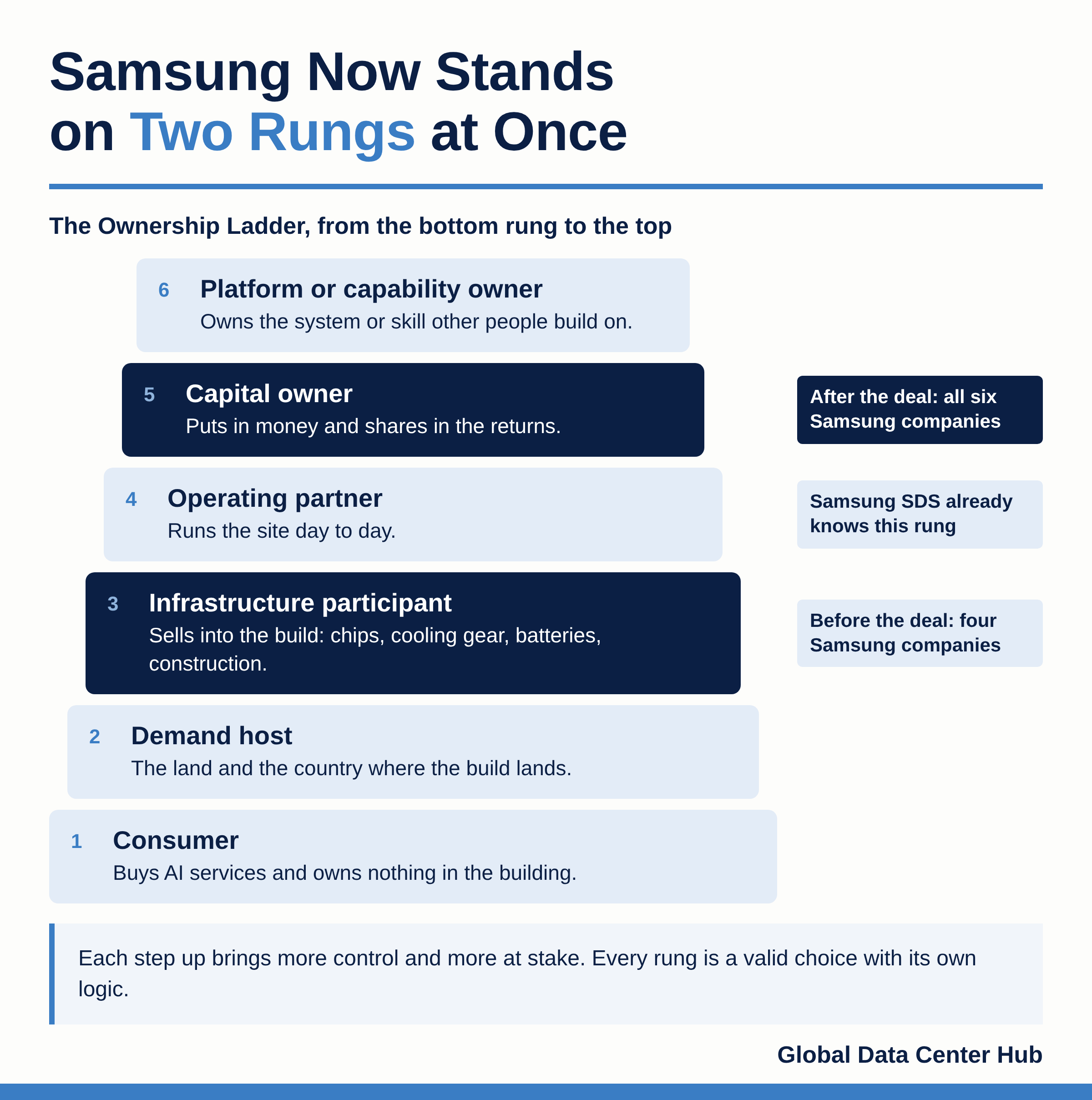
The Ownership Ladder sorts everyone in AI infrastructure by how much of the build they own. Each step up brings more control. Each step up also raises the stakes. Every rung is a valid choice with its own logic.
The bottom rung is the consumer. A consumer buys AI services and owns nothing in the building. The next rung is the demand host, the land and the country where the build lands. Then comes the infrastructure participant. This is the company that sells into the build: chips, cooling gear, batteries, construction. Above that is the operating partner, who runs the site day to day. Then the capital owner, who puts in money and shares in the returns. At the top sits the platform or capability owner, who owns the system or skill other people build on.
Before this deal, Samsung Electronics, Samsung C&T, Samsung SDS and Samsung SDI sat mostly on the infrastructure participant rung. They sold to builders. Samsung SDS also designs, builds and operates data centers, so it already knows the operating partner rung.
After this deal, all six Samsung companies share in Helix Digital Infrastructure’s returns. KKR’s release says so plainly. That puts them on the capital owner rung. The four that build still build. Samsung now stands on two rungs at once.
Picture a builder who also helps pay for your new house. The builder now cares how the whole house turns out, beyond the walls it puts up. It knows the materials. It can get crews on site sooner. And because it owns part of the result, a bad job hurts its own investment.
That is the trade I want you to follow. Supplier capital brings parts, skills, and a partner who wants the project built. It also needs clear rules, so both ways of getting paid point in the same direction. The rest of this piece shows you how to read both sides.
Most readers stop at the headline. The headline here says $1 billion. If you keep reading, you find a key part of the design at the bottom of KKR’s release, under a heading called Notice to Readers.
That notice says the Kuwait Investment Authority, NVIDIA, Samsung, and Vistra are investors in Helix Digital Infrastructure and will share in its returns. It says these and other investors will act as strategic partners. And it says they may have certain rights, such as priority or first-look rights, to supply goods or services to Helix Digital Infrastructure projects.
A first-look right means you get the first chance. Picture selling your car. Before you post an ad, you let one friend make an offer. Your friend sees the deal first. A first look in general is a chance to bid early. Your friend can still lose the car to a better offer.
A new reader skips this notice. It looks like legal filler. I go to it early, and I suggest you do too, because it shows how the company is built. Each strategic investor brings something hard to get. KKR’s June launch release named Vistra as Helix Digital Infrastructure’s preferred power provider. It named NVIDIA as a strategic partner for its AI factory designs. Samsung is the third supplier to invest, adding cooling, construction, batteries, and chips.
Other platforms use the same design. In March 2025, NVIDIA joined the AI Infrastructure Partnership as a member and technical advisor. BlackRock, Global Infrastructure Partners, Microsoft and MGX formed that partnership. GE Vernova agreed to help it plan its supply chain. So the pattern is spreading across AI infrastructure platforms.
KKR put the investor rights in writing from the start, for every strategic investor. So you can see the design before you judge it. There is a limit to what you can learn here. The notice says “may.” It does not say what rights Samsung holds or what they cover. Your job is to read the notice, see the design, and then ask how the rights work in practice.
Here is the driver behind the whole structure. When you look at any investor, ask how it gets paid. There are two ways.
The first way is the investor return. That is the investor’s share of the profits, or of the company’s value when it grows. Every investor in Helix Digital Infrastructure earns it if the company does well.
The second way is the supplier margin. That is the profit a supplier makes on what it sells. Only an investor that also supplies can earn it.
KKR’s release lists what each Samsung company brings. Samsung Electronics makes chips, including memory. Through FläktGroup, which it bought in 2025, Samsung Electronics also sells data center cooling, from air systems to coolant distribution units for liquid cooling. Samsung C&T builds data centers and power plants as an engineering, procurement and construction contractor. Samsung SDS designs, builds and runs data centers and rents out GPU computing. Samsung SDI makes uninterruptible power supplies and battery backup units. KKR says Helix Digital Infrastructure expects to leverage Samsung’s expertise in advanced technology, construction, energy storage, and cooling.
Two of the six play a different part. Samsung Life Insurance and Samsung Fire & Marine Insurance are insurers. The releases list nothing they supply. So within one $1 billion commitment, two Samsung companies earn only the investor return. Four can earn both.
The two often help each other. A supplier that owns part of the company wants its gear to work, arrive on time, and keep the sites running. If the projects do well, its investor return grows too. That shared interest is a big part of why strategic capital exists.
To know which matters more, you need two numbers. One is what share of returns the supplier holds. The other is how much it sells. Neither number is public. Samsung Electronics put in $500 million. The other five shared the rest, and the releases don’t disclose the split.
The one signal you should watch is a set of terms the public will not see. The releases mention first-look rights. They do not give the terms, and fund terms usually stay private. Those terms decide which goods the rights cover, how a price gets tested, and who decides when an investor bids on a job.
Every platform with supplier investors has to get one thing right. The price a supplier investor charges should hold up against what an outside seller would charge. When it does, the investor return and the supplier margin both work for the project. Good terms are what make that hold.
The trade gives two reads. The opportunity read: cooling gear, backup power, and builders can be hard to get. A supplier that is already committed can help a project start sooner, and a late project earns nothing while it waits. The read to manage: a first look works best when the price is still being tested, so speed comes at a fair cost.
Both reads lead to the same early question for you. When an investor bids on a job, how is the price compared, and who signs off? You will find the answer in the fund papers and side letters that set out the rights. You will also find it in any rule that has an investor step out of the vote on its own contract. Ask before money goes in, while every party can still shape the rules.
You can use this lesson well beyond Samsung. Before you judge an investor, count every way it gets paid. Investor returns and supplier margins can pull together or apart, and the terms decide which. Use the Ownership Ladder to see when one company stands on two rungs.
For private capital, the lesson is about who sits next to you. A fund that invests beside supplier investors gains partners who bring parts and know-how. Ask how prices get compared and how votes work, so you can count that value with confidence.
If you follow public markets, the lesson is about where the payoff shows up. When a listed company like Samsung Electronics invests in a platform it may supply, part of its payoff may arrive later as sales. If you read only the investment line, you see half of that story.
For operators, the lesson is about what supplier money brings. It can bring gear and a partner who wants the project built. It also brings a partner with a second reason to be in the room. Plan for both before you take the money.
If you work for a government or a development lender, the lesson is about what arrives with the money. A platform like this can bring its equipment makers and builders along with its capital. You can see both sides of the partnership before you choose a site.
So count the investor return and the supplier margin, and plan for both. The first named Helix Digital Infrastructure project will be the first public view of how this partnership works on the ground.