
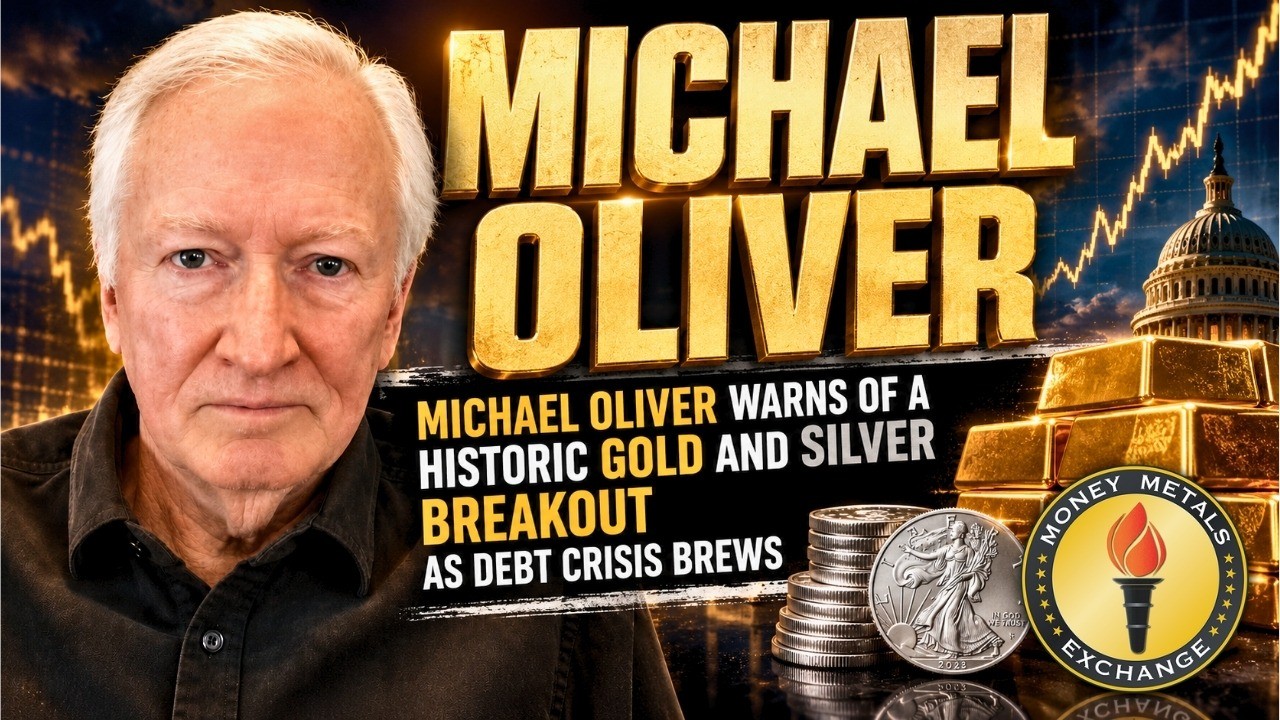
In a recent episode of the Money Metals Podcast, host Mike Maharrey sat down with veteran market analyst J. Michael Oliver, founder of Momentum Structural Analysis (MSA), for a sweeping discussion on precious metals, government debt, the stock market, and what Oliver believes could become a historic turning point for gold and silver investors.
Oliver, who launched MSA in 1992 after beginning his career in futures brokerage with E.F. Hutton in 1975, explained that his analytical approach differs sharply from conventional technical analysis. Rather than relying on price charts or moving averages alone, MSA focuses on momentum structures that often reveal market turning points before they become obvious in price action. According to Oliver, momentum frequently signals tops and bottoms long before traditional analysts recognize them.
That framework has led him to one of the most bullish outlooks on precious metals he has ever held.
(Interview Starts Around 6:42 Mark)
Geopolitical Headlines Are a Distraction
Despite ongoing geopolitical turmoil, including the Iran conflict and lingering fallout from the Ukraine war, Oliver argued that global headlines are largely irrelevant to the deeper forces driving markets.
He pointed to the fact that gold, oil, and commodities peaked shortly after the Ukraine war began and noted that silver and oil had already been declining before the latest Middle East tensions escalated. Likewise, fears surrounding tariffs sparked a stock market selloff during the first quarter of 2025, yet markets later recovered and pushed to new highs even though tariffs themselves never disappeared.
To Oliver, these events are temporary emotional catalysts rather than primary market drivers.
Instead, he believes the real story lies underneath the surface: a structural crisis forming in the U.S. government bond market combined with a massive revaluation of gold and silver.
According to Oliver, the stock market is in the process of forming a major long-term top while the U.S. Treasury market is nearing a dangerous breaking point. He predicts gold and silver are preparing for what he described as an unprecedented upside explosion that could unfold within the next three to four months.
Why Oliver Thinks Silver Could Reach Triple Digits — Or Higher
One of the interview’s most striking moments came when Oliver discussed silver’s upside potential.
He argued that silver has been historically mispriced for decades, trapped in a range between roughly $5 and $50 per ounce for nearly half a century. While gold repeatedly broke into new bull market highs during previous cycles, silver consistently failed to sustain major breakouts.
Oliver believes that imbalance is now correcting violently.
He compared silver’s current setup to copper in the late 2005 breakout period. Copper had traded lethargically between roughly 50 cents and $1.50 per pound throughout the 1980s and 1990s before suddenly exploding higher without any major headline catalyst. Within several quarters, copper surged to approximately $4.10 per pound.
Oliver also referenced the lead market’s sharp move in 2007 as another example of long-dormant commodities suddenly repricing upward after years of suppression.
In his view, silver is now poised for a similar catch-up phase.
He suggested silver could eventually reach between $300 and $500 per ounce, acknowledging that such targets sound extreme but arguing that markets frequently overshoot when correcting long-term pricing distortions. He noted that silver remains “insanely cheap” relative to gold and believes the gold-silver ratio is beginning to reverse decisively in silver’s favor.
Industrial Demand Is Colliding With Investment Demand
Oliver emphasized that silver’s bullish setup is not merely technical.
He pointed out that the global silver market has operated in a supply deficit for approximately five consecutive years, with annual demand consistently exceeding available supply. Yet higher prices have failed to stimulate sufficient new production because most silver is mined as a byproduct of base metal operations rather than from primary silver mines.
That means rising silver prices alone do not necessarily encourage substantial increases in output.
At the same time, industrial demand continues to accelerate.
Oliver highlighted the rapid global expansion of solar power, particularly Chinese solar panel manufacturing. Photovoltaic cells rely heavily on silver, and China currently accounts for roughly 80% to 90% of global solar panel production demand. As renewable energy adoption expands worldwide, Oliver sees silver consumption continuing to rise sharply.
Layered on top of that industrial demand is silver’s historic role as money.
For thousands of years, silver served alongside gold as a trusted store of value, and Oliver believes investors are beginning to rediscover that reality as confidence in fiat systems weakens.
Gold’s Bull Market May Be Far From Finished
Although Oliver expects silver to outperform gold on a percentage basis, he remains strongly bullish on gold itself.
He noted that gold’s previous two major bull markets — from 1976 to 1980 and from 2001 to 2011 — both generated roughly eightfold gains from bear-market lows to cycle highs.
Starting from gold’s 2015 low near $1,050 per ounce, Oliver argued that the current move has only achieved approximately a fourfold increase so far. If gold merely replicated its historical performance, he suggested prices could approach $8,500 per ounce.
He also referenced a recent JPMorgan projection calling for gold prices around $9,200, noting that such targets align surprisingly well with his broader structural outlook.
Still, Oliver stressed that he does not believe gold would necessarily stop there because the monetary backdrop today is fundamentally different from prior cycles.
The Real Crisis Is Government Debt
Throughout the interview, Oliver repeatedly returned to what he sees as the central issue confronting global markets: government debt.
He contrasted today’s environment with the 2007-2009 financial crisis, which revolved around mortgage debt and private sector leverage. This time, he said, the danger lies in sovereign debt itself.
Oliver warned that the U.S. Treasury market, particularly long-duration bonds, is approaching a crisis stage. He believes 30-year Treasury bonds are on the verge of breaking down to new lows in price while yields move sharply higher.
Even Federal Reserve intervention may not be enough to stop it.
He cited comments from JPMorgan CEO Jamie Dimon, who recently warned about an approaching government debt crisis. Oliver agreed with that assessment completely, arguing that the Fed’s ultimate response will be aggressive money creation.
In his words, “Gold knows this.”
Oliver believes gold has already been pricing in the coming debt emergency long before the broader public recognizes it.
Inflation Is Money Supply Growth
The conversation also touched heavily on inflation and Federal Reserve policy.
Mike Maharrey argued that many investors focus too narrowly on CPI data while ignoring money supply growth, and Oliver strongly agreed.
According to Oliver, money supply expansion itself is inflation, while rising consumer prices merely reflect that inflation later in the process. He noted that the S&P 500’s enormous gains since the 2000 dot-com peak largely mirror the expansion of the M2 money supply rather than representing genuine increases in real value.
Oliver also criticized the Federal Reserve’s long period of artificially cheap money. He pointed out that for roughly 10 of the last 15 years, Fed funds rates remained near zero, creating what he described as a massive liquidity-driven bubble in financial assets.
Now, he believes that bubble is beginning to crack.
Warning Signs Are Emerging Beneath the Surface
Although major stock indexes continue hovering near highs, Oliver sees deterioration occurring underneath the surface of the financial system.
He specifically highlighted weakness within the financial sector, noting that Visa, Mastercard, banks, insurers, and broker-dealers have all started underperforming the broader S&P 500.
According to Oliver, the XLF financial sector ETF is collapsing relative to the S&P in a manner similar to the pattern that emerged before the 2007 financial crisis.
He warned that investors remain focused on the wrong stories — Iran, tariffs, artificial intelligence, and short-term market moves — while missing the far more important structural deterioration taking place in credit markets and financial institutions.
Oliver also suggested that recent vertical moves in semiconductor stocks and companies like NVIDIA resemble classic late-stage bubble behavior rather than healthy long-term market leadership.
Why Oliver Prefers Silver Over Cash
Toward the end of the interview, Maharrey asked Oliver about his own investment positioning.
Oliver revealed that his personal portfolio is heavily concentrated in silver bullion ETFs and silver mining stocks, along with some exposure to gold miners and commodity-related assets.
Of course, we also know the many risks and issues that arise from paper ETFs when compared with physical precious metals (e.g., physical silver and physical gold). Physical precious metals carry far less counterparty risk than paper investments and provide final settlement because they are non-liability monetary assets.
Importantly, however,
Michael Oliver
said he has little interest in eventually rotating profits back into fiat cash because he views paper currencies as rapidly depreciating stores of value.
Instead, once silver experiences the explosive upside move he anticipates, Oliver expects to rotate substantial gains into physical gold bullion, treating gold not as an investment but as true savings and real money.
For Oliver, the coming years are not simply another commodity cycle. They represent a broader reckoning with debt, fiat currency, and confidence in financial institutions themselves.
Originally Published on Money Metals.